
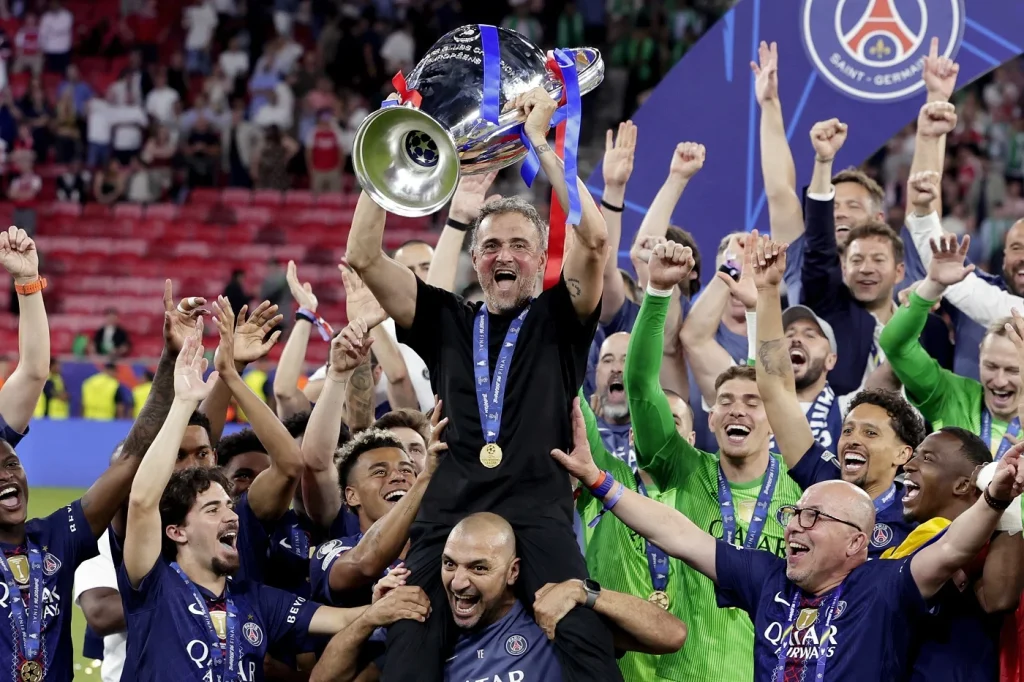
In the press conference a few hours before the final, Luis Enrique made no attempt to play down expectations. “We are the reigning champions, we accept our role as favourites and we want to bring the trophy back to Paris.”
A clear message — one that might sound slightly arrogant. And yet, delivered with that ever-present grin of his, the one that has become almost a meme in itself, it felt more like an admission of confidence. Of awareness.
Awareness of having given this PSG a new life. Of having built a model grounded in youth, in the idea that winning does not require superstars, but a collection of elite talents to be shaped and refined.
Right now, Luis Enrique is unquestionably the best coach in the world. Not only because he has reached an extraordinarily difficult objective, but because he has done something rarer still: taken a club and turned it into his own creation, building a dynasty.
Back-to-back Champions Leagues — PSG are only the second club to achieve that since the competition was rebranded — are merely the brightest neon sign in the window of wonders he has assembled. They confirm that PSG are no longer a club chasing success, but one that produces it as a matter of course.
Above all, they confirm Luis Enrique as the central figure in one of the most profound transformations European football has seen in recent years.
For over a decade, Paris Saint-Germain were described as the symbol of excess: the club of reckless spending, of superstar names assembled like collectible cards, of transfer windows designed to deliver instant glory — and of inevitable European disappointment when the pressure became too heavy to bear.
A club that was rich but fragile. Powerful, but incomplete.
That image now belongs to the past.
The victory over Arsenal represents another peak in a revolution Luis Enrique has driven with clarity and stubbornness. A rebuild not based on signing the most expensive player available, but on constructing a team — a group in the truest sense of the word. A concept that sounds obvious in football, yet had never truly existed in Paris.
If there is one defining feature of this PSG compared to all its previous versions, it is the ability to think long-term. In an era dominated by the obsession with immediate results, the French club chose the hardest path: investing in young players, accepting inevitable mistakes as part of development, and maintaining continuity in its technical project.
It is no coincidence that ten of the eleven starters in the final against Arsenal were already part of the team that won the Champions League against Inter a year earlier. The only exception was Safonov, who started ahead of Donnarumma. The rest of the core remained unchanged. That tells you more than any statistic ever could.
In modern football — where squads are rebuilt every summer and every setback triggers demands for radical change — maintaining such stability is almost a countercultural act.
Luis Enrique has insisted on continuity, on collective understanding, on automatisms that only time can build. PSG have become the symbol of a team that manages to combine two elements often considered incompatible: young talent and immediate success.
They have shown that it is not necessary to choose between present and future. It is possible to build a young team that wins now.
The growth of so many players — from prospects to decisive figures — has been the true masterpiece of the Spanish coach. Luis Enrique has not simply managed a team: he has created an ecosystem in which players improve continuously. He has given responsibility to the young, accepted their mistakes, and built a structure that allows them to evolve without being crushed by expectation.
But the clearest sign of his total authority came in the most controversial decisions — the ones that usually belong to directors, not coaches.
The most striking example is the Donnarumma case. After last season’s European triumph, his departure seemed almost unthinkable. Gigio had been one of the heroes of the final against Inter, a symbol of the club and one of the most recognisable goalkeepers in world football.
And yet Luis Enrique looked beyond that.
In his system, the goalkeeper is not just a shot-stopper. He is the first playmaker, the starting point of the entire build-up structure. That is why he pushed for the signing of Lucas Chevalier, seen as a better fit for his positional demands thanks to his distribution and involvement in possession.
Even then, however, Luis Enrique has shown he is not a prisoner of his own ideas. When Chevalier went through a difficult spell and made several mistakes, the coach did not hesitate to act. No ideology, no hierarchy protected by reputation. Safonov came in, performance took precedence, and once again the only untouchable element was the collective project.
This willingness to make unpopular decisions — and stand by them — is one of the reasons why Luis Enrique now holds almost absolute authority within the club. Not just because of results, but because every decision feels part of a coherent vision.
In recent years, PSG have stopped being a club governed by emotion and immediacy.
At the centre of this transformation stands Luis Enrique.
Today, no one sees the club as a surprise project or as a financial giant still searching for sporting legitimacy. PSG have become something else entirely: a model. A recognisable team, with a defined identity, and a clear technical, tactical and managerial culture.
In a game that moves at ever-increasing speed, where every three days a result can erase what came before, Luis Enrique has achieved something that feels almost impossible: he has slowed down time.
He has convinced an ambitious ownership to embrace patience, and built a team that grows together.
That is why his role now goes beyond that of a traditional coach. Luis Enrique has become the central figure of the PSG project — a reference point that extends beyond the pitch and shapes every layer of the club’s sporting life. A plenipotentiary figure, entrusted with the ability to imagine a brighter future — and make it real.
The Budapest final may simply be the latest chapter.
The real achievement is something else entirely: Luis Enrique has built the hardest thing in modern football.
A dynasty.