
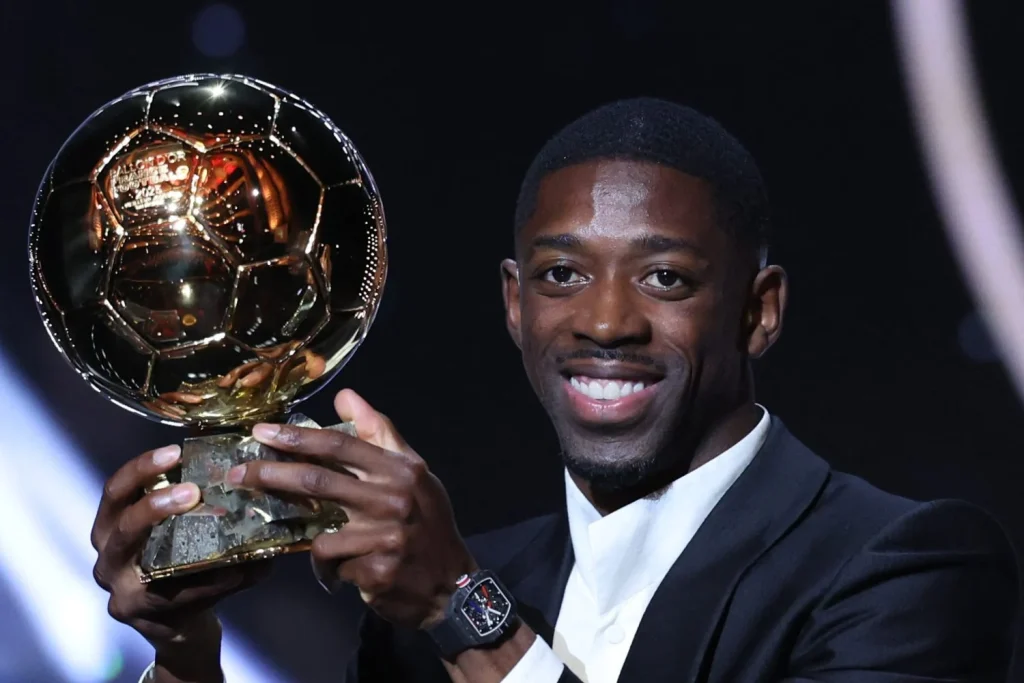
Winning the Ballon d’Or has not just changed Ousmane Dembélé’s career — it has quietly reshaped the way he moves through the world.
It is easy to assume that an award of this magnitude inevitably rewrites everything around a player. And in most cases it does. But in Dembélé’s case — a footballer who, until recently, was rarely spoken about in commercial terms as one of the game’s global headliners — the shift has been more subtle in intention, more radical in effect.
The PSG forward explained it himself in an interview with Ligue 1+, the French league’s official channel. “I used to rent a bike to get around Paris traffic, but that was before I won the Ballon d’Or. If I did it now, there would be a crowd gathering around me.”
It is a small image, almost trivial on its own. But it captures something larger: the sudden recalibration of proximity, visibility, expectation.
Because beyond the anecdotes, the reality is that the Ballon d’Or has transformed Dembélé’s profile. He has not changed much about his structure — the same agent, the same inner circle, the same long-standing staff — but everything around him has accelerated. Brands now come with far greater insistence, and in far greater numbers, than before.
According to L’Équipe, citing a member of his entourage, “requests have multiplied. We’ve received a huge number. But we made a clear decision: we want to stay selective. Only things that are aligned with Ousmane, his journey and his values.”
That principle has already shaped a series of decisions. A major luxury fashion house made a significant offer and was turned down. So were multiple companies linked to betting. Even on social media, where the numbers can be particularly aggressive, the response has been the same: a few months ago, a company reportedly offered several hundred thousand euros for a single Instagram post. It was rejected.
At the same time, the selectivity has not meant withdrawal. It has meant curation.
Partnerships with brands such as Zegna — which designed the suit worn by Dembélé at the Ballon d’Or ceremony — and Henry Jacques reflect a more controlled approach to visibility. Further collaborations are expected in the cosmetics and home appliances sectors, areas that fit within a more defined commercial identity.
Media interest has followed a similar pattern. Dembélé has been invited into a range of cultural and promotional spaces — from Les Enfoirés, the high-profile French charity event, where he appeared comfortable and well-received, to film premieres and concerts. But here too, the pattern is consistent: careful selection, limited exposure, no excess.
The idea is not to withdraw from visibility, but to manage it — to extract value from success without diluting it.
And so far, it has worked. PSG are still competing at the highest level, with a Champions League final potentially only hours away, and France remain among the favourites for the next World Cup. Both stages that would only reinforce the trajectory already in motion.
Not bad, for a player still leaving room for another Ballon d’Or.