
The heat building across Italy and parts of Europe has reached Paris with force. At Roland Garros, where the second week is still ahead, it has already altered the shape of matches.
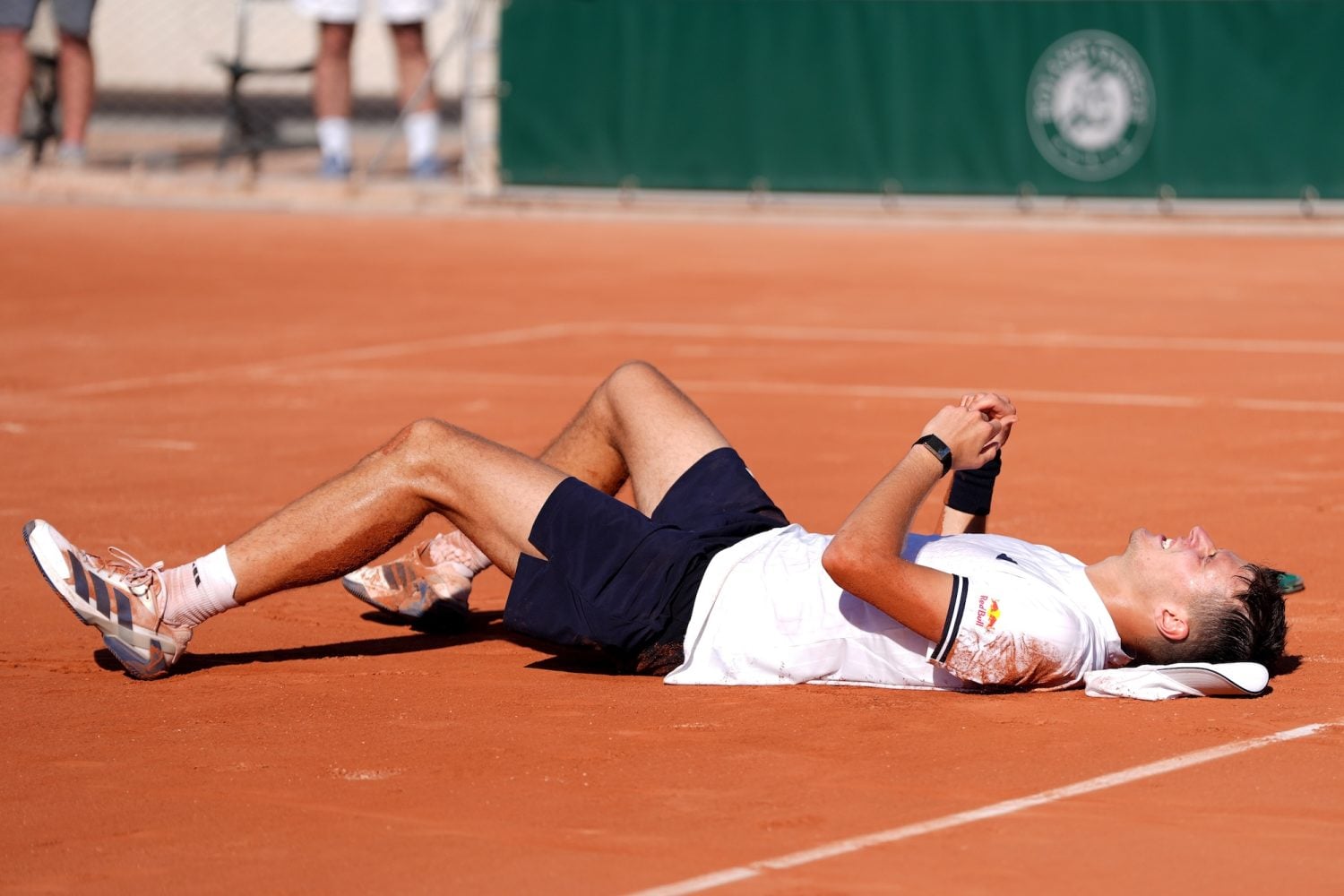
Jakub Menšík collapsed on court after four hours and 41 minutes against Mariano Navone in the second round. Temperatures had climbed to around 35°C. He had just closed out the match in five sets. The final point was followed by a step forward, then nothing resembling a recovery movement. Navone crossed the net to shake hands, but Menšík was still on the ground.
It took a few seconds to understand the direction of what was happening. The Czech remained flat on his back while medical staff arrived with ice packs pressed to his neck, chest, and head. He tried to stand. He did not manage it. A wheelchair was brought to take him off court.
“When I hit the last winner, the emotions went away and my body just shut down,” he said later. The scheduling drew his frustration. The match had started at 13:30, a time he described as unplayable in direct sun. “It’s madness to play in this weather,” he said. “More than four and a half hours in those conditions is just too much.” He later used an ice bath in an attempt to recover in time for his next match against Alex de Minaur, scheduled for the following day.
The court was one of the outer arenas, without shade. The surface stayed exposed throughout the afternoon. On other courts, even players not involved in long matches felt the same conditions.
Novak Djokovic, after his win over Valentin Royer, spoke about scheduling as a factor that might need adjustment. Evening slots, he suggested, could be an option when temperatures peak. He won in four sets and will face João Fonseca next.
Casper Ruud finished his match describing the conditions as disorienting. “I felt like a zombie,” he said, adding that he had feared heatstroke as temperatures stayed above 30°C throughout. Marta Kostyuk reported a similar experience after her own match. “It’s hot and very dry,” she said. “I felt like I needed to drink all the time. It was tough.”
So far, no match at Roland Garros has been suspended because of heat.
Organisers use two sensors to track the WBGT index, a measure of heat stress on the human body under direct sun. One is placed on the main court, the other on Court 14. If the threshold is reached, a 10-minute break can be introduced after the second set in women’s matches and after the third set in men’s. Full suspension is considered above 32.2°C on the index.
The system exists within a wider framework that differs from the ATP Tour. Slams operate under their own regulations, and matches are best of five sets in the men’s draw. Longer exposure changes the terms of endurance itself.
Holger Rune raised the issue last year in Shanghai, asking publicly why no formal heat rule existed on the ATP side. “Do you want a player to die on court?” he said at the time, remarks that led to the introduction of additional guidelines on Tour events, though not at the four majors.
At Roland Garros, those distinctions remain. Five-set matches, extended exposure, no unified global rule across formats. And for now, players continue to play through it.
The temperature on court does not appear in the draw, but it sits in every match.