
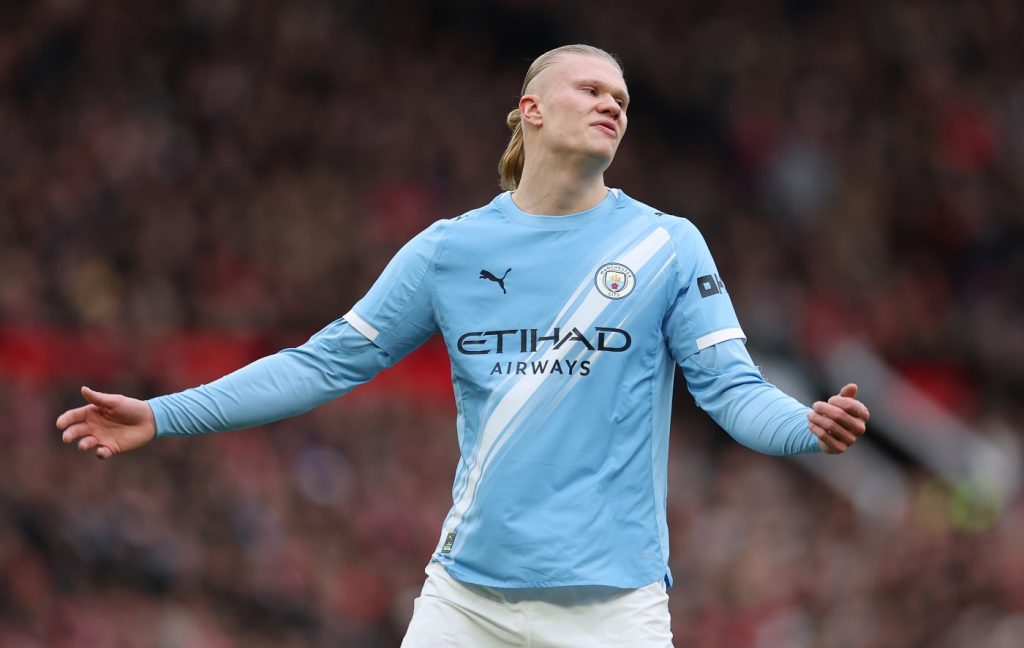
Erling Haaland has gone a month without scoring for Manchester City. For most strikers, that would be a difficult spell. For him, it is something of an event. But the goals are not the only thing occupying the Norwegian at the moment. According to The Telegraph, he is also involved in an unusual legal dispute with a Polish electrician over the commercial use of his surname. The story goes back to 2023, when Haaland tried to register his name as a trademark ahead of a planned range of products. He discovered that someone had got there first. Michael Wąs, a Polish citizen, had already submitted an application to use the Haaland name across 16 product categories. The list made for curious reading: sportswear, protein supplements, energy drinks and bags, alongside yoghurt, toys, spirits and even women’s underwear. It was quite a collection, and one that eventually attracted the attention of the European Union Intellectual Property Office (EUIPO).
Haaland’s lawyers challenged the application, arguing that it had been filed in bad faith and that Wąs was attempting to make commercial use of the striker’s international reputation without his permission. They submitted articles from the Polish press to show that Haaland was hardly an obscure figure in Wąs’s home country. The EUIPO panel examining the case was unconvinced that the applicant could have been unaware of the footballer, whose reputation had long since spread well beyond Norway.
Wąs, for his part, had another explanation. According to his defence, he works as an electrician in Norway and came up with Haaland as an entirely invented name, combining the Polish word «hala», meaning ‘hall’, with the English «land». He also connected it to a business project called «High Advanced Activity Land». The phrase had apparently inspired an email address he used in correspondence with the panel.
The explanation did not get very far. The experts questioned whether the email address might have been created simply to make the business project appear legitimate. They were equally sceptical about the claim that the first three letters of Haaland stood for «High Advanced Activity». If that was really the intention, they reasoned, why register the entire word, without punctuation, rather than the initials themselves? The EUIPO ruled that Wąs’s trademark was identical to the footballer’s surname and that the application had been made in bad faith, with the intention of taking advantage of Haaland’s reputation. The panel also pointed to the possibility of consumers assuming that products sold under the name had some connection with the player, or even his approval.
Wąs has not accepted the decision. He has taken the case to the courts of the European Union, hoping to have the EUIPO ruling overturned. No hearing date has yet been set, so the dispute is likely to remain unresolved for some time. Haaland, meanwhile, will have to wait to find out whether he can use his own surname across the product ranges he had in mind. It is not quite the sort of opposition he usually has to deal with. And there is no particular advantage in being one of the best strikers in the world when the argument is about a trademark.