
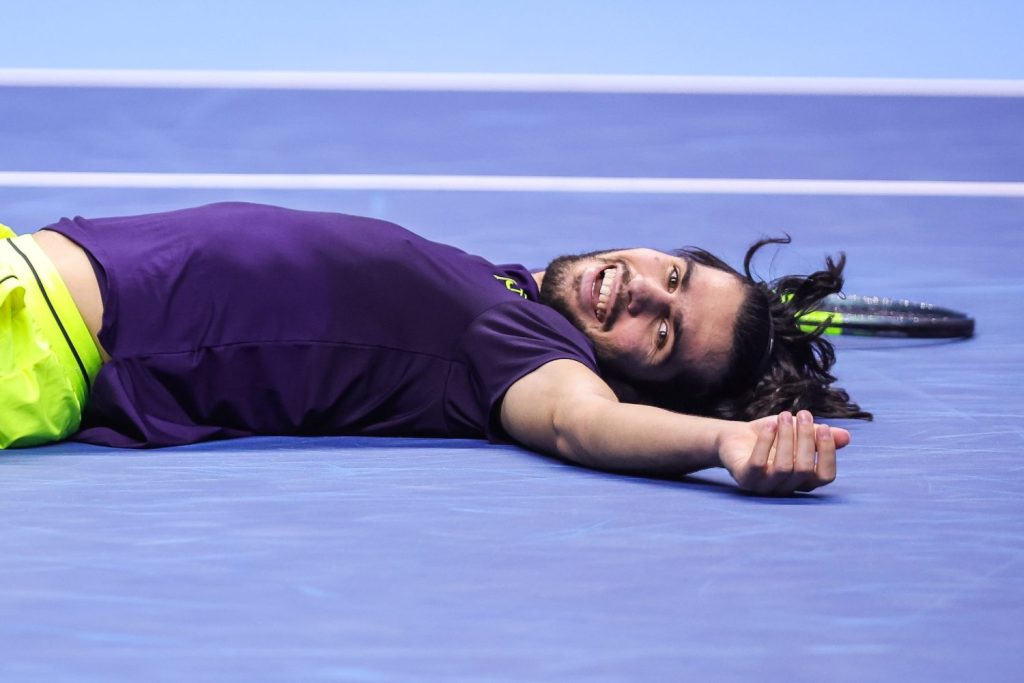
Alexander Zverev’s face told the story of the ATP Finals better than any statistic. There was a moment in the first set when the German seemed unable to believe what he had just witnessed. Carlos Alcaraz chased down a lob with a tweener, Zverev stepped forward to finish the point with a smash and sent the ball straight into the net. He turned, stared across the court, shook his head and hurled his racket to the ground. The reaction of a player beginning to wonder whether there was any way through. Alcaraz had done more than beat him 6-2, 7-6. He had outplayed him, dragged him from corner to corner, gradually worn down his confidence and, by the end, got inside his head.
In Turin, Alcaraz lifted the one major title missing from his collection and sent a message to the rest of the tour: he is back. Only a few days earlier, though, his place in the final had looked far from certain. During Wednesday’s match against Daniil Medvedev, the Spaniard had felt something in his left thigh, prompting a visit from the medical team and strapping around the affected area. There was enough to raise questions about his fitness. He won the match regardless, then beat Flavio Cobolli before producing an even more impressive recovery against Ben Shelton in the semi-finals, coming from a set down in a contest lasting more than two hours.
Waiting for him in the final was Alexander Zverev, the world number one, who had reached the last match of the tournament without dropping a set or losing his serve. He had faced six break points in his first four matches and saved every one. Alcaraz wasted little time in testing that record. Zverev made seven unforced errors in the opening two games and faced six break points, as many as he had conceded across his previous four matches. Despite landing only 44 per cent of his first serves in the first four games, Alcaraz was reading the German’s delivery early and making him play one more shot. Zverev held on briefly, but in the third game his serve finally went. Alcaraz kept pressing, broke again and moved into a 4-1 lead.
For a moment, Zverev managed to arrest the slide. In the sixth game, he seized on two loose points from Alcaraz to win back one of the breaks. The Spaniard could not afford to switch off, even briefly. He responded at once, breaking again and taking the set 6-2. Zverev had lost his serve three times in the opening set alone, having gone through the rest of the week without dropping it. Alcaraz had found his range, worked out the serve and, perhaps most importantly, begun to sense the uncertainty creeping into his opponent’s game. Zverev was already looking short of answers.
When Alcaraz broke to love in the third game of the second set, the final looked to be slipping beyond Zverev. The Spaniard led 6-2, 3-1 and was making the match look like a mismatch. Even at 4-4, the points tally stood at 60-45 in his favour, a reflection of how much of the contest had been played on his terms. Yet Zverev found a way back. Another lapse from Alcaraz allowed him to recover the break, and suddenly the German had an opening. In the tenth game, with Alcaraz serving to stay in the set, Zverev moved 30-0 ahead. Four points in succession, including an ace and a delicate drop shot, got the Spaniard out of trouble and sent the match into a tie-break.
It was the closest Zverev came to turning the final around. Alcaraz made the better start, moving 3-0 ahead, before the German reeled off six points in a row to lead 6-3. Three set points. A chance to take the match somewhere else entirely.
Alcaraz saved the first two with his serve, the second with one of those beautifully judged drop shots, then forced Zverev into an error on the third, with the German serving. From 6-3, it was 6-6. The chance had gone. Zverev had one more opening, but Alcaraz was back in control, varying the depth of his shots and changing pace whenever the moment called for it. At 7-7, another drop shot brought up match point. A backhand winner down the line finished the job. The tie-break was his, 9-7. His 30th career title, his sixth of the season and his 14th consecutive victory.
Having won all four Grand Slams, Alcaraz became only the fourth man in the Open Era, after Andre Agassi, Roger Federer and Novak Djokovic, to win the ATP Finals as well. A year after losing to Jannik Sinner in the final, he had his moment in Turin. The doubts that had followed him into the tournament were gone. So, too, was any suggestion that he had lost his grip on the game. He had come through a physical scare, found his level and finished the season with the title he wanted most. Zverev, who had barely put a foot wrong all week, had been made to look ordinary. Alcaraz took time away from him, anticipated his intentions and turned the German’s greatest strengths into weapons he could barely use. By the end, Zverev seemed unable to work out how to play the points, let alone win them. The racket hitting the court in the first set was one thing. The look on his face afterwards was another. Alcaraz had the answer all along.