
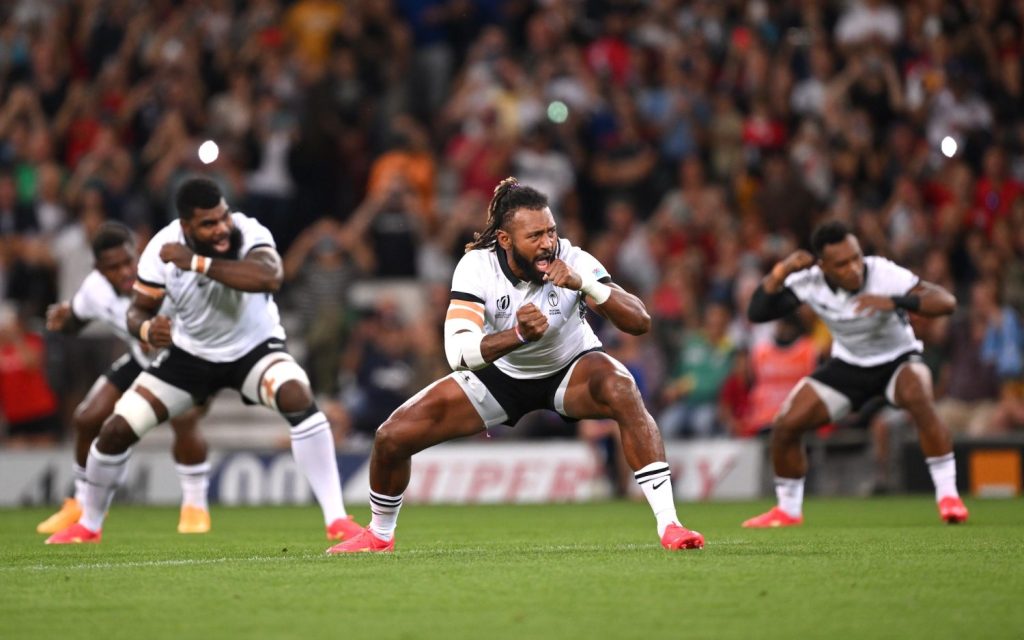
The Fiji archipelago covers 18,270 square kilometres, roughly 0.012 per cent of the planet’s land surface. Its population, estimated at 937,000, accounts for just 0.011 per cent of humanity. Yet Fijian players are everywhere in professional rugby. There are 27 in France’s Top 14, the wealthiest domestic competition in the game. Six more play in the English Premiership. Dozens represent clubs in Ireland, New Zealand, Australia, the United States and Japan. Measured against the size of the country, Fiji may be the most extraordinary producer of sporting talent anywhere in the world.
It is tempting to put this down to the landscape. Rugby romantics have long drawn a straight line between Fiji’s presence at the highest level and the familiar image of children playing barefoot on sandy beaches, passing around a battered old ball as the sun sinks into the Pacific. The dunes of Sigatoka are real. So is the devotion to the game in Suva and Nadi. But neither quite accounts for how a country of fewer than a million people has produced Waisale Serevi, Semi Radradra, Josua Tuisova and Jerry Tuwai. Nor how the Fijian style came to embody so much of what makes rugby exhilarating to watch.
There is a less comfortable side to the beachside idyll. In Namatakula, a village on Fiji’s Coral Coast, the beach where generations of children played rugby has gradually disappeared, eaten away by rising sea levels and the force of the waves. The village produced players including Nemani Nadolo and brothers Chris and Tevita Kuridrani. Samuela Kuridrani, who later returned to Australia, told the United Nations Environment Programme that the place where he played as a boy no longer exists. The coastline that appears to give Fiji a natural training ground is also among the parts of the country most vulnerable to climate change. Some children now have to play further inland, on rougher ground.
Fijian rugby did not begin on a beach. Its origins lie in the institutions of colonial Fiji. By the 1880s, soldiers in the Native Constabulary, the local police force, were already playing the game in Ba, both Europeans and Fijians. The first clubs were largely the preserve of expatriates. In 1914, a separate competition was established for indigenous players. Fiji’s first international came ten years later, against Western Samoa. Kick-off was scheduled for seven in the morning so that the Samoan players could go to work afterwards. Rugby had arrived through the structures of the British Empire. What developed across the islands was another matter.
By 1939, Fiji were already making a habit of confounding expectations. On their first tour of New Zealand, they won seven matches and drew one, finishing unbeaten. Their speed, handling and appetite for running rugby attracted widespread attention. Some players still took off their boots during matches. The Waikato Times called their performance “a scintillating spectacle”. The phrase has lasted rather better than most.
There is a danger in allowing such descriptions to turn a sporting tradition into an act of nature, as if talent simply appears without coaching, organisation or investment. Fijian creativity has been cultivated and passed down through clubs, school competitions and local tournaments, within a culture where rugby has become a common language across the archipelago. The Fiji Rugby Union says it administers 36 affiliated unions across 14 provinces and has 30,000 registered players in provincial and school competitions, before club rugby and grassroots participation are even counted. Behind the familiar images is a considerable sporting infrastructure, built over generations.
Rugby sevens gave that tradition a global stage. The shorter format, with its greater demands on speed, space and quick hands, seemed made for Fiji. At the 1997 World Cup in Hong Kong, Waisale Serevi inspired a remarkable comeback against South Africa, turning a 14-0 deficit into a 24-21 victory. Fiji won another world title in 2005. Then came the Olympics. When sevens made its debut at Rio 2016, Fiji claimed the first Olympic medal in the country’s history, beating Great Britain 43-7 in the final to take gold. They did it again in Tokyo, defeating New Zealand 27-12.
The 15-a-side team took longer to reach comparable heights. In 2023, Fiji beat Australia for the first time at a Rugby World Cup, winning 22-15 in Saint-Étienne. Tuisova crossed for a try, Simione Kuruvoli kicked 14 points and, through the closing stages, Fiji defended their lead with the assurance of a side entirely at ease with the occasion. “We approached this game like a final,” Tuisova said afterwards. They came within six points of a semi-final place against England in the quarter-finals. The tournament showed just how dangerous Fiji could be in attack. The harder part was holding that level.
The Fijian Drua were established, in part, to address the problem. Since joining Super Rugby Pacific, the trans-Tasman competition featuring franchises from Australia and New Zealand, in 2022, they have offered something largely missing from the domestic game. For years, a player emerging from the age-grade system faced a stark choice: stay in the national competition or leave Fiji in search of a professional career. The Drua created a third route, allowing players to develop and compete at a high level without leaving home. Simon Raiwalui, Fiji’s head coach at the 2023 World Cup, described them as “the missing link” in the player development pathway. In their first season, the franchise supplied 16 players to the national team.
It is a significant development, but it cannot by itself alter the economics of the sport. European and Japanese clubs have the financial muscle to offer salaries and facilities that the Fijian game cannot easily match. The challenge is to build a domestic environment attractive enough for players to make a career at home, while ensuring that the national team can draw on players developed in very different systems. For now, the best opportunities are still often elsewhere.
There is another question: where Fiji play, and who gets to watch. In 2026, the Flying Fijians’ home fixtures in the Nations Championship were staged in Britain. The national stadium in Suva does not meet the competition’s minimum capacity requirement, according to reports. Taking matches overseas brings in valuable revenue, and the union has said it intends to put that money back into infrastructure. But Fijian supporters have been unable to watch their national side play those fixtures at home. A peculiar position for a country in which rugby occupies so much space.
The union is looking to change things. On 13 October, it appointed Jake White as head coach, with the 2027 World Cup less than a year away. White led South Africa to the world title in 2007 and has since coached the ACT Brumbies in Australia, as well as the Bulls and Sharks in South Africa. It is an interesting appointment. Fiji already have the physicality and attacking ambition to trouble anyone. White’s reputation, by contrast, rests on organisation, preparation and giving a team a clear sense of how to play. He could bring greater authority to the set piece and more structure to the parts of a match where individual brilliance is not enough.
The temptation is to cast this as a meeting of Fijian flair and imported discipline. That would be too simple. Fiji’s best sides have never relied on instinct alone, just as no coach can teach the kind of technique that allows a player to keep an attack alive with a pass after contact. White’s job is to add control without taking away the freedom. To help Fiji win collisions, keep the ball and make better decisions when matches are on the line, without coaching out the improvisation that makes them so compelling.
The dunes will remain part of the picture. They are an evocative image of hard work and devotion, and the beaches are no sporting myth. But Fiji’s rugby story is written in far more than sand and sea, or some notion of natural athleticism. It belongs to a game embedded in local life, handed down through generations, refined in sevens and increasingly supported by a professional pathway at home. For a country so small in both population and land area, its place in world rugby is remarkable. The players keep coming. The question is what, and who, will be there to meet them.