
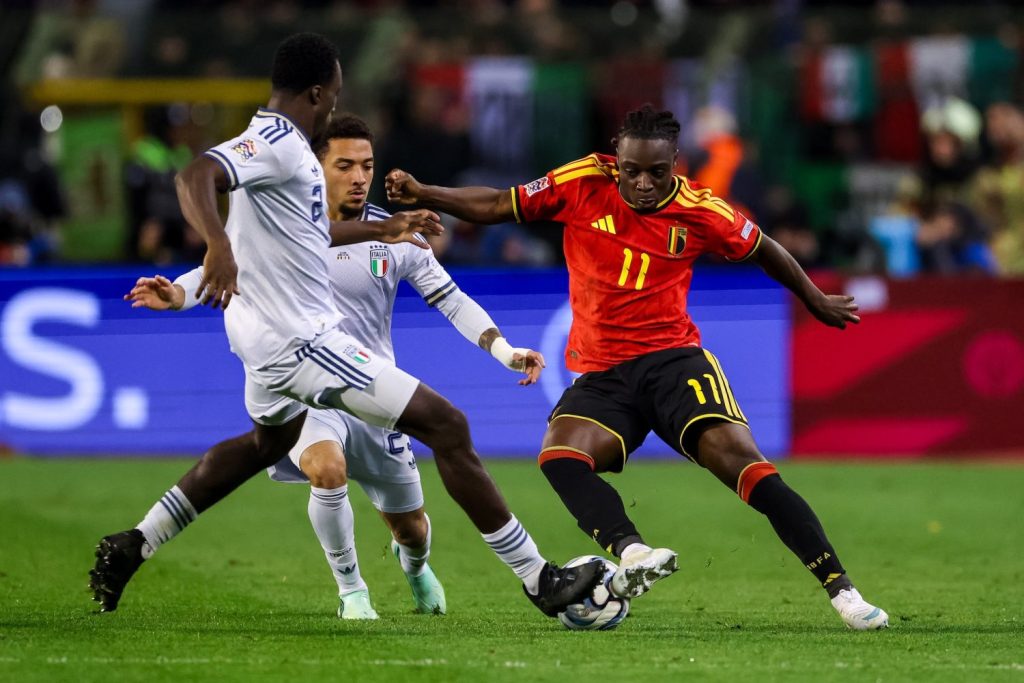
Belgium’s fourth goal, the one that put the finishing touch to Italy’s miserable night at the Roi Baudouin Stadium, captured the difference between the two sides better than anything else. Italy were stretched, trying to recover their shape, but every time they gave the ball away they found themselves facing a team able to turn a few yards of space into a run on goal. Doku and Moreira were already moving, ready to exploit the gaps, alert to the danger before it had even taken shape. They did not need to wait for the transition to develop. They gave it direction, then accelerated until it became impossible to contain. There was a difference in talent, certainly, but above all in the players each side had at its disposal. Belgium had two wide forwards capable of changing a game. Roberto Mancini is still searching for his own.
The 4-1 defeat in Brussels, which sent Italy out of the Nations League before the quarter-finals, laid bare the gap. Mancini’s side had arrived in Belgium with two results out of three enough to see them through, encouraged by their comeback against France. They were out of the game within fifteen minutes, despite having taken the lead, as Van Bommel’s side hit them with three goals in eleven minutes. Much of the damage was done by two players who gave the attacking flanks an entirely different character from Italy’s own wide men.
Doku was a problem the Italian defence never came close to solving. It was not simply a question of pace, although the physical mismatch with Scalvini was plain every time the Manchester City forward decided to go at him. Kayode’s strength offered little more protection. Doku played constantly on the edge between control and acceleration, forcing defenders to make difficult decisions in a split second. Scalvini had an especially difficult evening. He could not get close enough to anticipate him, because Doku always seemed to have another movement, another fraction of a second in which to escape the challenge. Yet when the defender held his position and tried to shepherd him towards the touchline, he was still vulnerable to the burst of speed.
Doubling up on Doku simply opened up space elsewhere. He needs very little to beat the first man and create an overload, but what makes him so dangerous is what follows. He is not interested in dribbling for its own sake, or in producing a spectacular moment every time he gets the ball. He varies his carries, changes direction, releases it at the right moment. The whole defensive line is forced to react. Italy were repeatedly driven backwards, and whenever Doku had space to run into he became almost impossible to stop. His goal for 3-1 in the 26th minute was typical of the evening. De Bruyne and Moreira combined before the ball reached the City forward, who slipped between Scalvini and Bastoni and found room to guide his shot across goal. An individual finish, but one made possible by a team that knew exactly how to give its best players the chance to hurt the opposition.
Moreira offered a different sort of threat on the other flank, less explosive but no less difficult to read. The Milan winger did more than attack the space behind the defence or take on his direct opponent. He moved between the touchline and the inside channel, coming into the half-spaces to link up with De Bruyne and De Ketelaere. Italy struggled to work out who should follow him and when. When Moreira came inside onto his stronger foot, Belgium had another player between the lines and another route through the middle. When he held his width, he took the full-back with him and left room for team-mates to make their runs.
Doku and Moreira are not the same kind of winger. Doku relies on acceleration, direct running and his ability to beat a man. Moreira brings combination play, technical quality and an instinct for the spaces between opponents. But both can change a game without waiting for the team to find them. They create openings, unsettle defensive structures and force opponents to keep adjusting. Italy had nobody who could do the same.
Moreira’s late fourth, set up by De Bruyne, completed the rout. The counter-attack showed how quickly Belgium could turn a recovery into a chance, and how exposed Italy had become whenever they were forced to defend large spaces. It was about more than speed: the timing of the runs, the distances between players, the instinct to recognise where the opening would appear. Belgium were already moving into space before Italy had registered the danger. The Azzurri were always a step behind. Even with the result settled, Doku and Moreira remained a threat.
For Mancini, the defeat raises a question that goes well beyond one night in Brussels. He has been trying to establish an attacking identity, changing personnel and experimenting with different combinations, but he has yet to find two players on the flanks who offer the same blend of acceleration, unpredictability and awareness. Koleosho, Pisilli and the other options he has tried bring different qualities, but none currently has the ability to beat an opponent and create something from nothing. The contrast with Belgium was hard to miss.
The problem is not simply one of individual technique. A modern wide forward has to know when to hold the width, when to run in behind, when to come inside and when to drive at the defence with the ball. He has to give defenders decisions to make, and make them pay whichever way they turn. Doku and Moreira did exactly that. Italy kept looking for an answer but never found anyone capable of changing the game. In Brussels, they lacked not only a way to stop Belgium’s wide forwards, but anyone who could cause the same problems at the other end.