
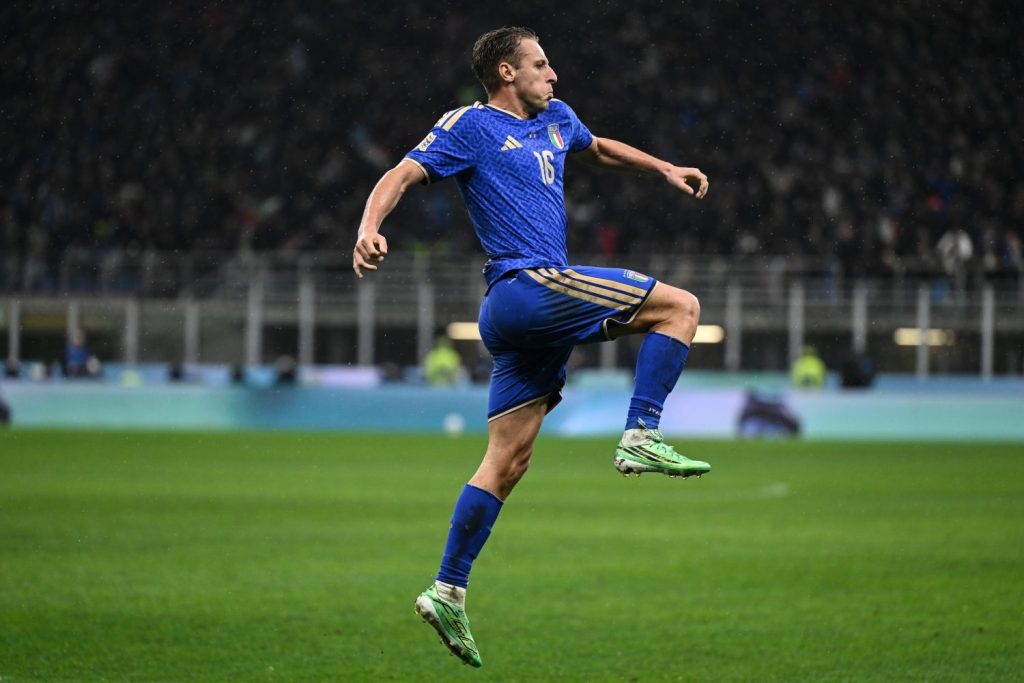
When there is something worth celebrating on the pitch, when the players give those perched in the stands a reason to believe, San Siro does more than come alive. It begins to boil. The noise builds, gathers force, then spills over, until the whole place seems to erupt, carried away by the sheer force of its own enthusiasm. That it should have happened for the Italian national team, the very same team – or not quite the same team, which is precisely the point – that lost to Bosnia less than eight months ago and missed out on a third consecutive World Cup, might seem absurd. Even a little naïve. It isn’t.
Italy beat France 3-1. Not just any France, either, but one of the most talented sides in world football. It was an even contest. The French had more individual quality, certainly, and might easily have scored more than the one goal they managed, which came courtesy of an extraordinary gift from Donnarumma. But Italy were entirely deserving of the win. Sebastiano Esposito, for one, had already missed a dreadful penalty just minutes before Frattesi put his side ahead. And there is, after all, only so much you can do about having to contend with Olise, Doué, Barcola, Cherki and Rabiot. A little suffering was inevitable. Quite a lot, perhaps.
So what has changed in less than eight months? Who has got their hands on a national team that looked – that was – dead and buried, and turned it into a side capable of going toe to toe with France? How have Donnarumma, Calafiori, Bastoni, Dimarco, Barella, Tonali, Frattesi and Esposito, all of whom were there in Zenica against Bosnia and all of whom played at San Siro against France, gone from that to this? The answer is Roberto Mancini, back in the job. The Italy of spring 2026 was, of course, a team paralysed by the fear of failure, and of failing all over again. Its manager had been brought in to deal with an emergency. The players were operating at a fraction of their ability. Mancini has found a way to put the pieces back together, to bring those qualities out again.
His work has been as much psychological as tactical, and the two are inseparable. Anyone who watched Italy-France will have seen it. The Azzurri looked second best from the start, at least in terms of individual quality. Barcola and Doué were finding space wherever they wanted; France kept threading balls in behind the midfield three of Barella, Tonali and Frattesi. Donnarumma produced an excellent save with his foot to deny Rabiot, then handed Olise the opening goal. An error like that, particularly at that moment, might have been enough to finish Italy off. It wasn’t. Mancini’s players held their nerve. They continued to struggle with the almost hypnotic movement of Zidane’s side – whose manager had been roundly booed by the San Siro crowd during the team announcements – but gradually began to push higher, find their feet and play with greater conviction. They started taking a few more risks, too. Cambiaghi’s run, which set up Esposito’s equaliser, was a case in point.
The equaliser opened the game up. Either side of half-time, France hit the post twice: first through Barcola, at the end of a wonderful move, then through Doué, after a muddled, extraordinary passage of play in which Donnarumma managed to be both brilliant and clumsy. That was more or less the end of France’s real threat. Italy began to find space between the lines, win more of their individual battles and turn defence into attack with greater purpose. Sebastiano Esposito missed his first penalty. Frattesi then scored from Dimarco’s pass, after the latter had replaced Esposito, taking up a position as the third forward when Italy had the ball and dropping into the back line as a fifth defender without it. Finally came the second penalty, converted by Pio Esposito after Vergara had won the ball back and driven forward with real intent.
Italy are playing recognisable football again. Mancini has built a system around the players he considers his best – Calafiori, Tonali, Barella and Pio Esposito – and is bringing the rest of the squad along with him. It is much the same approach he took during the first part of his previous spell in charge. The feeling at San Siro against France was unmistakable. As it was eight years ago, this new direction is also bringing a fresh generation into the picture. Kayode, Esposito, Esposito, Cambiaghi, Doumbia, Vergara and the other young players who have come through the Azzurri set-up between September and November. There is nothing quite like a new face to get supporters going, particularly when it belongs to someone who might be part of what comes next.
Better still, there are the results. Since that disastrous opening against Belgium, Italy have barely put a foot wrong. The victory over France might yet prove a turning point. It hardly matters that the French could afford a defeat, with Zidane needing only to beat Turkey in Paris on Sunday 15 November to secure qualification, or that Mbappé was absent. This is still one of the most gifted teams in recent European football. To beat a side of that calibre, and to beat them the right way, counts for something. San Siro knew it. The stadium had its say, found its voice, sang, and eventually gave itself over to a kind of joy that was as spontaneous as it was overwhelming. It had been a long time since the place had sounded like that. Not since the good days of Mancini. Perhaps that isn’t a coincidence.