
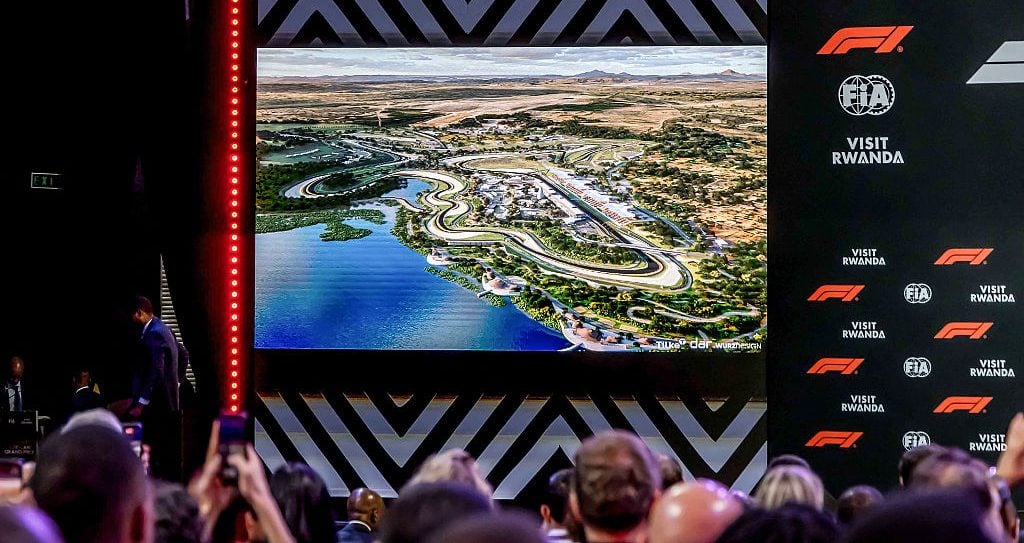
Call it a decision rooted in sporting tradition. No? Perhaps a way of bringing new audiences into the sport, drawing on the appeal of modern infrastructure. Still no? Then perhaps there is little point in dressing it up. Money attracts money, particularly in sport. Formula One is no exception. From 2030, the world championship is set to include an annual race in Rwanda. Yes, Rwanda. A country ravaged by violence, still bearing the scars of the genocide of the 1990s, suddenly finding itself at the centre of the motorsport world. With a little help from abroad.
The rather extraordinary news has also been reported by Forbes, which questions the wisdom of such a controversial move. Formula One has been looking to expand into Africa for some time. The continent has been without a Grand Prix since 1993, when South Africa hosted the last race there, shortly before the end of Apartheid. Not that this was an entirely uncontroversial destination, either. Given its economic weight and changing political landscape, South Africa had looked one of the strongest contenders for the new slot. Instead, the choice has fallen on Rwanda, backed by Qatar, one of the biggest financial players in Formula One and a country with substantial commercial interests of its own in the region.
The proposed circuit would be built south of the capital, Kigali, as part of the new Bugesera airport development, a project intended to turn the area into an international hub for the region. And the identity of its principal backer is hardly a surprise. According to Forbes, Qatar holds a 60% stake in the airport construction project and, through Qatar Airways, a 49% stake in RwandAir, the country’s national carrier. There is more. Wurz, Tilke and DAR, the major firms involved in designing the new circuit, all have close ties to Doha. They are the same companies behind the Formula One track at Lusail and a number of other major developments in Qatar.
Conflict of interest hardly seems an adequate description. Rwanda, meanwhile, is hardly a country whose record invites unquestioning approval. The situation across the region remains deeply unstable, further inflamed by incursions into neighbouring Democratic Republic of the Congo by armed groups backed by Rwanda. The roots of this conflict, too, lie in the genocide: Rwanda continues to regard many of those who fled across the border in its aftermath as a threat today. The humanitarian crisis remains unresolved. For many observers, the Formula One project is a textbook case of sportswashing: using the prestige of a major sporting event to divert attention from a country’s more troubling realities.
In recent years, Rwanda has poured money into sport, from cycling to football, in pursuit of precisely this kind of international visibility. Qatar has been among the strongest supporters of its regional commercial partner. Rwanda supplies the Gulf state with food reserves, raw materials and precious stones; in return, it receives state-of-the-art infrastructure and services. For Qatar, the relationship is also an opportunity to extend its soft power, with sporting investment accompanied by equally substantial commitments to peacekeeping and Rwanda’s economic development. Some of the effects are already visible in the country’s changing demographics. Between 1990 and today, the proportion of Rwanda’s population identifying as Muslim has risen from 2% to 15%. The ties between the two countries run deep. Formula One is now part of the picture, too.