
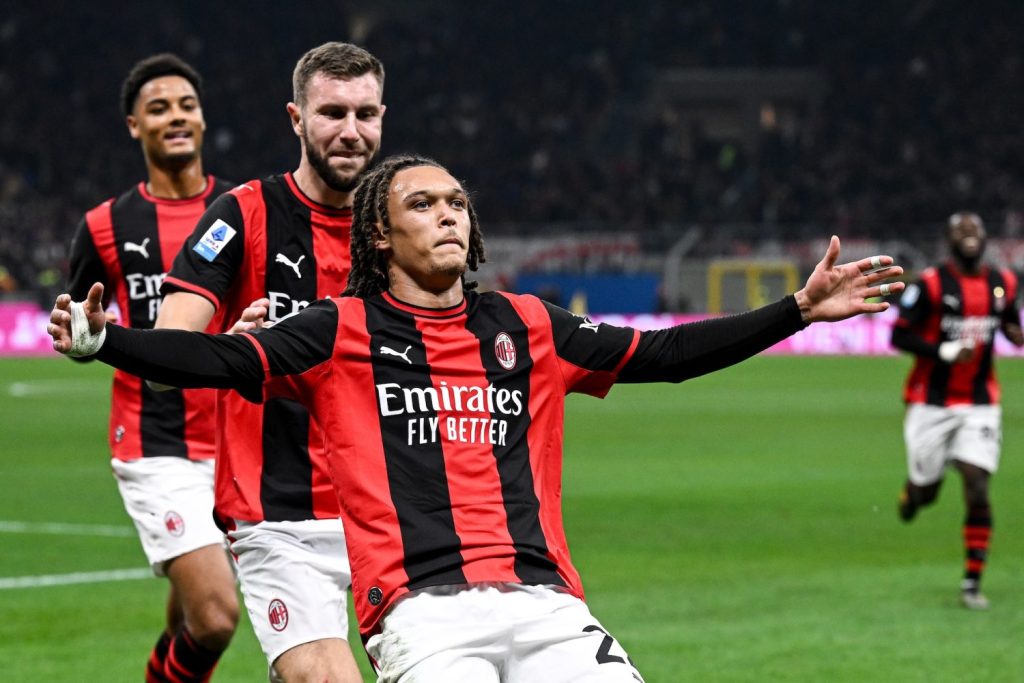
One of the defining images of Milan’s 3-1 win over Inter is Diego Moreira approaching Luka Modrić just before the free-kick that made it three. The Belgian stands in front of the Croatian, hands almost clasped, seemingly asking a favour: let me have this one. Modrić agrees. Moreira places the ball, takes his run-up and bends a left-footed shot over the wall and beyond Martínez. The perfect finish to an extraordinary first half. In that brief exchange, there is already so much to admire about the former Strasbourg winger: the confidence to ask a player of Modrić’s stature for the ball, the conviction that he can make something happen, the sheer nerve to want the moment for himself. Moreira did not just turn up for the derby. He took it over.
The free-kick was the final flourish in a performance that had been gathering force from the opening minutes. Moreira was involved in all three of Milan’s first-half goals, the spell in which they seized control of the game. In the fourth minute, he supplied the cross for Pulisic to finish. Picking up the ball wide on the right, he faced up Carlos Augusto, shifted inside onto his left foot and whipped in a delivery of perfect weight. It was more than a cross. There was intent in the way he went at his man, refusing the easy pass and choosing instead to create something himself. He took on his opponent, unsettled him and opened up the space.
Six minutes later, he had a hand in the second. From a corner, Moreira played a low ball into Rabiot, who found space at the near post and swept it across goal. Different situations, the same instinct: whenever the ball came to him, something could happen. Then came the free-kick on the stroke of half-time. Three goals, three direct contributions. There was little doubt about who had been the outstanding player of the half.
Moreira’s appeal, though, goes beyond his ability to burst past opponents. He is at his best with room to run into, but he is not dependent on it. Changes of direction, feints, sudden shifts of pace and sharp turns are all part of his game, as is an almost constant desire to take on his man. When he receives the ball out wide, his first thought is usually to attack the defender in front of him. It makes little difference whether that opponent has the physical advantage or is quicker over the ground. Moreira will look for a way past, waiting for the moment to move the ball and go the other way. Sometimes he does it with startling ease. Sometimes he tries one move too many and gives possession away. There is a risk attached to playing this way, but predictability is not really an option for him.
He is an instinctive, high-voltage player. There may be spells when he drifts out of the game, only to spring back into it without warning and force the opposition to adjust. He does not need a constant supply of the ball to be dangerous. Once he gets going, he is difficult to stop. His versatility is another reason he fits so naturally into Ruben Amorim’s system. Against Inter, he started on the right, with the freedom to hold his position out wide and take on Carlos Augusto. But he is not confined to the flank. Cutting inside onto his left foot, he can link the midfield and attack, find pockets of space and play forward, either with a pass between the lines or by carrying the ball himself. There is more to him than running the touchline. He has the instincts to come inside and get involved in the areas where games are won and lost.
He can also operate as a number ten, where his ability to turn sharply and drive at the defence becomes particularly useful. Equally, he can be trusted as a wing-back, dropping into the back line and providing the width when Milan need to work their way up the pitch. His contribution against Inter was not limited to the attacking phase. When Milan dropped into their defensive shape, with the team compact and narrow, Moreira tracked back to complete the line alongside his fellow wide players. He is prepared to do the work at both ends of the pitch, giving Amorim room to use him in different ways without losing the qualities that make him dangerous.
At San Siro, Moreira was quite simply outstanding. The unpredictability, the courage, the technical ability, the personality: all of it came together on a night when the occasion seemed to make no difference to him. What stood out most, however, was the way he approached the wing-back role in possession. He was not merely providing an outlet down the flank or making late runs into the box. He became one of Milan’s creative reference points, another attacking player for Inter to account for, and an increasingly difficult problem to solve. Three decisive contributions followed. The last was a beautifully struck free-kick that, by rights, belonged to Luka Modrić. Moreira had other ideas. He walked over and asked for it. Not many players get to tell a story like that about a derby.