
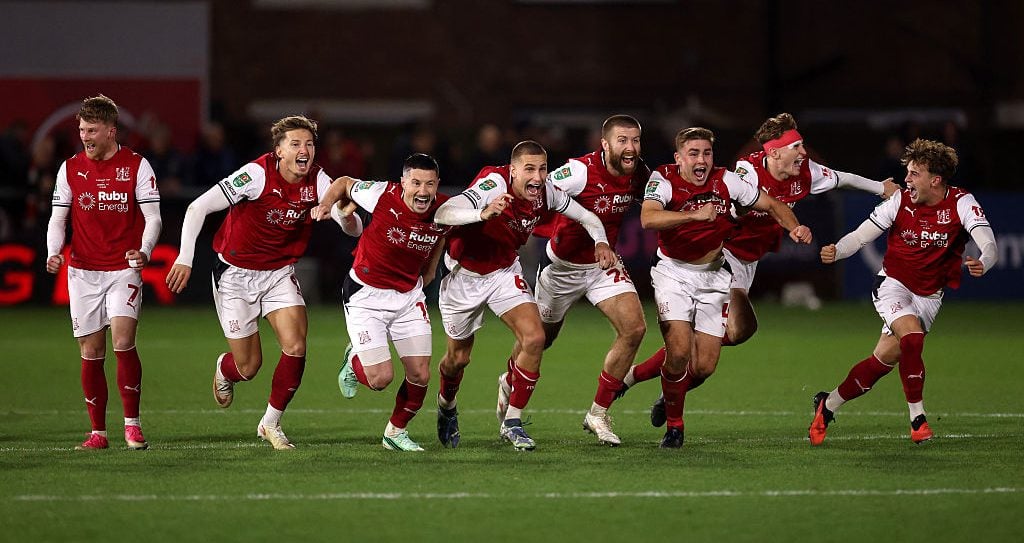
Perhaps it was the shirts: Fleetwood Town’s players looked like Arsenal’s. Perhaps it was the setting, Highbury, a small-scale replica of the historic London ground of the same name. Or perhaps it was simply the magic of the Cup, as they call it in England, which has a habit of striking when least expected. Whatever the reason, Tuesday night was about more than a fourth-tier club knocking a Premier League side out of the EFL Cup. This was Fleetwood Town, a club that has never even reached the Championship, against Arsenal, the reigning Premier League champions. The odds were 11/1 before kick-off. Yet Fleetwood took the lead in the first half, conceded an equaliser to Gyökeres after the break and somehow held on. All the way to penalties, where the home side were faultless. The conviction with which they stepped up to take their kicks was something to behold. Bruno Guimarães missed, leaving the Gunners to contemplate the unthinkable. For Arteta’s side, a setback in an otherwise formidable era. For little Fleetwood, a night that will live in club folklore. And an unexpected windfall.
Some excitement was inevitable. That is how it works in England: when an underdog draws a heavyweight in the EFL Cup or the FA Cup, players and staff celebrate. For many, it is a once-in-a-lifetime opportunity, both for the experience and the exposure — something the soporific, palaeolithic Coppa Italia rarely offers. At Highbury in Lancashire, fewer than 2,000 fans usually turn up for a match. Against Arsenal, the ground was full, with more than 5,000 people in the stands. “So why can’t we get those numbers throughout the season?” asks Jake Batty, one of the men behind the upset. Life at the wrong end of League Two does little to help, but sometimes all it takes is one extraordinary night to rekindle the spark in an entire fanbase.
According to estimates published by the Times, Fleetwood Town had expected to take around €500,000 at the gate, rising to €600,000 had Arsenal agreed to hand over their share of the receipts. A further €200,000 came from prize money for reaching the next round and broadcasting rights paid by Sky Sports, which showed the match on its main channel. Already, a substantial sum for a club whose entire red-and-white squad has a market value of less than €3 million.
But there was more to come. Much more. By winning the tie and reaching the EFL Cup quarter-finals for the first time in their history, Fleetwood opened up an entirely different set of financial possibilities. The further a club progresses, the greater the prize money, while ticket sales and television revenue bring in more too. Next up are the winners of Manchester City-Brighton, another big tie whichever side comes through. For a club of Fleetwood’s size, the sums involved are almost beyond imagining. It is rather like winning the lottery. The money from this cup run will give the club resources far beyond its usual means, which it can now put back into the team and its development. English football has seen this before. From Lincoln to Kidderminster Harriers, smaller clubs have used a cup run as a springboard, and the Football Association itself has been keen to highlight what is possible. The magic of the Cup. And the numbers, suddenly, add up too. Just ask the new heroes of Highbury.