
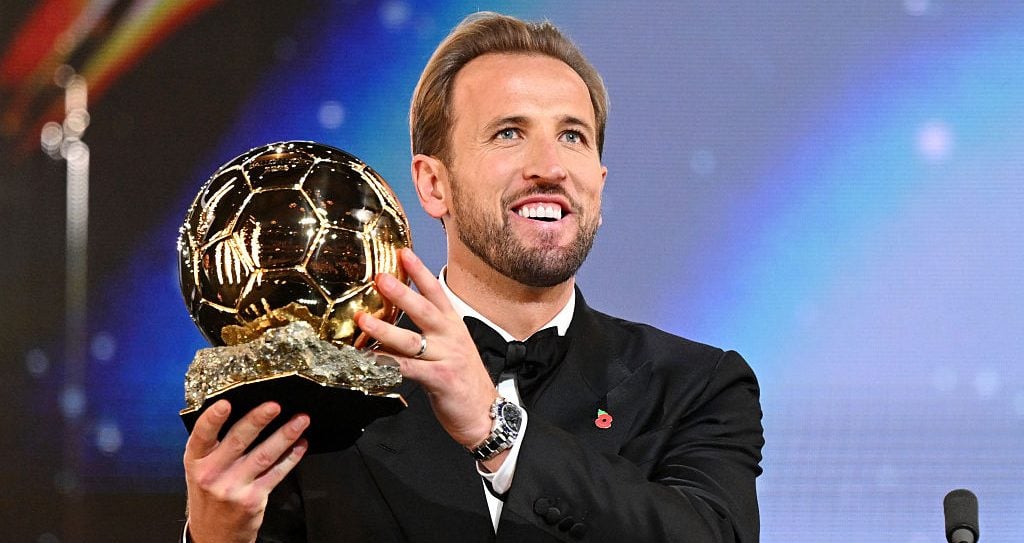
Everything seemed to be falling into place, starting with the ceremony itself, which had moved from Paris to London this year. Harry Kane’s year. The first Englishman to win the Ballon d’Or in exactly 25 years, since Michael Owen. The Bayern Munich striker had earned it after an extraordinary season, above all in front of goal – 73 goals in 65 appearances for club and country – and by taking advantage of a rare opening in a year when the award was more up for grabs than ever. When the biggest team achievements of the season belong to sides built around the collective, from Spain to PSG, the most prestigious individual prize is bound to be affected. Whoever won, someone was going to feel hard done by. Mbappé and Yamal, for starters.
Kane won it through consistency, and through the remarkable development of his game. At 33, he has become the best version of himself. The starting point was extraordinary enough. The former Tottenham striker had long been one of the finest centre-forwards of his generation. That was never in doubt. Now he is the best of them all. The Ballon d’Or, presented to him in London by Ronaldo, can be seen as a career award, though one that recognises not simply what Kane has achieved but how he has continued to develop. He has never stopped working on his game, or refining what makes him different.
Kane remains an almost unique kind of footballer. A product of the game as it evolved through the 2010s, he is an out-and-out striker who thinks, moves and combines with his teammates like a number ten. That instinct to bring others into the game, to make it work around him, has only grown stronger over the years, particularly since he joined Bayern. Under Kompany, he is both the centre-forward and the team’s chief playmaker. There are long stretches of almost every game when even the word attacking feels superfluous. Kane drops deep to collect the ball and dictate play, knitting everything together like a great central midfielder from the 1990s. He has the same range of passing, short and long, and the same elegance on the ball.
The 2026 Ballon d’Or also feels like a form of redress. Hard as it is to believe now, Harry Kane had never won a team trophy before the spring of 2025. For years, that absence became a stick with which to beat him. He was overlooked, sometimes openly mocked. There was talk of a curse, of a lack of leadership, of a player unable to deliver when it mattered most. That narrative has finally been put to rest, thanks to Bayern, where Kane has become the outstanding figure in a side that has dominated at home – two Bundesliga titles and three domestic cups in recent seasons – but is still chasing the European success that has eluded the club since the days of Lewandowski.
Which makes you wonder what Lewandowski made of the ceremony. In 2020, he was Kane before Kane, and then some, leading Bayern to Champions League glory. Yet the Ballon d’Or was not awarded that year, for the first and only time since France Football introduced the prize in 1956. The pandemic was the official reason, though it has never been entirely convincing: football resumed, and the major competitions were completed. Lewandowski should have won it. Kane has now won his. Try explaining the difference to the Pole.
For all the arguments that will inevitably follow, Kane’s victory rests on more than his goalscoring record. This is an award for a footballer of unusual intelligence and extraordinary versatility, whose contribution cannot be measured in goals alone. At the World Cup in the United States, where he captained England and broke the national records for both appearances and goals, he repeatedly dropped back alongside the midfield when England were out of possession, only to finish the tournament as its second-highest scorer. The final piece of unfinished business remains. There are plenty of other examples, but the point is the same: like Lewandowski, Kane has kept finding ways to extend his prime. Whatever changes around him, he continues to find another level. And he continues to score.