
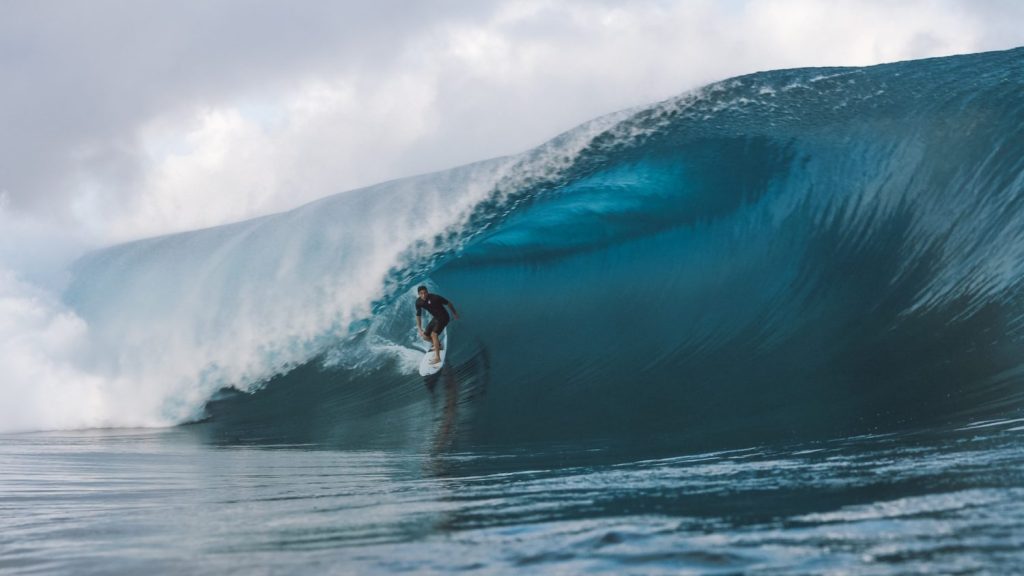
Peniche,Portugal,isoneofthemostanticipatedeventsontheWorldSurfLeaguecalendar.Heresurfismeasuredagainstoftenunpredictableconditions,wherethereadingof the wave andtheabilitytoadapttotheseacanmakethe
difference.
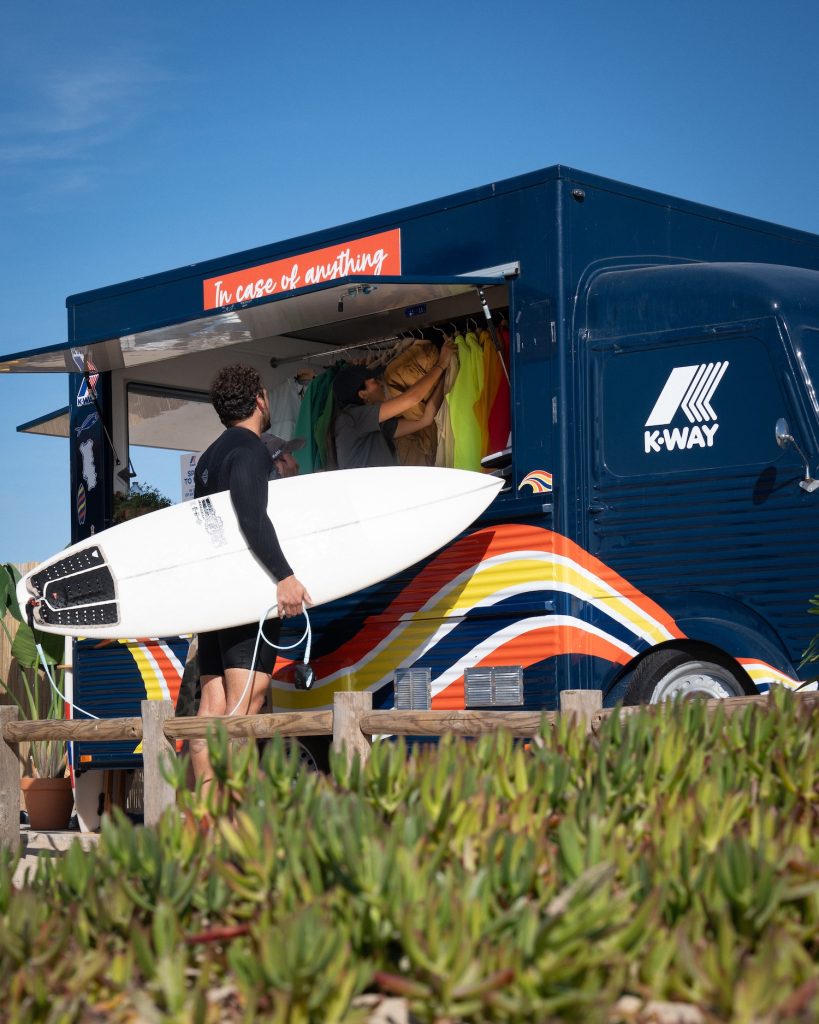
It is also the only European stop in the busy calendar of the year, which brings a flood of enthusiasts from all over the continent. Many also from Italy, driven by the great season of our top surfer: Leonardo Fioravanti, who is experiencing the most exciting season of his career, and who last June became the first Italian to win a stage of the World Surf League circuit. We met Fioravanti with K-Way, of which he has been an ambassador since 2023. For K-Way, surfing is a world with which there is a strong connection: in places where weather conditions, both in the water and beyond, change rapidly, the essence of the brand, both from a product and conceptual point of view, is immediately tangible – from freedom of movement to the ability to adapt to natural elements. In Peniche, for the occasion, K-Way set up a truck that became a meeting pointforthesurfcommunity, where Fioravanti himself was a protagonist among moments of meeting with fans and photo sessions. In the truck, visitors were also able to discoverSummerBreeze,thecapsulecollectiondevelopedincollaborationwiththeItaliansurfer.
In over ten years of career, Leonardo Fioravanti has contributed to the growth of surfing in Italy, perhaps more than he himself realizes. Sometimes, unexpected episodes remind him of this. Like the one that happened to him right in Peniche: “I met a boy who was here with his parents, who came to surf. His name is Leonardo and his parents told me: ‘We named him after you.’ It’s crazy. Knowing that there are parents who love surfing and decide to name their son Leonardo inspired by me is spectacular. It’s a name that lasts a lifetime. It was a moment that really made me reflect. These are the little things that make you understand that success is not only measured in the water, during a competition.”
Not only are you the strongest Italian surfer there is, but in a way you are a true pioneer of the discipline in our country. Do you realize you have played a fundamental role in bringing a surfing culture to Italy as well?
“I don’t even fully realize how much this discipline is growing in Italy. I notice it when I travel and see how much Italians are starting to love surfing more and more. Especially this year, after the victories I have achieved, I felt incredible support from Italy. I saw huge passion even from people who perhaps didn’t even know this sport before. I hope, and I am sure, that many parents have taken their children surfing this summer after seeing my results. This is also a true success: knowing that right now there are boys and girls who have started surfing thanks to me. It’s an incredible honor. The career I am having is primarily for myself, because I am living my dream and I have goals I want to achieve. But I also do it to inspire the new generation. Even today we see Italian talents emerging. Among the younger surfers, those aged between ten and thirteen, there are at least three or four Italians who, in my opinion, are among the best in the world. I am sure we will see a generation of very strong Italian surfers emerge.”
©Tommaso-Geraci
Today many young people see you as a role model to look up to. Was it more difficult for you, not having Italian surfers to take as an example?
“I was inspired by the greats of surfing in general: Kelly Slater, Mick Fanning, and the strongest surfers of my generation. I never closed myself off to the thought that, being Italian, it wasn’t possible to reach those levels. When I was young, that idea never crossed my mind. I was determined and, already at twelve or thirteen, I had a very high level compared to other surfers in the world. If at twelve you can beat Australians, Americans, and Brazilians, you start to understand that you can compete with them. And then you think: if I can beat them today, why shouldn’t I be able to do it in the future? Perhaps the fact that I started so early helped me not to develop that kind of mental limit. I never thought that being Italian was an insurmountable obstacle. It’s probably also a characteristic of my way of being: in the face of difficulties, I have never stopped, I have always tried to move forward.”
You are having an incredible season, with results never achieved before…
“For the first time, I find myself in a position where I am fighting for a world title. It’s an extraordinary opportunity, but it also comes with great responsibility. I feel like I’m managing it well: I try not to get too far ahead of myself, to stay calm, and to take it one heat at a time, one competition at a time. In recent years, my level of surfing has grown tremendously. I have not only improved in competition: it’s my surfing that has grown. It’s the result of repeated work over time, of hours spent with my coach, and also of my mentality. I never stop looking for something to improve. You have to be happy with the progress you make, but continue to look for those little details that can lead you to improve even more.”
And how do you react in the face of unlucky days, like this stop in Peniche?
“Surfing is a beautiful sport also for this: every wave is different. In a competition, however, it’s complicated. There are days when you have to try to get in tune with the ocean and find the right rhythm. There is no book that teaches you exactly how to do it: there is you and the ocean, and you have to find that harmony somehow. Sometimes it’s easy: you have the feeling that whatever you do, in any direction you move, you can find the right wave. Other times, the exact opposite happens. Days like this in Peniche are hard to explain. Perhaps this is the most frustrating aspect. Three or four years ago, I would have taken a defeat like this much harder and would have dropped much more mentally, risking not being ready one hundred percent for the next stop. It was a painful day, but the next day I woke up with the awareness that life goes on. For some time now, I’ve been thinking: I have to learn to manage my happiness; it cannot be dictated by results. An athlete’s happiness cannot depend solely on how competitions go. Of course, it’s normal to suffer when things don’t go well. You have to feel that pain; you have to let it burn. But you also have to learn to manage it and use it so that it can give you energy.”
©Tommaso-Geraci
Your profession takes you around the world. Is this an aspect you enjoy or does it weigh on you in the long run?
“I am fortunate because I can count on a team that travels with me: my wife, my coach, and Tommaso, who takes care of the videos and is also a great friend. Traveling with them means having a home and a family even when you are on the other side of the world. It’s important to feel comfortable in all places around the world. You can’t go to a place just to work and compete: you also have to appreciate it, enjoy the week, the preparation, and everything around it, regardless of the result. Today I love this lifestyle and I am happy to have found the right balance. Maybe in the future, when I have a bigger family, things will change.”
Can you manage not to think about surfing from time to time?
“My wife knows me well and knows how hard it is for me to disconnect, but it’s important to do so. There’s a phrase in English that I often repeat: less is more, which means ‘less is better.’ It doesn’t mean that to improve you have to train 365 days a year. You have to find the right balance. It also means spending time with your wife, going to play golf with friends, or engaging in other sports. For example, you can go hiking in the Swiss mountains, which are among the most beautiful in the world. It’s important to be able to invest your energies in other aspects of life as well. Then, when you return to compete, prepare, and train, you can give one hundred percent with pleasure and the right motivation.”