
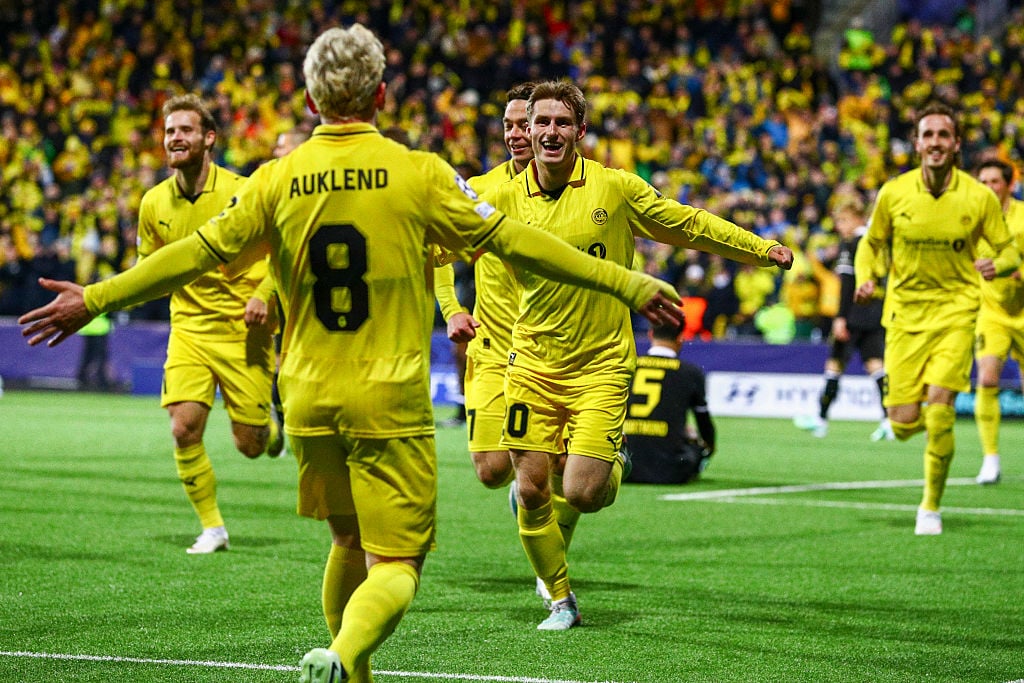
Tonight, Napoli host Bodø/Glimt in the Champions League. Despite playing in Italy, despite having won a Scudetto less than a year and a half ago, and despite the entire population of Bodø being able to fit inside the Stadio Diego Armando Maradona with a few seats to spare (53,638 inhabitants against 54,726 seats), it is the Norwegian side that arrives in better form. Or at least that is the impression left by Napoli’s recent performances under Allegri and Bodø/Glimt’s latest European exploits. In 2026, the Norwegians have beaten Manchester City, Atlético Madrid, Inter twice, Sporting Lisbon and Borussia Dortmund. It is one of those shifts in power that European football seems to produce with increasing frequency, a reminder that even clubs on the edges of the map can become a regular, and uncomfortable, presence in the game. To understand how it happened, we spoke to Bodø/Glimt CEO Frode Thomassen.
“I don’t think European clubs are afraid of us yet. But they certainly respect us now,” Thomassen told Undici on the eve of Napoli-Bodø. It is a striking statement from a club that was still playing in Norway’s second division in 2017. Bodø/Glimt come from a fishing town north of the Arctic Circle, around ten hours by car from the nearest city, whether heading north or south. Until a few years ago, European opponents treated the trip as something to get through as quickly as possible. When Mourinho’s Roma came to town in the Conference League in 2021, Thomassen recalls, “they didn’t even go out onto the pitch or visit the stadium, they didn’t train the day before, they just turned up on matchday”. Roma lost 6–1, and that was how Bodø/Glimt entered the European football conversation.
For Thomassen, the key to this success lies in the club’s strategic philosophy, Our Way. The principle is to turn what makes you different into an advantage. “Every club has to understand the context it operates in.” For Bodø/Glimt, that context is the distance from the rest of the world: a remote town, almost forgotten by God, where the club and the community have become inseparable. Culture, the identity surrounding the club, is, for Thomassen, the most important thing. It is rooted in the history of Bodø and runs through its families, too. Patrick Berg, one of the most important players in the squad and a regular for Norway, is the third generation of his family to wear the yellow and black, following his grandfather Harald and his father Ørjan, as well as two uncles and a great-uncle. The family also helped save the club from bankruptcy in 2010, carrying that spirit forward.
The divisions have changed, as have the ambitions and the infrastructure, but the heart of Bodø/Glimt has remained the same, even now that the team plays in Europe’s biggest stadiums. “Many of the people who held key positions in 2017 are still here,” Thomassen says. “Continuity is a big part of it.” Among them is Bjørn Mannsverk, the team’s mental coach, who arrived in 2017 and was already working with the F-16 pilots based in Bodø at the time. Thomassen prefers another term: “I call him more a culture builder, because this club is built around people’s mentality, their values, the way they think and act.” His work begins with a group that takes responsibility for itself. Bodø have ten captains, and the players choose who wears the armband for each match. “We don’t know who the captain will be against Napoli,” Thomassen says. “The players decide the night before.” Mannsverk starts with this group of captains to understand the mood in the dressing room and what needs to be addressed, week after week. Working on the players’ mentality means building a shared identity in which responsibility belongs to everyone.
Then there is the stadium. Aspmyra Stadion is iconic, instantly recognisable for its cramped corners, and has become a fixture online: a small, old ground, with a stand dating back to 1966, wedged between apartment blocks, including a student residence, with the northern lights overhead on winter nights. At its centre is the artificial pitch, which can unsettle visiting teams and is often considered Bodø/Glimt’s secret weapon. Thomassen does not deny that playing in Bodø can come as a shock to the bigger clubs. But the surface is only part of it. “It’s not just the artificial grass. There’s something about the environment that makes it difficult to play against us.” The same stadium that helped make Bodø/Glimt’s name is now beginning to feel too small. “Two years ago, I would have said our stadium was a limitation,” Thomassen says. A new ground with 10,000 seats is due to open in late 2027. The club sees it as “a showcase for the technologies of the future”, a place where companies can test innovative solutions before taking them into larger stadiums across Europe and the world.
Asked whether there is a limit to what Bodø/Glimt can achieve, Thomassen dismisses the idea. “If we think there is a boundary, we should close the club.” Financially, he admits, Bodø will never be able to compete with the giants of Europe’s five major leagues. But that is not where the club’s progress will come from. It starts with the 1%, the principle repeated throughout the club: finding ways to improve every day, often in the smallest details. Climate, food, sleep, recovery. Everything is monitored and put to use. It is why the team flew to Naples on Saturday, four days before the match. In just a few years, Bodø/Glimt have gone from Norway’s second division to the brink of the Champions League quarter-finals, a prospect that Thomassen says many would have considered impossible for a club like his five years ago.
Tonight, the result matters less than it might seem. Thomassen knows he is facing players who are probably better than his own. He knows his team can lose. But the question in Bodø is not how the match will end. It is how to be better than yesterday. “It’s not about thinking about results, but about being better tomorrow than we are today. Then we’ll see how far we can go.”