
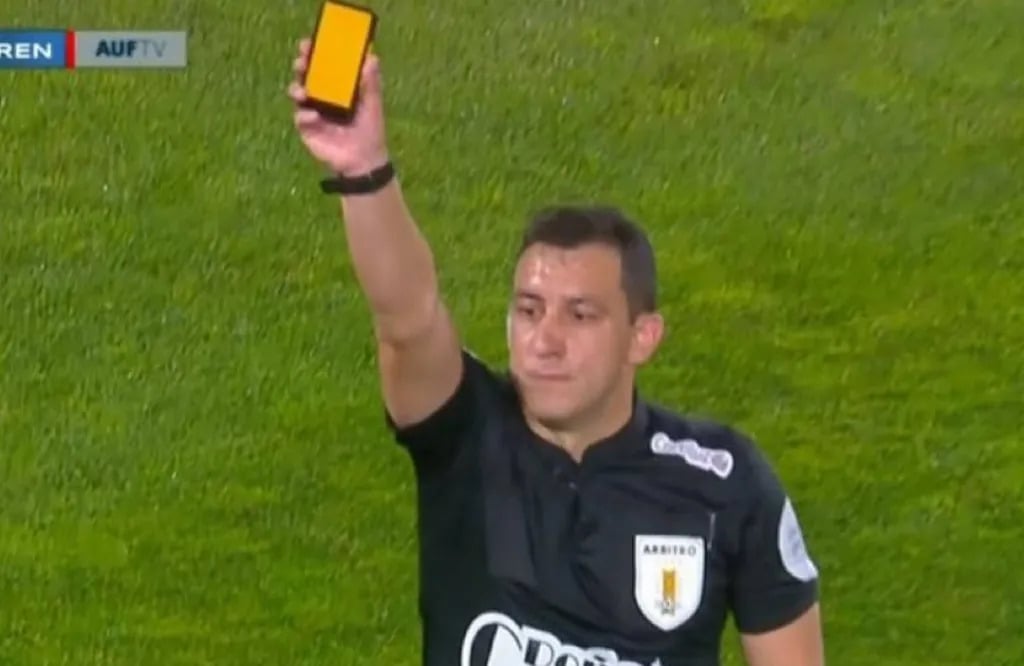
Technological innovation in football often centres on refereeing. It may not rank alongside VAR and semi-automated offside technology, two of the most significant changes in the game’s history, but the latest experiment in Uruguay is certainly an unusual one, particularly as it has yet to work as intended. As reported by AS, referee Eduardo Varela tested an electronic device resembling a smartphone during Nacional’s 3-0 win over Rentistas in the Copa Uruguay. Rather than reaching into his pocket for a traditional card, he could display the relevant colour on its screen. The experiment drew attention from fans and those around the game, while also exposing a few problems.
The device has two buttons, one for yellow and one for red. Pressing either illuminates the screen in the corresponding colour, allowing the referee to signal a booking or dismissal without producing a traditional card. The first player to receive a virtual yellow was Rentistas midfielder Juan Pablo Plada, booked in the 12th minute for a foul on Nacional striker Maximiliano Silvera. The electronic red was also used during the match. Developed in Uruguay in collaboration with a private company, the system is intended primarily to simplify referees’ administrative work. It automatically records bookings, dismissals, substitutions, penalties and other match incidents, sending the information in real time to COMET, the digital platform used by the Uruguayan Football Association (AUF). This reduces the need for referees to make handwritten notes during a match and transfer the details into their reports afterwards. The system is also intended to make the same information available to the media as events unfold.
Referees in Uruguay have started to use digital yellow and red cards https://t.co/MpSVZrxz9G
— Total Football (@TotalFootball) October 16, 2026
The first trial was scheduled for late September, during the match between Defensor Sporting and Plaza Colonia, but the lighting conditions made the colours difficult to distinguish. The problem persisted at the Gran Parque Central, where spectators at Nacional’s match against Rentistas complained that the screen was hard to see, particularly from a distance and on television. The developers have acknowledged that the hardware needs further work, with side-mounted LED lights among the options being considered to make the colours more visible.