
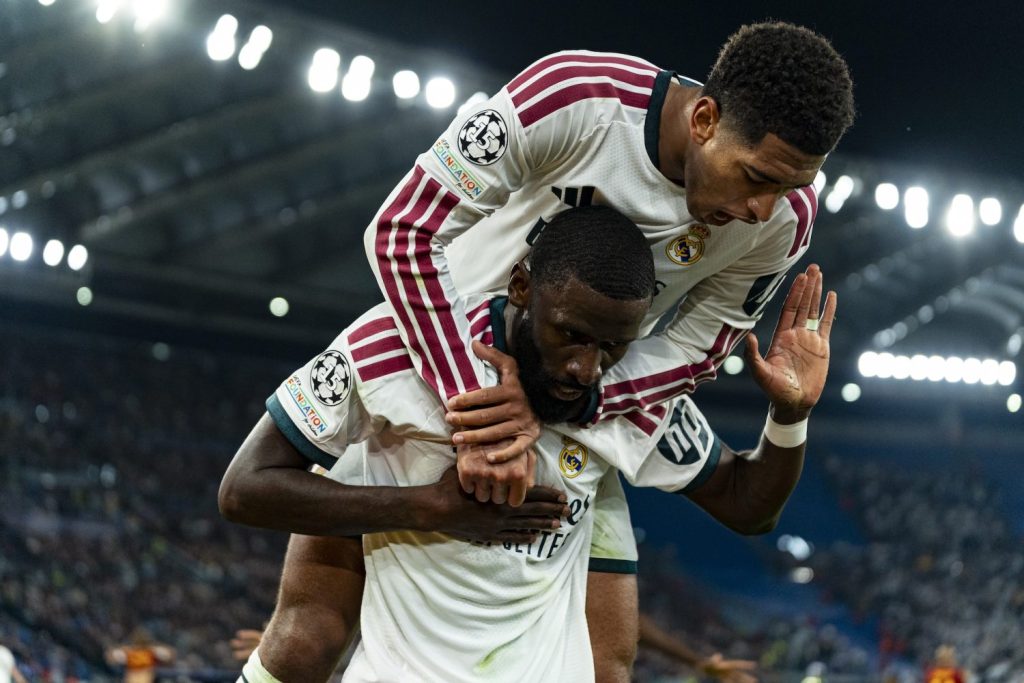
A raised index finger heading into the Olimpico tunnel: the neatest summary of a match that felt lost until Real Madrid decided to win it, long after anyone would have taken a bet on their comeback. José Mourinho walked with the quiet stillness of a man who had just watched something he knew inside out. The gesture seemed to say I knew it, or more precisely, that with this shirt, these players, and this history, you can never treat a match as finished. By the eighty-third minute Roma were leading 3–1, but by the ninetieth Madrid had flipped the whole evening to 4–3, three goals born of three corners, even after looking for long stretches like a side barely able to recognize themselves.
In Spain there is a line that surfaces on cue whenever Madrid manage to come out alive from a match they ought to have lost: «Así gana el Madrid». That is how Real Madrid win. It is a formula that packs a great deal into a few characters because it invokes the sheer weight of the shirt, the prestige of their history, and an accrued experience in top-level football, above all in the Champions League. Given how the night unfolded, it remains hard to find a explanation more convincing than that overused, almost banal idea of the mystique, yet looking closely there are no real alternatives: Real did not win because they played better than Roma over ninety minutes, but because in the final eight they reminded everyone who they were.
The distinction matters, particularly to Mourinho. The Portuguese coach made no attempt to hide behind the comeback, nor did he use the outcome to wipe away everything that had happened before. In his press conference he took full responsibility for an opening stretch where Roma had dominated his team, finding spaces and numerical overloads with an ease that laid bare the underlying problems of his Real. Gian Piero Gasperini’s players knew how to catch their opponents off guard, attacking with conviction and exploiting the fragilities of a Madrid side still searching for balance, to the point where the 3–1 scoreline signed by De Roon and a Malen double felt almost narrow for what had actually been seen on the pitch.
This was largely because Real Madrid gave the distinct impression of being a collection of major individual talents unable to find a common shape. The distances between the lines kept stretching, possession never translated into real control, and individual quality failed to produce a recognizable design. When a team built to dominate matches ends up chasing opponents without ever imposing its own tempo, pedigree is no longer enough—or at least, it shouldn’t be.
Then came the eighty-second minute, and the match simply shifted. It did not happen through intricate build-up play, a tactical stroke capable of dismantling Roma, or a long sequence of passes, but through three corner kicks, three balls sent into the penalty area, and a cluster of moments where Real found everything they had lacked until then: precision, aggression, conviction. Carlos Espí cut the deficit, Endrick signed the equalizer with a header, and Antonio Rüdiger, as a former Roma player, completed the turnaround—three goals in seven minutes and forty-three seconds, the fastest away comeback in Champions League history, and enough to transform a night to forget into one that instantly enters the cabinet of Madrid exploits.
The substitutions made the difference too. Mourinho had started the match with choices that failed to function, but he had the merit of stepping in and relying on players who could rewrite the ending. Endrick, Espí, and Arda Güler became the protagonists of a comeback that had seemed well out of reach: the Brazilian scored and helped build the equalizer, Espí provided the first goal of the revival, and Güler put his quality at the service of dead-ball situations, proving decisive in the move for the fourth goal. Two goals and two assists off the bench mean you can fairly say Mou turned the match on its head.
And yet, the Real Madrid manager owned his mistakes without surrendering the validity of his choices. It is a subtle but essential distinction: Real did not play a great match, yet showed they possessed enough resources to reclaim one that appeared lost. The result repairs none of the issues exposed in the first eighty minutes, builds no instant identity, and offers no guarantee that a comeback like this can be repeated every time, but it delivers six points from the first two Champions League fixtures, against Inter and Roma no less.
Mourinho himself, after the victory over the Nerazzurri, had acknowledged how chaotic, and therefore accidental, that win had been. Now the script has repeated itself with an added edge: against Roma, Real spent an even larger portion of the evening without deserving the final outcome. Six points, then, without truly convincing on either occasion—the paradox every coach managing a team at this level must face, where the result protects you, but does not absolve you.
So that raised finger in the tunnel carries an extra layer of meaning. It is not merely the satisfaction of someone who has beaten his former club, nor the celebration of a personal comeback, but the recognition of a mechanism Mourinho understands and Real Madrid continue to feed: the ability to remain inside matches even when they no longer seem to belong to them. For eighty minutes Roma showed they could be superior, that they had a plan and knew how to execute it, but in the final ten and a bit, Real found a shortcut paved with talent, depth, and historical weight. They are not a complete team yet, but perhaps, for now, they are above all a team that knows how to win, and in the Champions League, where Real built a decisive part of their legend on matches that seemed impossible to save, that alone can be enough to carry you a very long way. «Así gana el Madrid», even when they shouldn’t.