
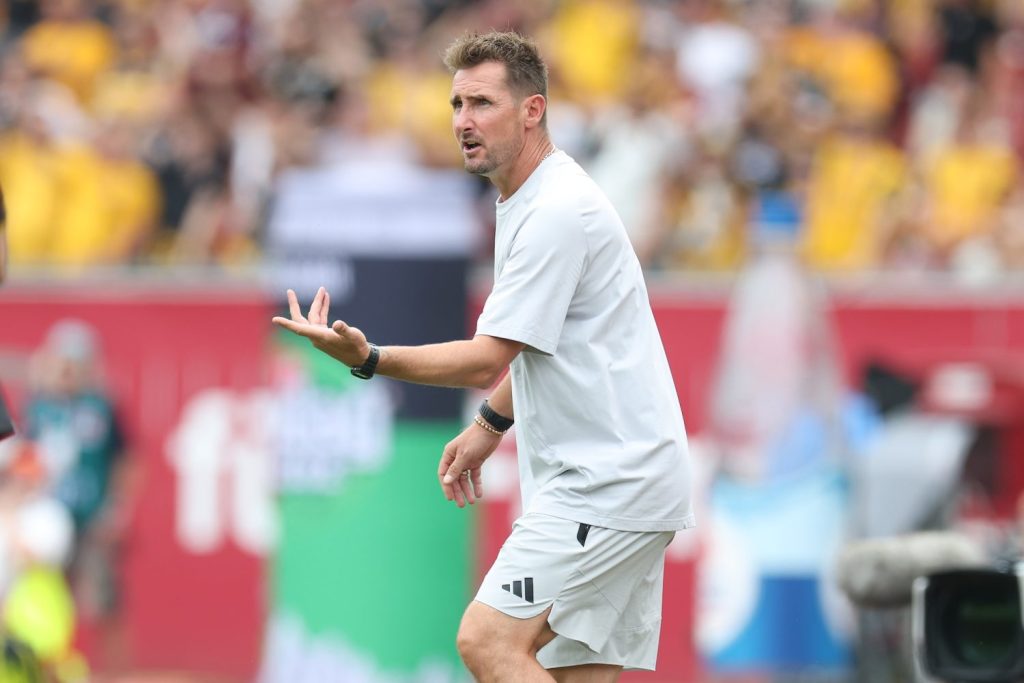
Miroslav Klose retired ten years ago, bringing a distinguished spell at Lazio to a close. Four years into his managerial career, following a stint at Altach, he took charge of Nuremberg in 2024. Der Club — the club, as if no other could possibly exist — is a giant of German football, out of the Bundesliga since 2019. Five wins and two draws from their opening seven games have kept them in the promotion race, but Klose’s influence extends beyond results. Writing recently in the European press, Philipp Lahm identified something quietly distinctive in his approach. “Miro has the DNA of a great coach.”
As Lahm sees it, Klose has little appetite for unnecessary complexity. He trusts his system, resists constant changes to his line-up and looks for players who fit the club’s needs. A young, increasingly settled side is taking shape. Mohamed Zoma earned a call-up to the Italian national team while playing in Germany’s second tier. Three academy graduates are making their mark: Tim Janisch, 21, Eric Porstner, 19, and Piet Scobel, 21. The captain is Jan Reichert, a goalkeeper born just a few miles from the city centre who came through the club’s own academy.
Klose describes himself as obsessed with detail. Every morning, he shakes each player’s hand. Punctuality matters; so do dress codes and behaviour before, during and after training. Lahm sees in these routines the imprint of Klose’s playing career: an instinct for hierarchy, discipline and tactical awareness. But order need not mean austerity. Jokes relieve the tension, while small gestures keep authority from becoming distance. Even the dining room has its own choreography. Klose rearranges the seating each day, ensuring that different players sit together. The ingredients are there: a clear method, a young side and a coach who knows what he wants. Whether Klose can turn that promise into sustained success remains to be seen. His playing career established his credentials. Management will have to do the rest.