
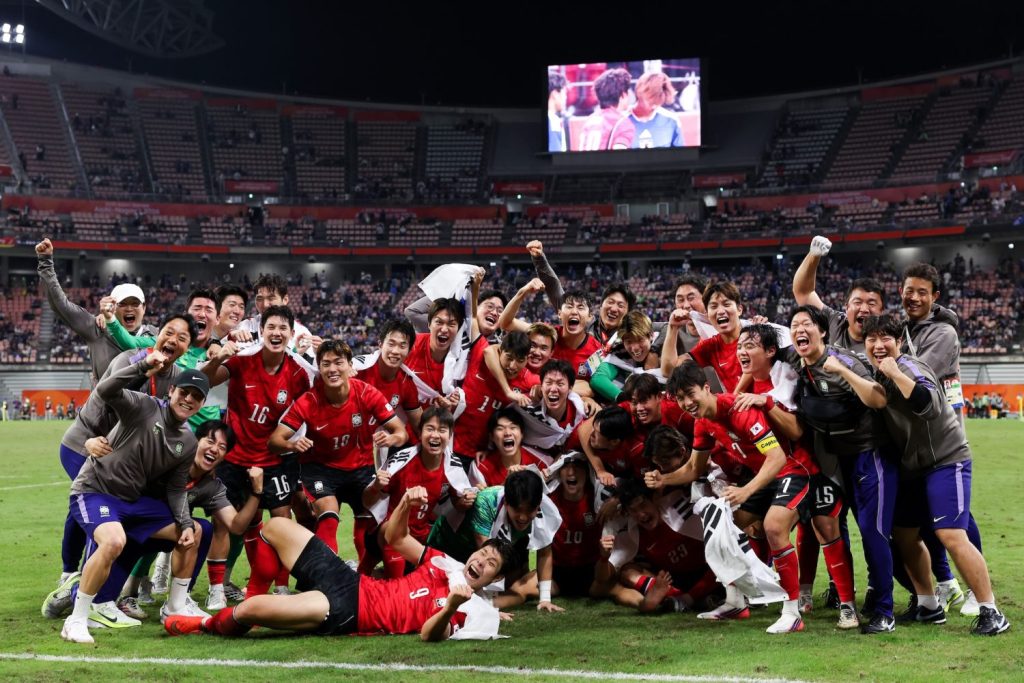
The fact that South Korean athletes – footballers above all – face major problems with compulsory military service, a long-standing institution in their country, has attracted international attention. Controversy over athletes forced to look for loopholes, or even to interrupt their sporting careers abroad, resurfaces periodically. Now it has flared up again after the Asian Games, where South Korea won the gold medal and 20 of its 23 players qualified for an exemption: after the final, captain Lee Gi-hyuk held up his medal at the post-match press conference and celebrated by saying, “I won’t go into the army!” Another member of the squad, Yang Min-Hyeok, openly said that he had focused “more on being able to skip military service than on winning a trophy”.
The problem, then, is that sporting success – particularly an Olympic medal or gold at the Asian Games – can reduce South Korean athletes’ compulsory service, which normally lasts at least 20 months, to a few weeks of “basic” training. A victory on the field is therefore inevitably celebrated for this “secondary” benefit as well – which is not exactly secondary, given that it can have a decisive effect on the careers of professional athletes. South Korean politics and public opinion are highly sensitive to the subject, and the national team players subsequently apologised for their celebrations.
And so, however difficult it is to imagine a system of military service like this fitting alongside a career in elite sport, Seoul has taken a hard line: in the coming months, the rules governing exemptions will be reviewed, rather than compulsory service itself. The announcement came from Choi Hwi-young, South Korea’s minister of Culture, Sports and Tourism, who said at a press conference that “the system needs to undergo a new and thorough review. It is true that so far it has helped outstanding artists and athletes develop their abilities in different fields, but the values surrounding fairness and the public perception of military service have changed. Exemptions will therefore have to be scaled back”.
In particular, the review is expected to take factors such as fairness and the declining number of men of military age in the country into account. There is no timetable yet, but the controversy that erupted after the Asian Games has drawn attention to how easily South Korean athletes can win gold at the continental event – at the 2026 edition, they won 39 gold medals and 150 medals overall. It is therefore easy to imagine that Seoul will eventually stop granting an (almost) total exemption for an achievement that no longer looks quite so exceptional. All the more so, perhaps, if they end up celebrating the exemption more than the sporting success itself.