
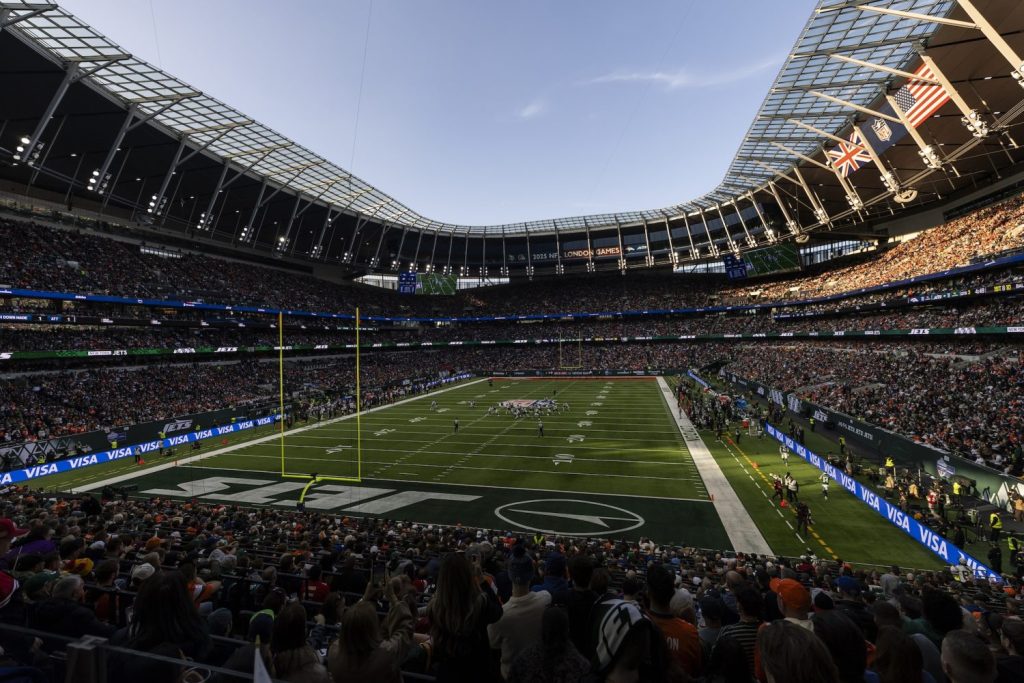
As the project for a new $3.8 billion stadium in Washington, D.C. gets under way, Commanders owner Josh Harris has been visiting several NFL venues in search of inspiration. His search has taken him beyond the United States, too. Nothing unusual there, except that one of the stadiums he has visited is in Europe. And not an American football stadium, but a soccer one. Or, at least, one built by a soccer club. It is, naturally, Tottenham Hotspur Stadium in north London. Harris already knows it well: his franchise has played there several times, and the stadium was designed and built to NFL standards.
In fact, as Sportico reports, the NFL did more than take part in the design of Tottenham Hotspur Stadium. It also contributed financially to its construction. Opened in 2019 after a $1.3 billion development, it is one of the most advanced examples of an English soccer stadium transformed into a full commercial ecosystem, a model increasingly common in American professional sports. And as NFL owners look with growing interest at the opportunities offered by European soccer, Tottenham Hotspur Stadium has also become a symbol of how these modern business strategies have crossed the Atlantic and made their way into the thinking of executives on the other side.
Tottenham’s stadium has around 60 suites, thousands of premium seats and a surrounding area that generates revenue 365 days a year. At one end is the Goal Line Bar, 65 metres long and considered the longest bar in Europe. It is a world away from the compact grounds, with their brick and bare stands, that for decades represented the identity of English soccer and still define some of the country’s most important clubs.
An asset like this was bound to change Tottenham’s business. The numbers tell the story. In 2016/17, the club’s final season at a reduced-capacity White Hart Lane, matchday revenue from Premier League and other competitions stood at just over €50 million. In 2024/25, the latest financial year available, it had more than tripled, reaching €155 million. The other sources of revenue have followed a similar path. Over the same period, sponsorship and hospitality income rose from €79 million to €194 million, while merchandising increased from €16 million to €48 million.
Then there is an entirely new line, one that did not even exist in the club’s accounts ten years ago. It covers non-football events, from NFL games to concerts, as well as the commercial activities developed around the stadium: fan tours, the Skywalk on the roof and the Formula 1-branded go-kart track. In the last year alone, all of these activities generated another €100 million.
It is a model that has helped turn Tottenham into one of the richest soccer clubs in the world. According to the latest estimates from Sportico, the club is worth $3 billion, putting it tenth globally in football. From the stands, meanwhile, the visual language is much more familiar to any NFL fan: individual seats, glass-walled suites, 270-degree LED screens, video walls and numerous pitchside boxes. It looks like an NFL stadium.
Hidden beneath the natural grass used by Tottenham is an artificial surface built to NFL standards. There is also a dedicated hospitality area, the Commissioner’s Suite, used for every event held at the stadium, not just NFL games. The venue has two locker rooms built to NFL specifications as well, much larger than those normally used by the soccer club — partly because NFL rosters are bigger, players are larger and the equipment takes up more space. When the NFL is not using them, Tottenham uses them for hospitality.
It may sound like a detail, but it is not. When the NFL began playing games at Estadio Azteca in Mexico City, it had to drill through rock to build temporary locker rooms outside the stadium, says Henry Hodgson, general manager of the NFL’s UK operations. The NFL currently has a ten-year agreement with Tottenham, recently extended, under which at least two regular-season games are played at the stadium every year through 2029. It is hardly a coincidence.