
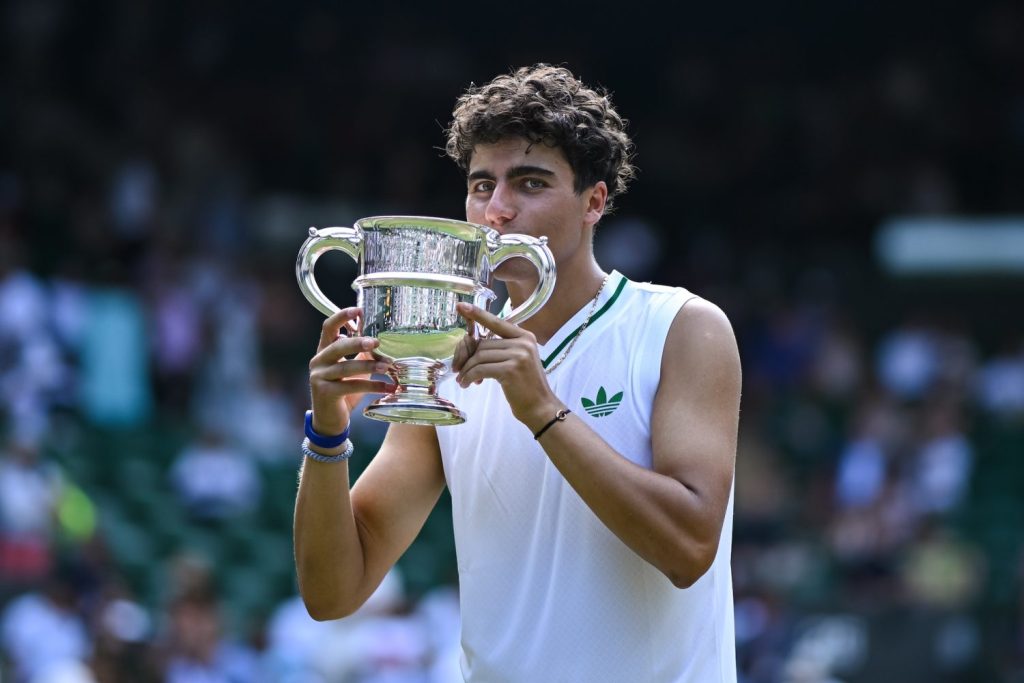
Remember this name: Ivan Ivanov. Last year he won the Wimbledon and US Open junior titles, finished the season as the world’s No. 1 junior player and, still only 17, has already made his first appearances on the Challenger circuit this year. As El Mundo wrote, “with his forehand, he will reach the top of Bulgarian tennis, even if the country has a rather limited tennis tradition”. Ivanov’s story is made even more interesting by the fact that he grew up at the Rafa Nadal Academy in Manacor, where he has trained for the past three years and shares the courts with other young talents from around the world: Slovenia’s Ziga Sesko, this year’s Australian Open junior champion; Germany’s Diego Dedura, who has already won an ATP match; American Max Exsted; and Britain’s Hannah Klugman.
There are plenty of young players making their mark at the school Nadal opened in 2016, which is celebrating its tenth anniversary with an exhibition tournament featuring the founder himself, along with some of his old rivals and friends, including Andy Murray, Marat Safin, Richard Gasquet and Carlos Moyá. “Our main mission has always been to develop people, not athletes,” Rafa said. That is still the idea in Manacor, where an international boarding school and student accommodation sit alongside the academy’s courts, even as players worth following continue to emerge. Alongside the group of talents approaching 18, there are already examples of players who have made it from Manacor to the top of the sport. Casper Ruud and Jaume Munar trained elsewhere before going on to build their careers at the Rafa Nadal Academy, while Filipino Alex Eala broke through this year. She arrived in Manacor as a child and is now No. 18 in the WTA rankings.
Unlike other centres, the academy founded by Nadal has never set out to attract professionals who are already established. The idea is to find very young talent around the world and help them develop. You only need to walk around the complex under the Mallorcan sun to see what the academy puts at its players’ disposal: 45 tennis courts, another 19 for padel, a museum and, in the middle of it all, classrooms and dormitory-style rooms. Not everyone who makes it into the academy will become a professional, of course. Some will win a Grand Slam, others will earn a scholarship to attend a university in the United States, while others will simply carry their experience of Manacor with them.
The hardest part of the journey for an aspiring tennis player often comes when the junior game ends and the professional circuit begins. That is where some decide to walk away, even if they do not leave empty-handed. One of the academy’s remaining ambitions is to attract more Spanish talent, as it has done with Martin Landaluce, now No. 73 in the world. In Spain, though, there is no shortage of high-level academies and the competition is fierce. The Rafa Nadal Academy has hosted a Challenger 75 since 2018, as well as junior tournaments and even an ITF event for veterans.
But the project is growing beyond Manacor too. Alongside a second base in Marbella, Rafa Nadal has already opened centres in six countries across several continents: Mexico, Greece, Kuwait, Hong Kong, the Dominican Republic and Egypt. Ten years ago, Manacor was best known as the home of a champion. Today, young players arrive from all over the world with a dream, and some go on to take on the best players on the planet, as Eala has done. And now, as the academy celebrates its tenth birthday, a 17-year-old Bulgarian is still hitting forehands on the courts of Manacor. Maybe ten years from now, someone will write an article like this about him.