
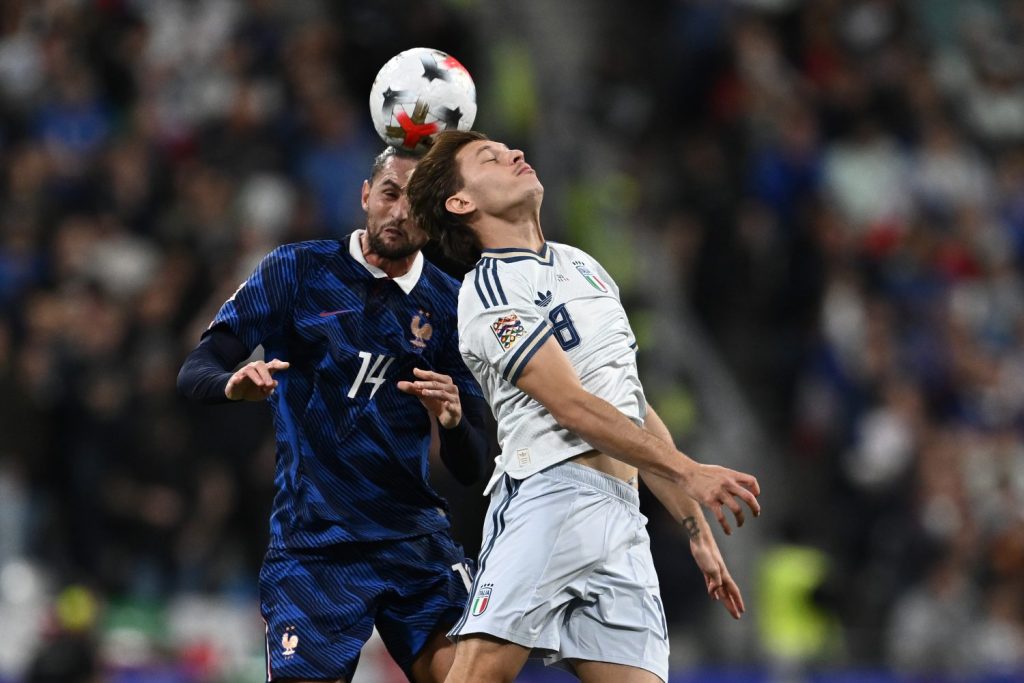
Yes, it is true: Gianluigi Donnarumma was the undisputed MVP of France–Italy 1–1, which tells you just how many clear-cut chances Zidane’s team created. At the same time, though, anyone who watched the game cannot say – let alone think – that Mancini’s Italy were exclusively defensive, or that the final draw was entirely undeserved. The truth, as so often happens, lies somewhere in between: the Azzurri were made to suffer by France’s dazzling quality, they were rescued by their goalkeeper on several occasions – but he is, after all, a member of the team, so his interventions are not simply a matter of luck – and they also did plenty of good things.
That is precisely the point: an Italy that had looked completely broken – or at least that was the general perception of Mancini’s team, especially after the ugly home defeat to Belgium – went to Saint-Denis to face France, on Zidane’s home debut as head coach, no less, and for significant stretches of the game they were able to match Les Bleus. In any case, they were in it. From beginning to end, they never really left the game. They wobbled at certain moments, but which national team in the world would not wobble against Dembélé, Olise and Doué? Italy managed to equalise with an attack built on courage, on a willingness to take risks. Towards the end they even seemed capable of winning, although frankly that would have been too much.
All these positive signs are down to Roberto Mancini. He needed only a few hours of work – and perhaps, in that sense, the jolt of the defeat to Belgium was useful – to immediately identify some key figures and ideas to build on. Because it is not simply a matter of a fluid 4-3-3 with three players who play as centre-forwards for their clubs – Kean and the Esposito brothers – all deployed together; it is also about Kayode occupying the right-back slot, Frattesi being used as a shadow striker, Calafiori providing constant support in the build-up, the fearless aggression shown by Scalvini and Bastoni in a press that was perhaps not always especially intense, fine, but was well designed and reasonably well coordinated.
And there it is: Bastoni’s goal, which you can see above in the match highlights, is a clear message. This system and this approach can work, not least because they suit the players Italy have available. Not all of them, perhaps, but those who are in the best shape at the moment: Scalvini and Bastoni – the latter also capable of playing as a centre-back in a back four – with Calafiori keeping close to them, staying nearby and supporting them; Tonali, Sebastiano and Pio Esposito; and then Kayode, who in theory would be a full-back but instead plays as a genuine wing-back, an attacking one at that.
Then, of course, let us repeat it: France certainly did more than Italy, and they also gave the impression of dominating possession, of repelling the Azzurri attacks as though Upamecano and Jacquet had formed an impenetrable wall. And yet, despite Zidane’s team having the upper hand, Italy managed to create and earn some important chances. They did it in the first half, and then again after the break, once Olise had found the only possible way to beat a Donnarumma in octopus mode. With only a few minutes remaining, the Azzurri even managed to lure a naïve Upamecano into getting himself sent off. These are not small things. Quite the opposite: there is a lot to take from them. Especially when you think about the depths Mancini’s spell as national-team coach had reached, and the poor showing at the Olimpico against Belgium.
So you can say this: precisely because Italy managed to measure themselves against an opponent so far removed from them in individual and overall quality, the Azzurri can only be satisfied with the game they played against France. Also because the way Barella and, above all, Vergara came off the bench opened up new possibilities for the coach, showing that there are other interesting Azzurri options among both the veterans and the debutants. At a time like this, all these answers – tactical, technical, emotional – matter enormously; they are the fuel needed to get the machine moving again, they are like fresh air entering a room after the windows have been kept closed for quite a while. The fact that it was Roberto Mancini who opened those windows, Roberto Mancini again, much as he did during the golden three-year spell from 2018 to 2021, may be a coincidence. But only if you believe in coincidence.