
Sepang International Circuit helped spearhead Formula 1’s expansion into Asia. Singapore helped redefine what an Asian Grand Prix could be. Now, in one of the sport’s more unlikely double bills, the two are going head to head. Absent from Formula 1 since the final Malaysian Grand Prix in 2017, Sepang has been called back into action as host of the relocated Bahrain Grand Prix on October 4, followed just a week later by Singapore’s night race, some 300 kilometres away. On a map, the two venues are close neighbours. As expressions of what a Formula 1 Grand Prix can be, they could hardly be more different. To understand why, it is worth going back to 1999.
When Sepang International Circuit opened in 1999, Malaysia was emerging as one of Southeast Asia’s new economic powers. The state-of-the-art circuit was both a source of national pride and a gateway for Formula 1’s expansion into Asia. “In the mid-1990s, Malaysia looked like the coming economy of Southeast Asia—the place international corporations chose for regional headquarters and production,” says Matthew Marsh, a former racing driver turned Formula 1 broadcaster. “Prime Minister Mahathir Mohamad recognised that Formula 1 was a platform, not merely a sport.”
Sepang was built on a scale to match that ambition. Located beside the recently opened Kuala Lumpur International Airport, it combined vast grandstands with state-of-the-art pit facilities and a purpose-built circuit designed by German engineer and track designer Hermann Tilke, who would go on to create F1 circuits in Bahrain, Shanghai, Istanbul and Abu Dhabi, among others.“Scale was the point,” says Marsh. “That suited the argument Malaysia was making at the time, which was about infrastructure: we can build facilities to international standards, so build your regional business here.”
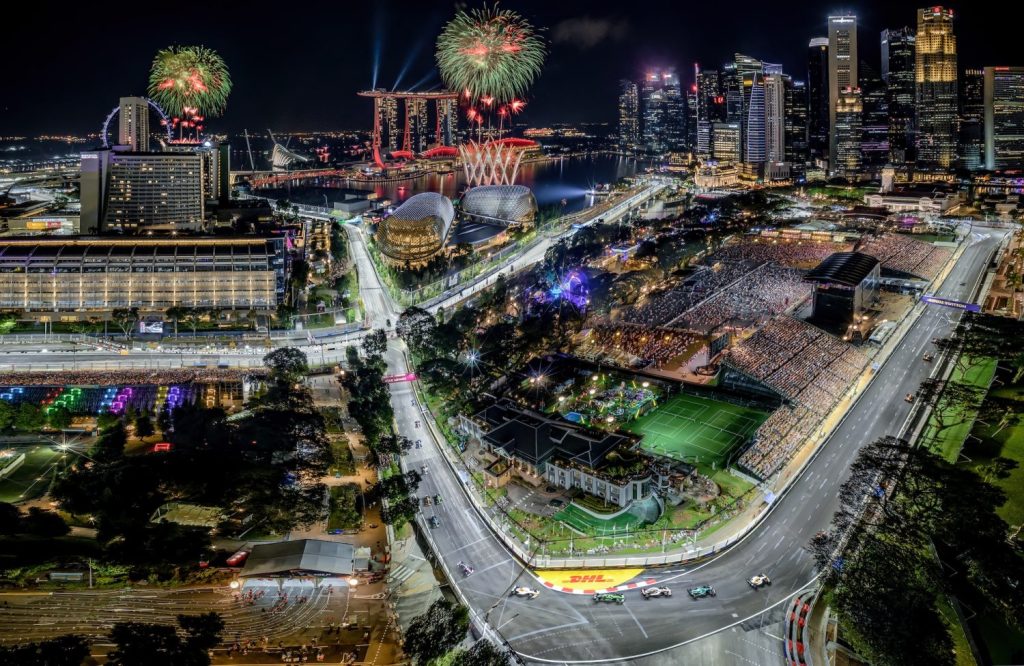
Marsh sees it as a model that would be repeated elsewhere. Hungary had already used a Grand Prix to help open itself to the world in 1986; Malaysia became the first Asian country to pursue a comparable strategy, with the Gulf races that followed taking the idea further. Nine years after Sepang opened, Singapore offered a very different vision of Formula 1’s future. With land at a premium, the city-state took another route: the Grand Prix would take place on the streets of Marina Bay and, for the first time in Formula 1 history, at night. The timing allowed the race to reach European television audiences while turning Singapore’s illuminated skyline into an instantly recognisable backdrop.
Just as importantly, the ambition extended beyond the circuit from the outset. The race launched alongside Grand Prix Season Singapore, with concerts, hospitality, dining, retail and entertainment helping turn the Grand Prix into a lifestyle event and a citywide festival. “Races had staged concerts before,” says Marsh. “Singapore was first conceived the other way round, with the Grand Prix as one strand of a larger production.” The government, he says, also recognised the wider benefits: appeal to tourists, credibility with international corporations and a place on the world stage.
If Sepang had used Formula 1 partly as a demonstration of what Malaysia could build, Singapore made the city itself part of the spectacle. In the years that followed, however, the fortunes of the two races began to diverge. As costs rose and attendances fell at Sepang, the Malaysian Grand Prix was dropped after the 2017 race. The timing, in hindsight, was remarkable. Liberty Media completed its takeover of Formula 1 in January 2017, with Malaysia’s exit announced that April. Two years later, ‘Drive to Survive’ arrived on Netflix. The sport began attracting a larger, younger and more diverse audience, while its appeal increasingly stretched beyond what happened on Sunday afternoon. “Formula 1 stopped being motorsport and became entertainment,” says Marsh.
Singapore had already demonstrated the potential of that broader proposition. The race has become the centrepiece of a 10-day festival stretching beyond Marina Bay, with this year’s programme featuring performances from The Killers, Janet Jackson, Lana Del Rey and many more, alongside motorsport-themed exhibitions, takeovers, pop-ups and interactive zones across the city. The numbers suggest the approach has paid off. According to the Singapore Tourism Board, the race has attracted more than 720,000 international visitors since its 2008 debut and generated more than S$2.2 billion in incremental tourism receipts. Lilian Chee, Director, Sports at the Singapore Tourism Board, says the aim has been to create “a distinctive race experience” that extends across the city during race week.
Yet the contrast between Sepang and Singapore extends beyond economics, tourism and entertainment. It can also be felt on the asphalt. Sepang remains particularly well regarded as a pure racing circuit, combining long straights and overtaking opportunities with flowing corners and significant technical challenges. “The two circuits illustrate one of the real strengths of Formula 1: 24 races, each with its own flavour. Sepang and Marina Bay sit at opposite ends of that range,” says Marsh, who has driven both. “Sepang boasts unusually long straights with a single hairpin dividing them—a layout built to produce overtaking. Drivers rate it because the corners are genuinely good and stringing a perfect lap together is difficult, which makes it satisfying when it comes right. That reputation transfers to the fans.”
Marina Bay presents an altogether different challenge. The walls are close, the speeds lower and the margin for error minimal, while the heat and humidity turn an already long race into an intense physical test. “Rather than tortuous and slow, as street tracks often are, Marina Bay flows and has moments of high speed,” says Marsh. “The pace is still low enough that the race regularly runs close to the two-hour limit, and sustaining that in heat and humidity with no room for error anywhere demands absolute concentration. Fluid loss costs drivers three to four kilograms over the race.”
For Sepang International Circuit CEO Azhan Shafriman Hanif, the unexpected return of Formula 1 is a chance to put the circuit back on the sport’s biggest stage. “I’m really looking forward to seeing Formula 1 back here in Malaysia,” he says. “We have always been in the top three circuits that people want to see back on the calendar.” The return is expected to be a one-off. But perhaps the most revealing aspect of Sepang’s comeback is not what happens on the circuit at all. It is what is happening 300 kilometres down the road. There was a time when holding the Malaysian and Singapore Grands Prix on consecutive weekends was regarded as commercially undesirable. The assumption was straightforward: two events so close together would be competing for the same spectators.
“In the past we said that Singapore and Malaysia shouldn’t be back-to-back because it would cannibalise the market,” says Hanif. “But that was then. Now the demand for Formula 1 is really impressive.” Singapore had already sold out its tickets before the Bahrain Grand Prix’s move to Sepang was confirmed. When Sepang put its own tickets on sale, Hanif says demand surprised him. The circuit is expecting around 100,000 spectators and is heading towards a sellout of its own. It is a striking measure of how much has changed.
When Sepang opened in 1999, it represented a new frontier for Formula 1, embodying Malaysia’s economic ambitions and helping establish a blueprint for the sport’s expansion into new markets. Less than a decade later, Singapore proposed something different: a Grand Prix in which the city, spectacle and culture surrounding the race became almost as important as the racing itself. For years, their fortunes appeared to suggest that one vision belonged to Formula 1’s past and the other to its future. This October complicates that story.
Through an unlikely twist of the calendar, Sepang and Singapore will suddenly sit side by side again. Two neighbouring races, conceived in different eras and built around very different ideas, will take place on consecutive weekends—and both appear capable of filling their grandstands. Perhaps that is the most revealing thing about Formula 1’s evolution in Asia. The sport has not simply moved from one model to another. It has grown large enough to accommodate both.