
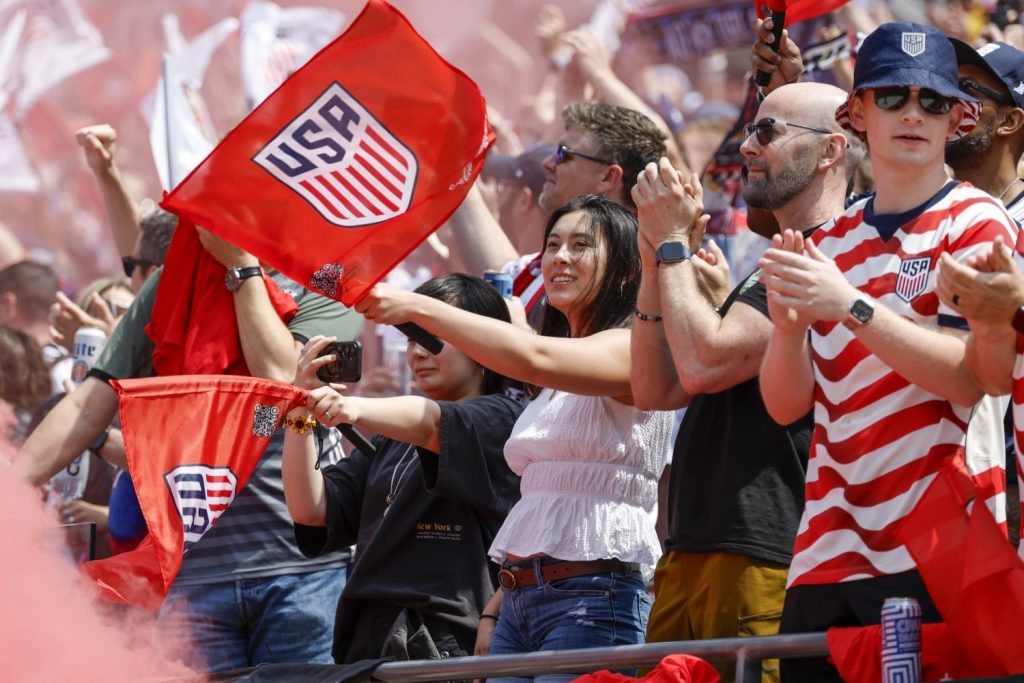
The experiment appears to have worked. Thanks to a home World Cup and the growth of MLS, American soccer fans have, at least in absolute numbers, overtaken hockey fans. MLS, then, appears to have become the third major league in American professional sports, taking the place of the NHL. That’s the picture painted by Bloomberg, which takes several factors into account. According to a Morning Consult poll conducted for the publication in September, 46% of Americans now consider themselves soccer fans. That is ten percentage points higher than a similar survey carried out in May, before the World Cup began. The increase has allowed soccer to overtake ice hockey and the NHL in overall popularity and draw closer to college basketball. The shift is particularly evident among younger generations. Among Gen Z, the share of people who consider themselves fans, even occasional ones, has risen by 16 points. Today, 61% of people in that age group say they follow soccer. Only the NBA, at 67%, and the NFL, at 73%, are ahead. It is perhaps the clearest indication yet of how far the game has come in the United States.
American soccer began laying its foundations around the 1994 World Cup, hosted in the United States. Two years later, Major League Soccer got underway, having been established before the tournament with just ten teams. Thirty years later, the number of clubs has tripled, and the return of the World Cup has given the sport fresh momentum. MLS says that both overall attendance and ticket sales have increased since the World Cup. The league and its clubs have gained ground on social media, too, adding almost six million followers since the end of the tournament.
The change is becoming visible in the stands as well. The effect is not limited to people watching matches. MLS youth programmes have also recorded an increase of around 40% in participation compared with last year. That is another indication of soccer’s changing place in American sport. A television audience can be swayed by the appeal of a major event, while the number of children taking up the game suggests something more lasting: the possibility that soccer could become part of the sporting lives of young Americans, after decades spent on the margins.
The World Cup also had a huge impact on television. The final drew more than 62 million viewers in the United States, setting another record for the tournament. But the surge was not uniform, and the generational divide has, if anything, widened. Gen Z showed the biggest increase, while soccer continues to encounter much more resistance among Baby Boomers. More than half of the Baby Boomers surveyed said they had not followed the World Cup in any way: no matches on television, no highlights, not even articles or news about the tournament. Around a quarter said the World Cup had actually reduced their interest in soccer. The difference is difficult to ignore.
That, too, is part of the picture of American soccer in 2026. Soccer has not won everyone over in the same way, nor has it erased overnight the distance that still separates it from the sports most deeply rooted in the country. But the numbers suggest that its base has expanded, particularly among younger people, and that is perhaps where the change is most visible. The result is that soccer has overtaken the NHL in the number of Americans who define themselves as fans. That does not mean it has suddenly become the dominant sport in the United States: football, basketball and baseball remain far more deeply established reference points. But the hierarchy, particularly among younger generations, is changing, even if the shift is not always immediately apparent. American soccer can look at the post-World Cup numbers and see growth across different age groups, new viewers coming to MLS, more children taking up the sport and, above all, soccer moving ahead of one of the country’s traditional sports. The picture is still uneven, but soccer is no longer a marginal presence. The World Cup did not turn America into a soccer country overnight. But it showed just how large the audience for the game already was.