
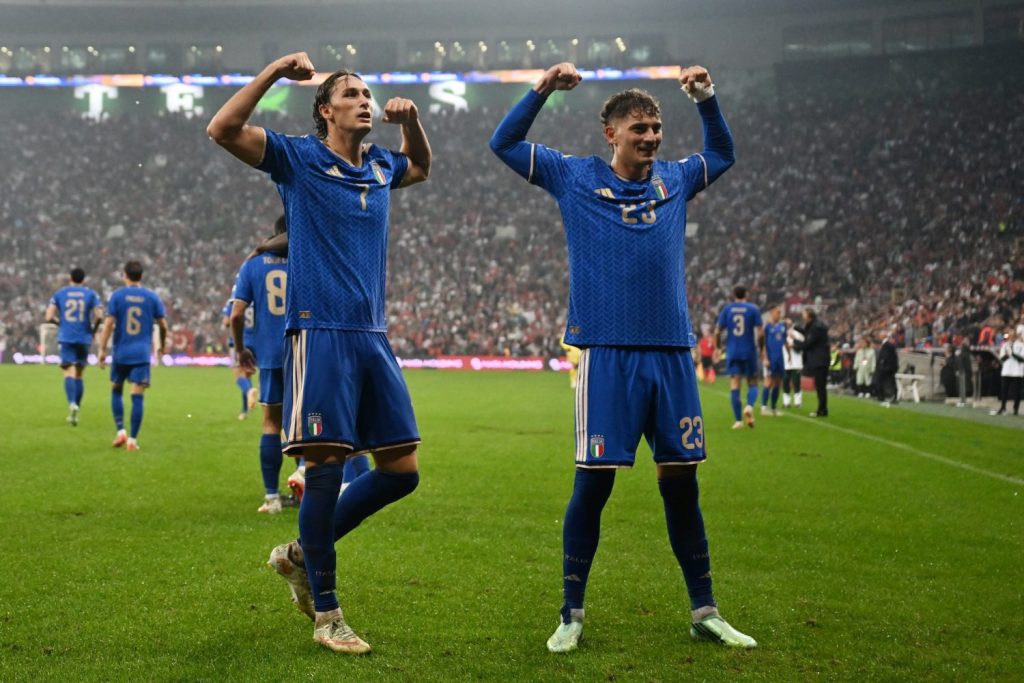
“Everyone played a great game.” Roberto Mancini said it after the 4-1 win over Turkey, but there was more to the remark than the obvious satisfaction of a victory. There was the sense that, this time, almost every decision he made had paid off. After a game against Belgium in which everything seemed to go wrong, Bursa offered something entirely different: eight changes, young players given their chance, others brought back in, and a team capable of putting the game to bed before half-time.
Inevitably, the Esposito brothers were at the heart of it. Mancini had the courage to start them together: two brothers had not appeared together for Italy for 26 years, since the Inzaghi brothers, and to find two brothers in an Italy starting XI you have to go all the way back to the Ceveninis in 1915. The response was immediate. Pio scored the fourth, the goal that pushed Turkey back just as they were finding their way into the game, but more importantly he helped create the third, sliding the ball through to Kayode for a finish that needed only a touch. Sebastiano, making his senior Italy debut, gave the attack depth, movement and a presence that made the front three, completed by Raspadori, harder to read.
The attacking set-up was one of the evening’s bigger gambles, and Mancini got it right. Not simply because Pio scored and Sebastiano impressed, but because putting the brothers together gave Italy an attack that looked different from the one against Belgium: more mobile, more direct, less predictable. It also vindicated Mancini’s decision to use these matches to work out which young players might become part of the next Italy cycle.
The same was true of Michael Kayode. On the eve of the game against Turkey, Mancini had spoken about the energy a young player can bring to the national team, and then put him straight in at right-back. The Brentford defender repaid that faith in the best possible way: a starting berth on his debut and Italy’s third goal of the night, finishing off a move that was simple but carried real momentum. The goal was only part of the performance. There was also the personality he showed in a team that, after Belgium, needed above all to find its legs again, along with its courage and aggression.
Then there were the players Mancini chose to bring back in. Frattesi returned to the starting line-up and scored the second, arriving in the right place after another Kayode effort. Bastoni came back into the centre of defence and opened the scoring in the ninth minute, pouncing after the Turkish defence made a mess of a corner. Those first two goals also reflected a clear decision: to bring experienced, high-quality players back into the side without putting the renewal process on hold. Bastoni and Frattesi were not simply two new faces compared with Belgium. They were two players Mancini needed to see respond, and they did so on the pitch.
The eight changes from the Belgium line-up made the gamble even clearer. Mancini rebuilt the defence, with Kayode and Ruggeri on the flanks and Bastoni and Scalvini in the middle, while Frattesi and Fagioli came into midfield. Up front came the most eye-catching choice: Pio and Sebastiano Esposito together, with Raspadori completing the front three. Only Donnarumma, Tonali and Pio Esposito kept their places. There was another detail that said plenty about the way Mancini was managing the squad: ten players remained at Coverciano. Not as punishment, and not because of an emergency, but because the coach wanted to use this game to see more of the younger players. He had explained as much before the match, speaking also about Barella’s absence. Some players, Mancini said, were already known quantities; others needed to be seen in real matches.
Now he can do that with a win behind him and a larger group of players seen in competitive action. Perhaps that is the most important thing to come out of Bursa. The senior players left at home were not simply reserves left out of the trip, but another part of the squad, with further quality and experience that could already prove useful on Friday in Paris. After Turkey, Mancini can look towards France with more options: on one side, the players who have just answered the call; on the other, those who were not used and can arrive fresher for Saint-Denis.
The 4-1 in Bursa does not erase the poor performance against Belgium, nor does it settle all the questions around a national team still taking shape in a single night. What it gives Mancini is something more useful: choice. He has seen that Sebastiano Esposito can handle this level, that Kayode can make his mark in an international match, that Pio can make the difference, and that Frattesi and Bastoni can be important to Italy. Above all, the stumble on opening night has not become a hole in the table. France is next, and Italy go there with three points, a few more answers and ten fresh players back at Coverciano. Against Belgium, almost everything had seemed wrong. In Turkey, for one night, almost everything fell into place. Exactly what Mancini needed.