
Italy’s problem against Belgium was not simply the result, nor can it be reduced to the quality of a few individual players. Van Bommel’s side were superior physically and tactically, in the spacing between the lines, in their organisation and in the clarity of their ideas. They played a recognisable game, with clear principles and a team that moved together. Italy, by contrast, often looked like a collection of players searching for individual solutions. The 0-2 at the Olimpico, with goals from Godts and Lukebakio, was the clearest expression of a deeper difference.
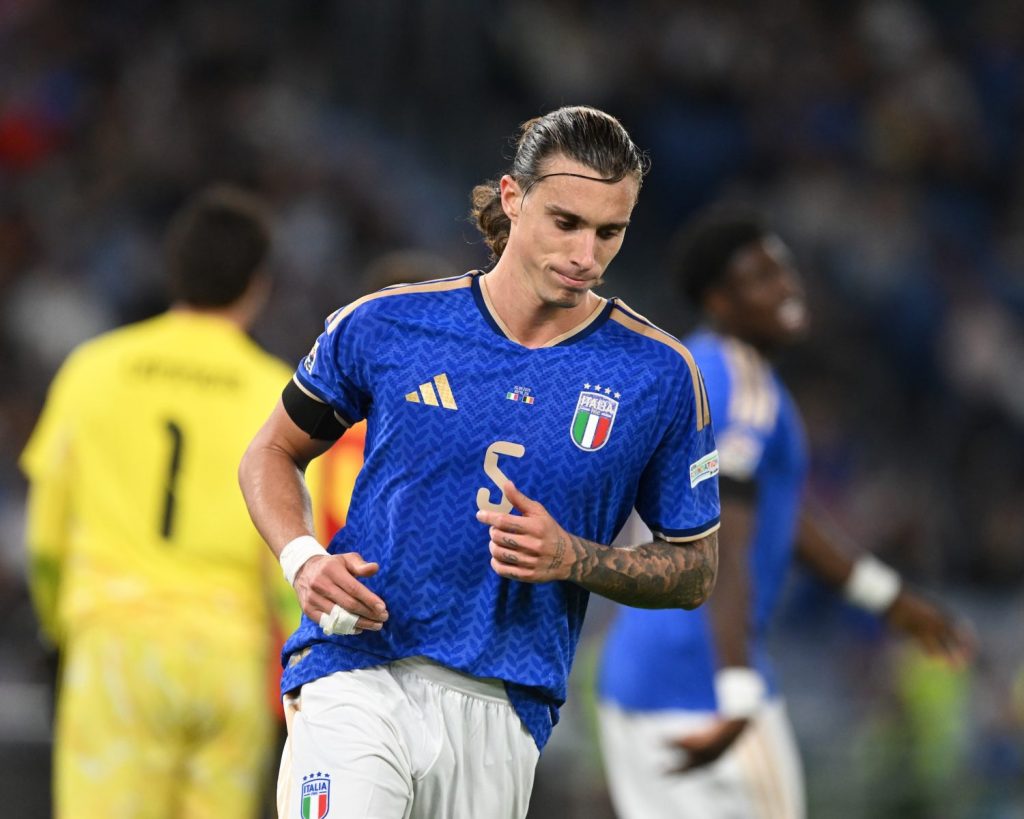
The first crack came at the back, where the Mancini-Coppola pairing did not work. Not so much because of technical errors, but because of the way the two centre-backs had to defend throughout the game: too far from their opponents, repeatedly forced to chase, unable to close the space with any consistency. For the first goal, Godts received De Bruyne’s pass inside the area and had time to take on both of them; one feint took Coppola and Mancini out of the play before the finish beat Donnarumma. It is a small detail that says a great deal. The Belgian winger was not simply given the chance to produce the individual action; he was given the space and time to do it. The two centre-backs were there, but always arrived late. They did not step out to the receiver, did not close the gap early enough, did not manage to steer the opponent towards a less dangerous area.
The same problem resurfaced in the second half for Lukebakio’s second goal. The Belgian forward received the ball from De Ketelaere, carried it towards the edge of the area and struck left-footed towards the far post. Once again, Italy could not disrupt the move: Lukebakio had time to think, set himself and finish almost undisturbed. It was another example of the defensive approach, particularly given what might have been expected from Mancini. His club sides this season have shown a much greater appetite for individual aggression. Inter, Roma and Como, each with their own characteristics, have used man-to-man defending as a way of compressing the pitch and making it difficult for opponents to receive comfortably. Against Belgium, that aggression was largely absent. The defenders too often waited, dropping off instead of stepping out decisively to the man.
Italy struggled just as much in possession. The starting 4-3-3 had Barella, Romano and Tonali in midfield, with Cambiaghi, Pio Esposito and Kean ahead of them. On paper, it could have provided width and depth, but on the pitch it produced a team that was too stretched and offered too few connections. Cambiaghi and Kean stayed too wide, leaving Pio Esposito often isolated through the middle, while Barella and Tonali tried to support him from positions that were too deep. By the time the two midfielders reached the final third, Belgium had already had time to restore its shape. The result was predictable: there were too few coordinated movements capable of creating an overload around the striker.
Above all, the rotations were missing, the kind now seen with increasing frequency among the leading teams in the league: the full-back pushing forward, the winger moving inside, the midfielder occupying the space left open. These movements do not simply create passing lanes; they shift several opponents at once and, in doing so, open spaces elsewhere. Against Belgium, Italy’s players too often remained in their own lanes and in their starting positions, leaving Esposito with few balls he could really work with and even fewer in favourable conditions. The chances were there nonetheless: the striker hit the post early on, albeit from an offside position, and in the second half had a close-range effort saved by Lammens. Kean also had opportunities to bring Italy back into the game, but they felt like isolated initiatives rather than the product of a functioning attacking structure.
Perhaps that is where the work starts, because the Italy we saw against Belgium did not reflect what Serie A is currently producing: teams with distinct ideas, varied roles and greater freedom in how they occupy the pitch. Serie A is producing sides capable of alternating man-to-man defending with positional play, creating rotations, occupying space with greater flexibility and defending on the front foot. The national team, at least in this first outing, looked more static, more disconnected and less synchronised. Belgium were superior for that reason too: not simply because they had more quality, or because Godts and Lukebakio produced two excellent individual actions, but because for 90 minutes they functioned as a team. Italy, by contrast, looked more like a collection of individuals, and at this level the gap between the two can become enormous.