
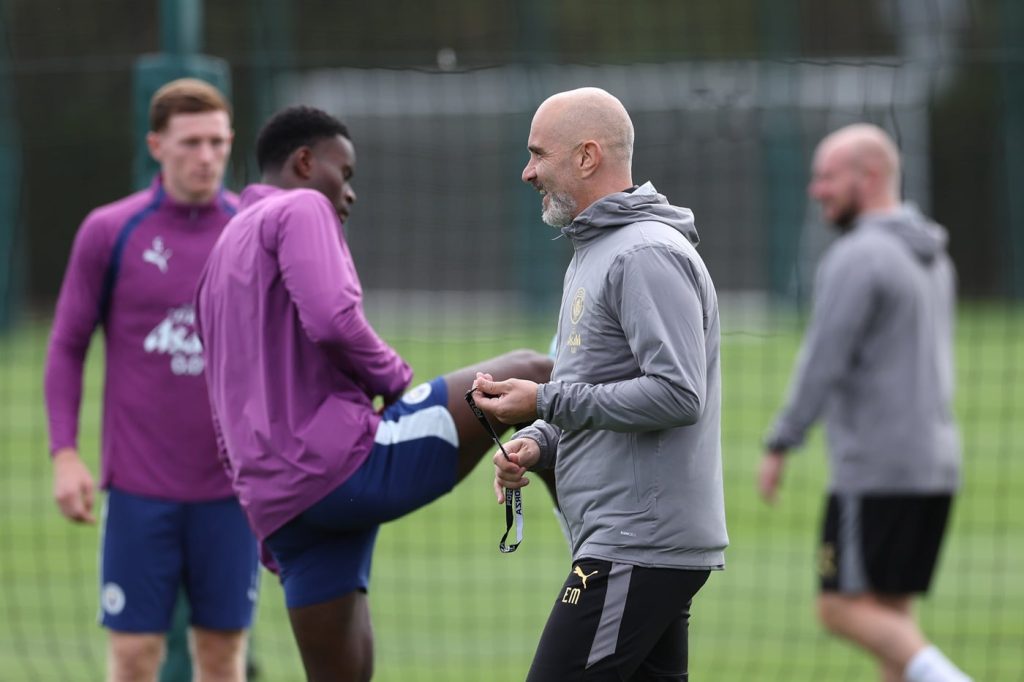
You know the story by now: for Premier League managers, increasingly young and innovative, the calm and wellbeing of their players have become fundamental, to the point that they are willing to overhaul training routines to achieve them. Enzo Maresca, who inherited Guardiola’s considerable legacy at Manchester City, is no exception. The former Chelsea manager has brought music into training sessions. As The Athletic revealed, dance music now plays daily through the huge speakers positioned around the pitch while Manchester City’s players go through their warm-up. Electronic tracks are played through the club-branded speakers when the squad takes to the field, while when Maresca wants to get more complex tactical messages across, the music is turned down or switched off altogether.
“It’s something I was already doing at Leicester and Chelsea, and I’ve introduced it here too,” the Italian explained on the eve of the Champions League match against Porto, which City went on to win 2-0. “There are days when the players are happier with music and can work better. They choose the songs themselves. It’s simply about creating a more enjoyable environment for them.” Matheus Nunes was an enthusiastic supporter of the idea. “All the players want to be DJs,” he said on the eve of the Porto game. “I like it. Why not?”
Maresca is not the first Premier League manager to try something similar. Last season, while in charge of Burnley, Scott Parker also used music during warm-ups and the ball-work phases of training, switching it off, like his Italian counterpart, when it was time for tactical drills. It is not only about creating the right atmosphere, either. There is scientific evidence to suggest that music can have a positive effect on performance.
In 2013, researchers at the Institute of Sports Sciences at the University of Hanover in Germany carried out a study, supported by audio equipment specialist Sennheiser, which found that footballers could improve their performance by listening to music at a predetermined tempo through headphones. The researchers formed two five-a-side teams, who played ten-minute matches against each other. In one of the three games, one team wore wireless headphones playing fast-paced electronic music at 140 beats per minute. The players on the other team also wore headphones, but each listened to different tracks at different tempos. In the third match, the conditions were reversed: one team listened to synchronised tracks, while the other received asynchronous music, with different tempos and speeds.
Professional coaches were brought in to assess the performances of the two teams, using recognised criteria: the frequency and accuracy of passing and the ability to successfully complete moves in play. The result was clear: the team listening to synchronised music played “significantly better”. Other managers, including Arsenal boss Mikel Arteta, have used music in a different way. The Spaniard once prepared his players for the trip to Anfield by playing them “You’ll Never Walk Alone”, the song that accompanies Liverpool’s entrance onto the pitch before matches, so they could become familiar with the atmosphere that awaited them.
Maresca, of course, was already known during his time at West Bromwich Albion for singing Italian pop songs in the dressing-room shower. Those moments were part of what made him popular with his teammates off the pitch, just as his qualities on it made an impression. Now, as a manager, Maresca is drawing on that same love of music to forge connections and shape his new Manchester City, in the small details as much as anywhere else.