
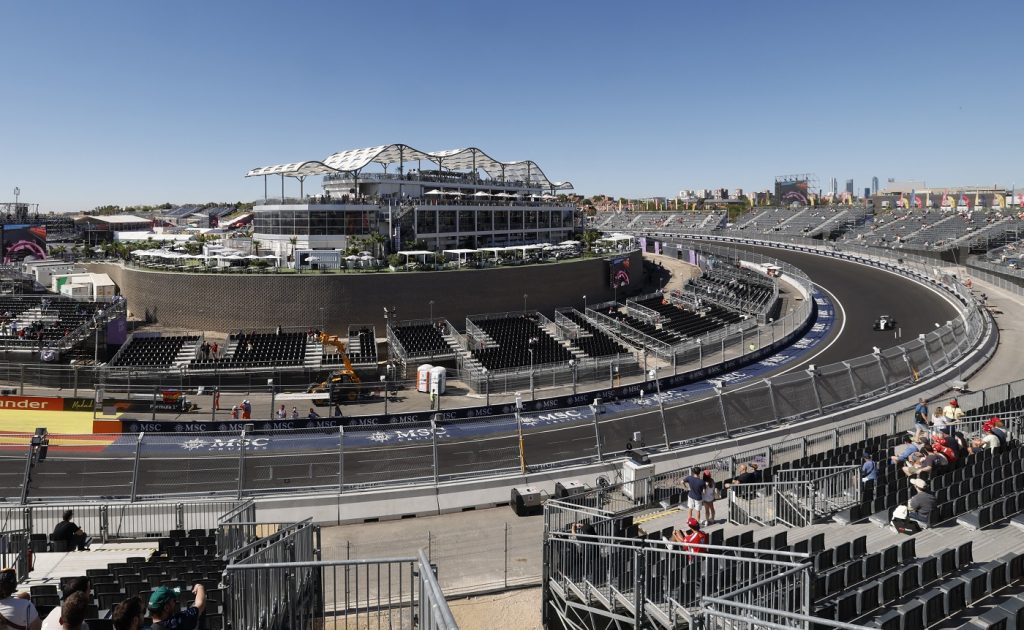
The Madring impressed the drivers in practice and qualifying, much less so in the race. The problem was the one feared before the weekend: overtaking is almost impossible. The first Formula One race on Madrid’s new circuit, won by Kimi Antonelli, left the feeling that the track, as it stands, needs a few adjustments to turn a spectacular circuit to drive into one capable of producing a spectacular race too. The Grand Prix was defined by the difficulty of getting past the car ahead. After the opening lap, there were very few chances to overtake, to the point that the final tally could be the lowest of the season, even below Monaco, where ten overtakes were completed in the race. In Madrid, Liam Lawson on Franco Colapinto and George Russell on Lawson were among the few examples of duels that genuinely worked. The problem was not only tyre management, but the layout itself, which leaves no real place for one car to get alongside another.
And yet this is the Madring’s paradox: the track is good. The drivers like it. It is demanding and fast, full of walls and blind corners, with the spectacular banking of La Monumental. In qualifying, when the only task is to find the limit, the circuit was a thrill. In the race, the same layout turned into a cage. Kimi Antonelli put it plainly: in many places, attempting an overtake means risking contact. “It’s nice over one lap, but in the race you’re simply stuck behind,” he said.
The biggest problem is the chicane between Turns 5 and 6. It was meant to be the main opportunity to attack after the first sector and the long approach, but the braking zone and the shape of the kerbs make it difficult for two cars to enter side by side. Defending is relatively easy; attacking is another matter. The choice was also dictated by safety, given the tunnel at the exit and the limited run-off, but it has ended up hurting the racing.
The criticism came quickly. Bortoleto admitted that he had almost fallen asleep during the race, while Albon pointed out that it had already been clear from the junior categories that the problem lay in the shape of the circuit. Even Max Verstappen, before the Grand Prix, said he could not identify a single genuine overtaking opportunity simply by looking at the map. For the drivers, then, there is no need to reinvent the Madring. A few places need changing. Madrid is already looking at them. For 2027, modifications are being considered in three specific areas. The first is the 5-6 chicane, which should be widened and have its approach redesigned so that two cars can take it side by side. The second is Turn 13, immediately after La Monumental. At present it is a medium-speed corner that does not demand enough braking to create an attack after the banked section. The idea is to tighten it and turn it into a proper overtaking opportunity. The third is Turn 20, one of the narrowest points on the circuit. Widening the track and changing the alignment of the barriers should give drivers room to attempt a move without the risk of not being able to complete the corner.
The changes could go further, though. Norris singled out Turns 18 and 19, which he considers essentially pointless. His idea is to remove them, creating a longer straight before a much wider hairpin. That would produce a proper braking point, more like those found on some of the better street circuits. Albon has also identified the section between Turns 3 and 5 as a possible area for redesign, while another idea is to shorten the pit lane to encourage strategies with more stops.
The good news for Madrid is that a revolution may not be necessary. Leclerc believes that one or two targeted changes could transform the quality of the racing. Baku and Macau suggest much the same thing: you do not need ten overtaking zones. One is enough, if it is in the right place, with a long straight and a braking zone wide enough for two cars to run alongside each other. The Madring, then, has not been written off. The track has personality, difficulty and a clear identity, but the first race showed that being good to drive and being good to race on are not necessarily the same thing. Madrid knew this before the debut, but chose not to alter the project rather than put the homologation and construction timetable at risk. Now the first Grand Prix has provided the missing evidence. For 2027, the Madring will change. It may not take much.