
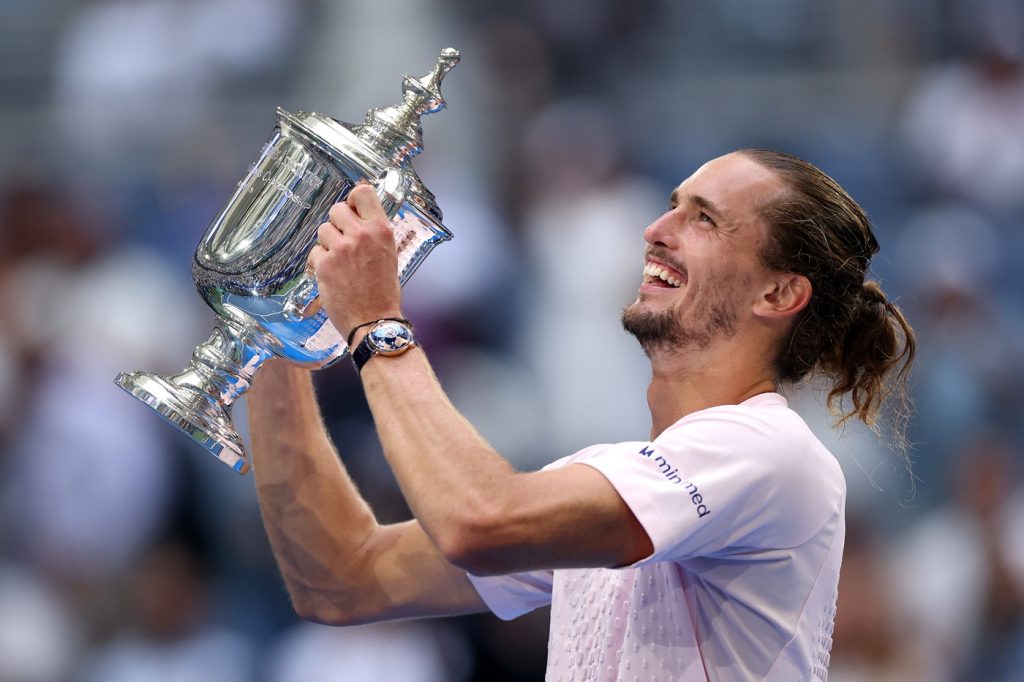
For a few seconds, Alexander Zverev did not even realise he had won the US Open. He had closed out the match with his serve, but instead of letting the racket go, raising his arms or immediately looking towards his box, he remained almost waiting for the next point, as if the match were supposed to continue. Then he looked towards his box, caught the eyes of his coaches and only then understood: it really was over. The German had been so deep inside the match that he had not realised the last point he won was also the point that won him the title. It is an image worth more than a thousand celebrations because it captures the nature of his victory perfectly. Zverev is the new US Open champion after beating Ben Shelton 6-3, 7-6, 5-7, 6-2 in three hours and 33 minutes. He has won the second Grand Slam of his career, following the French Open title he claimed only a few months ago. More than that, he has finally closed the circle that New York left open six years ago, when he broke down in tears on Arthur Ashe after losing a final that had seemed to be his against Dominic Thiem.
The 2020 defeat had been one of the most painful of his career: Zverev had won the first two sets, moved to within two points of the title and then watched the Austrian come back, becoming the first player since 1949 to lose a Grand Slam final after leading by two sets. Six years later he returned to the same court, but this time the story was different. And he finished the job. He did so because, against Shelton, he played at an exceptional level for long stretches. The first set was almost an exercise in control: Zverev took advantage of the American’s tension, playing his first Grand Slam final in front of his home crowd, and built his lead without offering a single break point. In the second he continued to dictate with his serve and his solidity from the baseline, resisting Shelton’s attempts to stay in touch before playing an almost perfect tiebreak, which he won 7-2. At that point, there seemed to be only one way the match could go.
The lapse came in the third set. And perhaps that is what makes the final victory all the more important. Zverev faced the first break point of the match at 3-3, after three consecutive errors had suddenly brought Arthur Ashe to life. He saved it, but Shelton had started playing a different match: he looked more aggressive, more precise, more willing to take risks with his forehand and, above all, much more effective on serve. For the first time in the final, Zverev lost some of his authority with the forehand, gave the American more court to work with and, towards the end of the set, paid for that small dip. Shelton broke at 5-5 and reopened a match that had seemed almost decided. The third set was the best Shelton had played, as he cut down his errors and raised the quality of his tennis whenever Zverev stopped dictating the exchanges for a few minutes. The 5-7 was not the sign of a collapse, but the consequence of an opponent who had finally found a way into the match. And that was when the champion answered.
In the fourth set, Zverev left no room for a comeback. He immediately recovered his depth, rhythm and, above all, the solidity that had defined the first two sets, putting Shelton under pressure from the opening points. The American saved a first break point, but not the second, and Zverev turned the opening game into another decisive shift. His reaction was that of a player who is now completely different from the young man of 2020: no nerves, no rush, no fear of what had just happened. Shelton tried to stay with him, continued serving above 220 kilometres per hour and found some spectacular points, but Zverev regained control of the exchanges. He stretched the rallies, forced the American to hit one more ball and, above all, began dictating again with his backhand and serve. The second break, in the seventh game, finally took the tension out of the match. At that point, all that remained was to close it out.
And it is significant that, on the final point, Zverev was not thinking about the title: “I didn’t even know it was match point,” the German said afterwards, explaining his curious lack of celebration. It may be the clearest picture of the way he has changed: in 2020 he had been overwhelmed by the weight of the occasion; today he was so focused on the point itself that he did not even realise the final exchange had handed him the trophy. “Six years ago I was here and lost a final after being two sets up. It was a very difficult moment. Today the story is completely different,” the German recalled. Even before the final, he had explained that he felt like a different player from the one who had played that final: he had played many more important matches, and experience had taught him how to handle situations that at the time had seemed enormous.
The New York triumph is also confirmation that his French Open victory was no isolated episode. Zverev has won his second Grand Slam of the season, reached a third consecutive major final and, above all, finally turned consistency at the highest level into titles. In 2026 he reached the semi-finals of the Australian Open, won in Paris, reached the final at Wimbledon and has now conquered New York. In the US Open record books, he succeeds Carlos Alcaraz and becomes the second German of the Open Era to win at Flushing Meadows after Boris Becker, 37 years after the last German triumph. For American tennis, meanwhile, the wait goes on: Shelton could not end a drought stretching back to 2003, when Andy Roddick won the last Grand Slam claimed by an American man.
And then there is the ranking, which makes the victory even more significant. Zverev has cut Jannik Sinner’s lead to 1,810 points: the German moves to 9,690, while the Italian remains on 11,500. Sinner is still certain to keep the number one ranking until at least the end of the Shanghai Masters on October 18, but the picture has changed. Because Zverev is now free of a weight that had followed him for years. He has won the first Grand Slam, then the second, settled his unfinished business with New York and shown that he can win even when a match slips away from him for a set. Alcaraz and Sinner remain the reference points of world tennis, but behind them there is finally a player who no longer needs to ask himself whether he is ready to beat them when it matters. And perhaps that is the real closing of the circle: in 2020 Zverev lost because, for a few minutes, the title had become bigger than him. In 2026 he won precisely because, in the end, the title seemed almost beside the point; there was only the point to play. And when that point was over, for a few seconds, he did not even realise he had become US Open champion.