
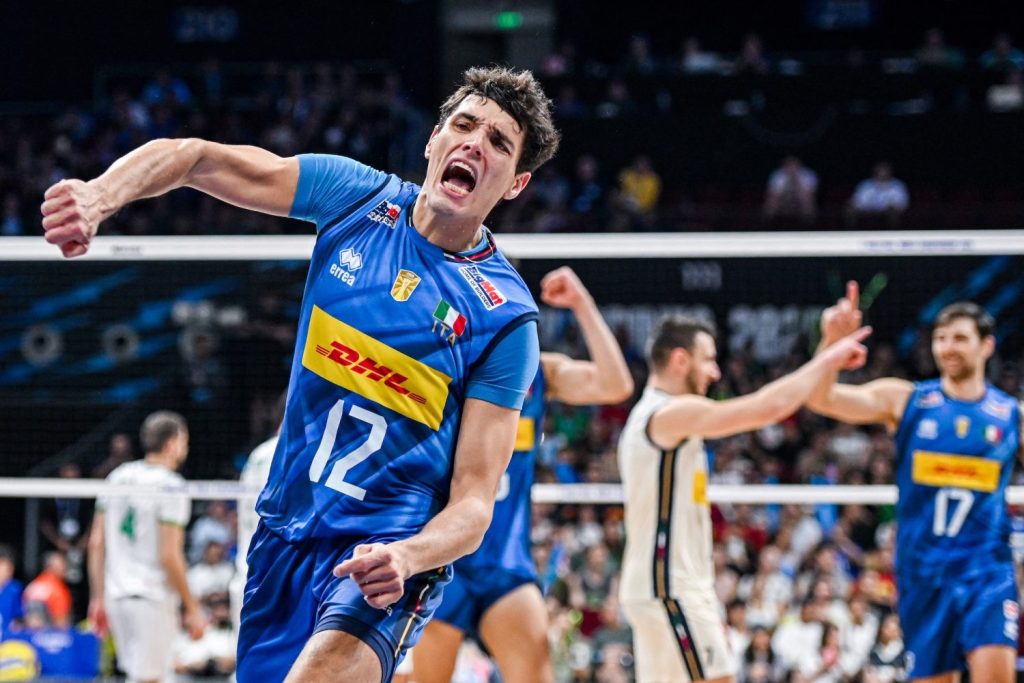
They are children of another god. Boys who live for football and get emotional when Zanetti is on the other end of the phone. Or Ibrahimovic. They have no idols in volleyball. Older brothers, at most. Because Italian volleyball, in the years they grew up, simply did not produce them. It produced excellent players, of course, but if you take away Zaytsev’s aces that carried Italy to the Olympic final in Rio in 2016, most of those players would not have gone down in history. You go down in history by winning. That’s how it works. So they took care of it themselves. Since 2021, when they won the European Championship as virtual unknowns, they have never stopped, and Italy’s men’s national team is now preparing to play a European Championship on home soil after winning two World Championships in a row. Yes, you read that right. Starting in Naples, the Azzurri will head north to Modena, then Turin and, they hope, Milan for the finals.
“I’m football-mad, I admit it. So you’ll never hear me speak badly about it. And I can say with absolute certainty that volleyball, besides giving me huge satisfaction as an athlete, has given me the chance to meet and spend time with Inter players, to be applauded by the whole of San Siro!” Those are the words of Alessandro Michieletto, the outside hitter who was named the world’s best player in 2025. Not exactly a nobody.
There is also someone who tried to make it in football. He didn’t, and turned to volleyball instead. Yuri Romanò, born in 1997 like Barella, is probably the emblem of this new generation. The boy who seemed to have been sent there by fate at the 2021 European Championship. The left-hander who came straight from Serie A2 and, in the final – a final they had been losing until moments before, no less – dragged Italy to gold when nobody, absolutely nobody, knew who he was. The one who won a World Championship and then became a regular starter for his club.
They are children of a generation with no idols, but no rivals inside the dressing room either. A generation that can tell you how they were gasping for air in the moment before winning two World Championships in a row. Boys who turn up at the microphones with a gold medal around their necks and, instead of swaggering, find their voices breaking. Extraordinary sporting talents whose eyes fill with emotion because an injured team-mate is sitting in the studio and: “Hey mate, I took your shirt onto the podium because it was as if you were there with us.” A generation of men loved, too, for that courtesy and decency that seem almost essential qualities for making the squad. Because someone chose those players, backed them, protected them, threw them into the deep end.
That someone is Ferdinando “Fefè” De Giorgi, who in 2021 changed the rules and the players. He left out the elephant in the room – the Zaytsev mentioned above – sensing that, even though he was still the strongest opposite hitter of them all, he risked becoming a player out of his time. And he was right, or rather, the results proved him right. Not only after winning the first World Championship in 2022, 24 years after the previous one, but also after the 2025 title, which came after the group’s dissatisfaction with certain rules that were no longer workable. Especially when you don’t win – Paris, for instance – and the frustration builds. Because everyone knows that, in men’s volleyball, the Olympic Games have always been an open wound. All the more so now that the women’s national team, by contrast, put Olympic gold around their necks at the first attempt.
But Fefè – in volleyball, just say Fefè: five World Championship gold medals, three as a player and two as a coach – deserves credit for always having a clear vision. When he was given the job by the federation in 2021, Blengini was still the head coach. A curious arrangement. Even for a man with his sense of humour. So while one was in Tokyo with Juantorena and Zaytsev, De Giorgi was shaping the Italy that would come next. “I already had the generational change in my head. It’s not as if I could decide based on how the Games went. In this project, Simone Giannelli had to be the leader, I had no doubts. I gave him space and responsibility straight away because I had always recognised extraordinary personal qualities in him.”
There is no doubt that, thanks to that faith, the Azzurri setter took his career to another level. Giannelli had been a phenomenon for years, but De Giorgi finally recognised him as a leader. “Fefè believed in my leadership and entrusted me with the team. For me, it’s an honour to be captain,” he says. But it isn’t only that. It’s almost as if, once certain veterans had left the picture, Giannelli found himself carrying less weight on his shoulders. “What I wanted was for everyone to be on the same level, everyone with the same rights, those who had just arrived in the national team and the more experienced players. I’m the first one who wants to do the same things as the youngest guy. That way of doing things brings us all together.” There it is, the key to success: individually outstanding, winners as a group.
Let’s go back to Yuri Romanò for a moment. Football-mad and crazy about Inter – the only life he would swap for his own is that of a Nerazzurri footballer – he draws a parallel that says something about why volleyball wins so much. “In football, everything is bigger and that’s the good fortune of so-called ‘minor’ sports. We don’t have all that pressure, which is only negative. We live our sport with more joy and serenity. Football needs a revolution. I couldn’t tell you what kind, but I know volleyball started winning by playing young players.” Because if what Giannelli says made the difference on court, there is something that came before it, and Romanò reminds us what that was.
And so the words of federation president Giuseppe Manfredi are needed to close the circle. Giannelli, Egonu, Michieletto – all right. But how did Italian volleyball manage to win an Olympic gold medal and a World Championship with the women, and two World Championships in a row with the men? “The rule that there must always be three Italians on court in the league is decisive. The federation works as a system with the leagues and the Serie A clubs, which give our young players the chance to play. We’re not just thinking about finding the next Simone Giannelli or the next Paola Egonu. They are phenomena; we want to prepare athletes for the highest level. Volleyball has an excellent recruitment system and is present at every youth competition, so a player arrives ready for the top division. The clubs, too, understand that having Italian players gives them more appeal with supporters and future athletes, because young people need to see Italian champions.”
The same champions who win two World Championships in a row and then still can’t quite believe it. “Getting compliments from Barella, Adani, Cassano, people I watch on TV, and knowing that they’re the ones who have watched me, still feels surreal,” Romanò says. They are children of another god. What can you do.