
Club Bruges’ 2026 summer window ended with €63 million in sales. €40 million came from Christos Tzolis, signed by Arsenal, while another €23 million came from Aleksandar Stankovic, bought back by Inter through the buy-back clause included in his transfer to the Belgian club. Bruges had paid a combined €16 million for the two players. So, once the accounting details are taken out of the equation, the club has made €40 million in profit in a very short space of time. This is the formula that allows Bruges to remain competitive at the highest level. For years, Club Bruges has identified talent from all over the world, developed it and then sold it on for major fees to Europe’s biggest clubs. A strategy we have seen before, you might think. But there is something different about the way Bruges goes about it: the club is not simply looking for young, talented players, but also for those who, as sporting director Maarten Debobbeleer told The Athletic, fit «the club’s eight football principles». Debobbeleer explained: «For me, it’s absolutely fine to look at transfers made by certain clubs and say: “Yes, we knew him, but we rejected him.” Not because we’re talking about a player who isn’t suited to playing in Belgium, but because he doesn’t completely fit the profile Club Bruges is looking for.»
The scouts in West Flanders, then, do not judge players only on their physical and technical qualities, but also on how well they fit the “Bruges system”. This approach has helped the club post some of the biggest sales in its history, including Ardon Jashari and Igor Thiago, sold to Milan and Brentford for €36 million and €33 million respectively, both in the summer of 2025. But what are these football principles? Essentially, they are tactical concepts that do not change with every new manager — in fact, the coaches themselves are identified and signed according to how closely they fit the same model of play — and they shape Bruges’ approach to the game. Three concern possession, three determine what happens without the ball, from pressing to dropping back and defending, while the other two are broader, concerning attitude, mentality and the transitions between one phase of play and another. The Club Bruges scouts, then, are not simply looking for good players with potential, as everyone does, but for players capable of carrying out the tasks demanded by these principles.
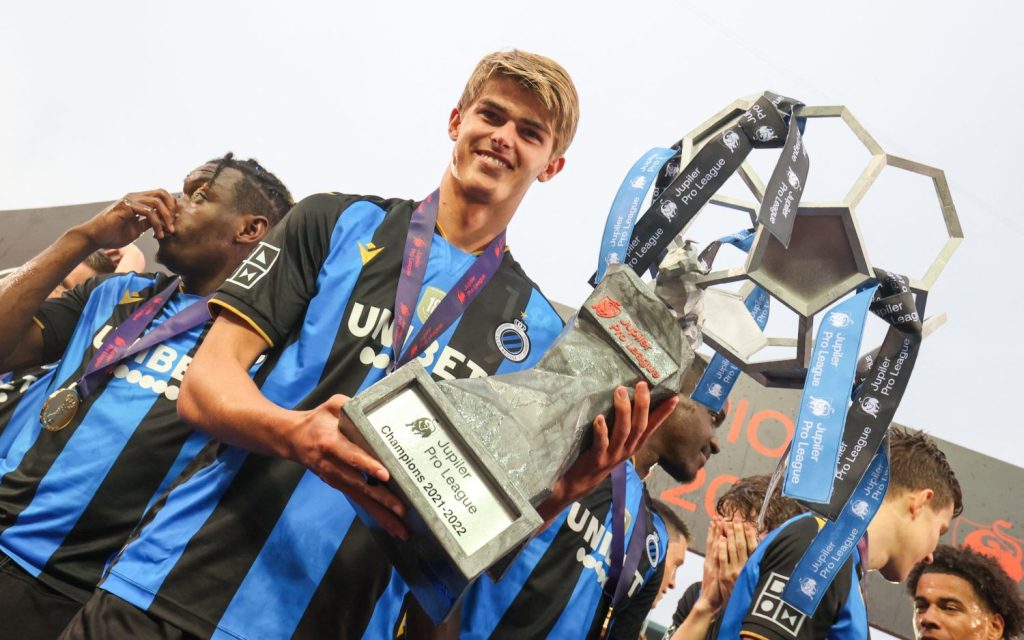
The same approach is used to develop the talent already in the club’s own academy. Bruges has one of the best youth systems around, Club NXT, while its Under-23 side plays in the second tier of Belgian football. This allows the best young players to start playing professional football, against professionals, from a very early age. In recent years, it is no coincidence that players such as Maxim De Cuyper, Senne Lammens, Lois Openda and Charles De Ketelaere have come through Bruges — or Brugge, in the Dutch spelling — before establishing themselves at clubs in other leagues, clubs with ambitions well beyond those of the Jupiler Pro League. This strategy, together with an ownership that thinks and acts for the long term, has made Bruges one of the clubs Europe’s biggest sides look to when they enter the transfer market. The numbers are revealing: between 2010 and 2018, only eleven players from the Belgian club were sold to teams in Europe’s five major leagues; from 2019 to 2026, the figure rose to 24, more than double. And there is no reason to expect the process to stop. «At the beginning of February,» Debobbeleer said, «right after the winter transfer window closes, we have a meeting where we look two transfer windows ahead. We basically decide who we would like to keep, who we will most likely have to part with and who we want to part with.» There has to be room for new talent. The cycle does not end.