
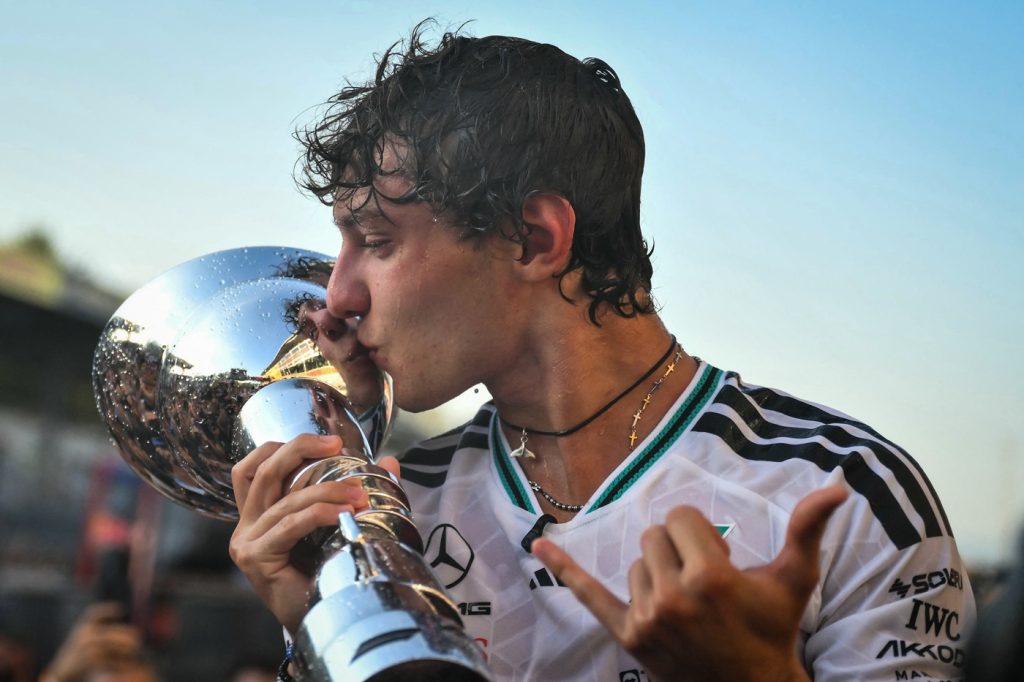
There comes a moment in the story of every great driver when he stops being simply a promise and becomes something harder to define: a certainty. For Kimi Antonelli, that moment may have arrived at Monza on September 6, 2026. Not because he claimed his first victory at his home circuit, nor because it was his seventh Formula One win, but because, for the first time, he took a race that seemed to be slipping away from him before it had even begun and turned it into the best Sunday imaginable. Starting 19th at Monza after changing his power unit meant effectively starting a different Grand Prix from everyone else. The penalty had been Mercedes’ strategic choice: better to take it at a circuit where the long straights make overtaking possible and where a fresh power unit can make the difference.
Nobody, though, could have known what was coming. Antonelli seemed to believe it was possible. In the days before the race, he never had the air of someone preparing simply to limit the damage. He spoke of a “full attack” race, explaining that starting from the back would allow him to work on the setup differently and focus entirely on Sunday. A top-five finish, he felt, was within reach. It was not something he said to feed the dream of the Italian crowd. It was simply how he saw the race. Then the race came, and that feeling became reality. Mercedes had the pace to send Kimi through the field at an extraordinary rate. The red flag caused by Charles Leclerc’s crash at the Parabolica complicated the race, but it also opened up new strategic possibilities. Antonelli took every opportunity, without wasting tyres or losing time, knowing when to attack and when to wait. He climbed into the podium fight, passed Lewis Hamilton and then went after Max Verstappen, and above all George Russell.
The final part of the race was a perfect picture of the driver Antonelli has become. Russell was ahead, Verstappen the last obstacle before the lead. Kimi had fresher tyres and more pace. He waited for the right moment, built the overtake and, with three laps to go, took first place, not with the urgency of a boy who had something to prove, but with the calm of someone who knew exactly what his car could do and how much he could ask of himself. From 19th to first, it was the biggest comeback in the history of the Italian Grand Prix. Antonelli erased Peter Gethin’s previous record, set in 1971 when the Englishman started 11th before going on to win. In the entire history of Formula One, only John Watson had won from further back, from 22nd at Long Beach in 1983.
Antonelli’s record therefore reaches well beyond Italy. And then there is Italy, which had been waiting for sixty years. The last Italian to win at Monza had been Ludovico Scarfiotti, in 1966. Sixty years later, the crowd at the Autodromo could finally shout the name of an Italian driver again. Antonelli also became the first Italian to stand on the Monza podium in 21 years, since Giancarlo Fisichella finished third with Renault in 2005. His victory was also the 50th by an Italian driver in Formula One history.
And the remarkable thing is that Kimi is only twenty. At 20 years and 12 days, he became the youngest winner in Monza’s history, beating the record set by Sebastian Vettel in 2008, when the German won with Toro Rosso at 21 years, two months and 11 days. The victory in Italy was also the seventh of his 2026 season, another record for an Italian driver: nobody had ever won so many races in a single season. The previous mark belonged to Alberto Ascari, with six victories in 1952. Antonelli had already matched him at Spa, so Monza gave him the record outright. There is another number that says plenty about the speed at which this boy is writing his story: seven victories in just 37 Grands Prix. George Russell, his team-mate, has seven in 165. It is not only a question of talent. There is a precocity here that is difficult to measure.
But Monza was not only about statistics. It was emotion, too. The tricolour helmet inspired by Valentino Rossi, prepared especially for the Italian weekend, seemed almost to anticipate the meaning of the day: Kimi was not simply racing his home Grand Prix, he was returning to an Italian sporting tradition that, in Formula One, had seemed broken for too long. The helmet was a tribute to Italy and to his idol, with the tricolour and Rossi’s design accompanying Antonelli through the weekend. And then there were the tears. Those on the podium perhaps said more than any record. Antonelli is already used to winning: this was his seventh victory of 2026, but he had never won at Monza and had never had an Italian crowd like this behind him, a wave of flags, Ferrari shirts, tricolours and applause that, in the end, swept over him too. Ferrari endured a bitter Sunday, with Leclerc retiring and Hamilton finishing sixth, but the Italian crowd had someone to applaud all the same.
For once, at Monza, the hearts of Ferrari fans could beat for a Mercedes too, for an Italian boy who has never stopped feeling Italian despite racing for a German team and now leading a championship that could give him a historic title. Perhaps that was the strangest thing about the whole afternoon. When Kimi crossed the finish line, he did not simply win a race. He ended a sixty-year wait, broke a record that had seemed to belong to another age, wrote Italy’s 50th Formula One victory and moved beyond Ascari in a statistic that had seemed untouchable. Above all, he showed that the calm he had displayed in the days before the race was not recklessness, but conviction. Perhaps Antonelli really did know he could do it. At Monza, he simply found a way to prove it.