
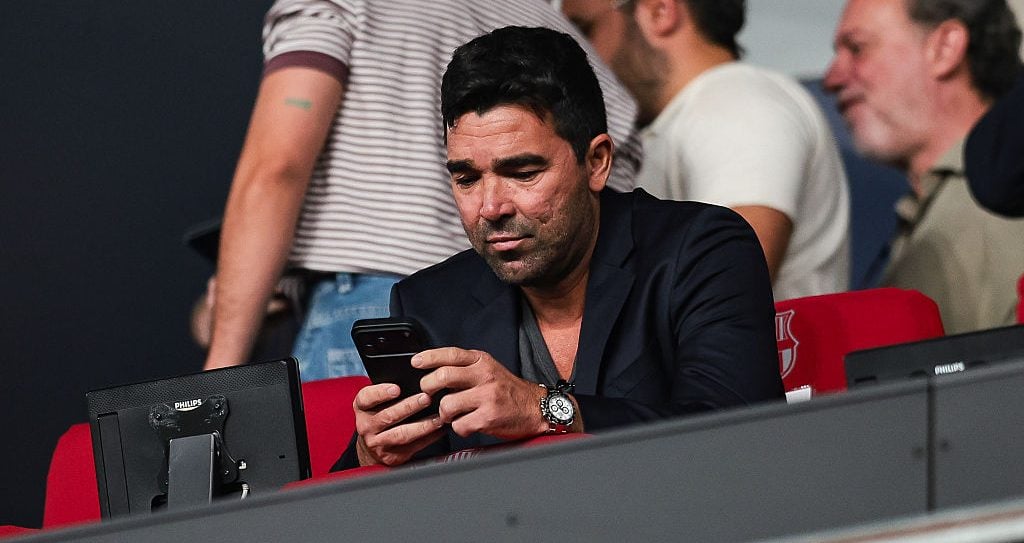
Don’t be fooled by appearances. Anderson Luís de Souza, better known as Deco, was an excellent midfielder and has only recently embarked on a career as a sporting director: for several years after retiring, he followed Jorge Mendes as an ‘apprentice’ agent, without ever losing touch with the clubs that had made him great in midfield. Barcelona above all. And so, in 2023, he somewhat surprisingly became the blaugrana’s sporting director. His previous experience in the role was limited, but his knowledge of the club and the trust of president Laporta led to the gamble at a moment of profound transition around Camp Nou. Deco did the rest: three seasons later, we are talking about a revitalised powerhouse that, under his direction, has returned to winning more than 40 games per season on average.
How did Deco do it? As AS tells it, by leaving every fashionable gimmick aside: no algorithms, no Big Data, no fiddling around on Football Manager. In that sense, the 49-year-old Portuguese is an old-school sporting director: an eye for a player, a feel for the moment, a readiness to buy and sell at the right time. He builds his team by watching the pitch, but even more so the dressing room — in his view, the real birthplace of every winning cycle. The challenge was formidable, with Barça still searching for a new technical and philosophical identity after the golden era of Leo Messi. Yet rather than stubbornly looking for a new No. 10 in the image of the previous one — spoiler: impossible — under Deco’s direction, Barcelona gradually became recognisable again.
Lamine Yamal’s generational talent certainly helped accelerate the process, but with Hansi Flick on the bench, regardless of individuals, the blaugrana are once again a team at the heart of Spanish and European football. A swashbuckling, fearless side with almost limitless attacking potential. And a group that enjoys working together: it is fun to watch because the players themselves are the first to enjoy what they are doing on the pitch. For Deco, that has always been a fundamental quality to build around. Always with very specific profiles: not necessarily the best players on the market — although the two often coincide — but the ones who fit the project best, with the human side always in mind. Whether they come from elsewhere or from La Masia. Koundé, Cubarsí, Szczesny, Gerard Martín, De Jong, Balde, Pedri, Gavi, Raphinha, Fermín, Bernal. And, naturally, Lamine. The core around which Deco has forged the new Barça is substantial and easy enough to name.
Now Rodri has been added, the undisputed heartbeat of Spain’s World Cup-winning side: again, not simply for his peerless qualities as the team’s barometer, but also for his quiet value in the dressing room and on the training ground every day. For Deco, that second quality mattered just as much as the first in bringing the former City player to Barcelona. The sporting director has also found himself at the centre of criticism at times, in a club as demanding as Barça: when Dani Olmo arrived, many did not consider him a €61 million player; today he is a fixture in the side — and often a problem for opposing teams. Raphinha, before the past two seasons, was a talent prone to inconsistency. Today he is a devastating attacking outlet, partly because Deco chose to make him one of the team’s technical leaders. So far, he has been proved right. Almost too often, for a former legend who had never tried his hand at the job before. And yet, if Barça are now looking towards the future, they owe it to one of the most old-school sporting directors in the game.