
In a few days, 21 teams from 12 countries will race across the roads of mainland China. Among them will be an Italian delegation, ready to test itself against the Asian teams in a late-summer microclimate suspended between the oppressive humidity of the metropolis and the threat of sudden downpours. Just over a month later, from 14 to 18 October, attention will move indoors, into the velodrome that will host the UCI Track World Championships.
The dates are revealing. Shanghai does not need a cycling race to make itself visible to the rest of the world: it already has the metallic verticality of Pudong, the historic architecture of the Bund, the neon lights and an economic weight that needs no introduction. The more interesting story begins when the metropolis stops looking like its own postcards and chooses to leave the traditional tourist routes behind. The city changes shape with astonishing speed. What remains of the old lilongs, the network of lanes and courtyards that defined communal life for a century, now survives alongside skyscrapers and glass towers; farther out, entire neighbourhoods seem to rise from nowhere within a single season. Shanghai is a city the collective imagination tends to see from above. The bicycle brings it down to street level, through motorway interchanges and those pockets of shadow where the metropolis seems to dissolve into an open construction site.
The Tour of Shanghai New City avoids the usual centres of gravity, heading instead to Jiading, Songjiang, Qingpu and Fengxian, before reaching Nanhui in the Pudong New Area. These are the new cities, urban centres designed to ease the pressure on the historic core. Bringing international cycling here means turning a race into a direct glimpse of Chinese urban planning over the next twenty years. Added to the UCI Asia Tour calendar in 2025 as a 2.2 event, the 2026 edition raises the quality of the field. The riders come from across the contemporary cycling landscape, from local outfits such as the Li Ning Star Continental Team to European and Italian teams, reflecting the way the sport’s centre of gravity is shifting towards the Asia-Pacific and tightening the links between Europe, Shanghai and the region’s major financial hubs, including Hong Kong.
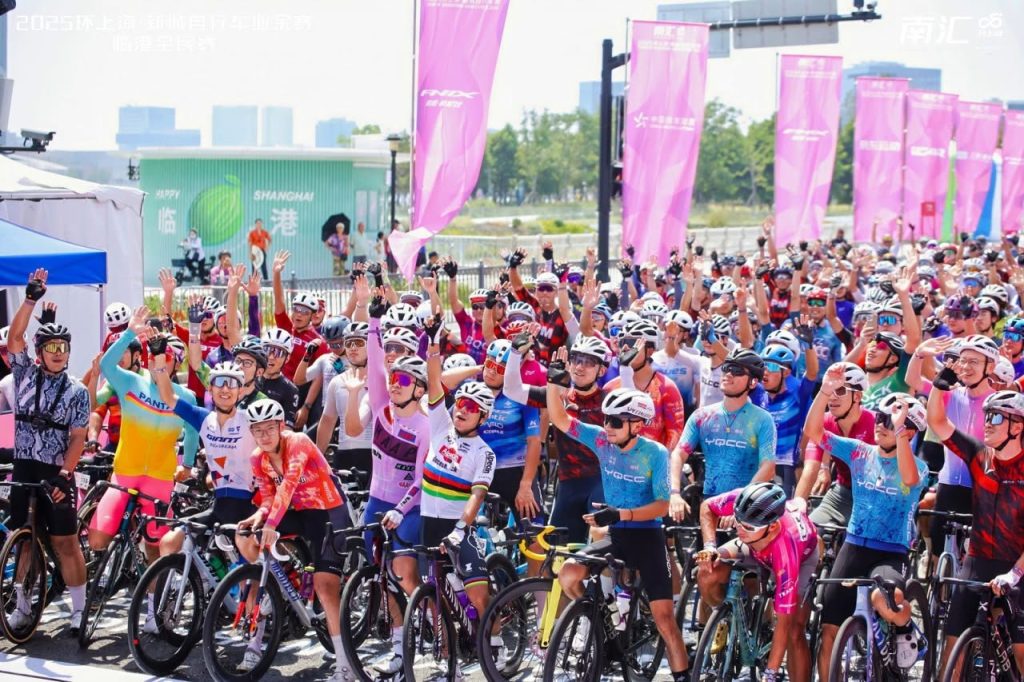
The most singular element of the race, however, lies in the way its different levels of competition overlap. On 6 September, immediately after the main race passes through, twenty elite amateur teams will set off on the same 100.2-kilometre course between Fengxian and Nanhui. For a few hours, the distance between those who race for a living and those who ride for the love of it disappears. The road stops being a passive backdrop seen through the barriers and becomes physical again: crosswinds, rough patches of asphalt and shared fatigue.
There is a digital side to the event too, by now an almost unavoidable part of sport in Asia. The 2026 edition has expanded the virtual qualifiers into two categories: Open and University (for university students). After the first challenges, contested from home on screens, the twenty best riders in each group will meet in live finals, still riding on rollers connected to monitors, on 4 September in Jiading and 5 September in Songjiang. The top four in each category, eight cyclists in all, will earn the right to form a real team and race on 6 September alongside the amateurs on the official courses.
Over the weekend of 5 and 6 September, around the artificial basin of Dishui Lake in the Lingang Special Area, the race will become a public meeting point, with commercial villages and activities open to visitors. China is moving beyond the idea of the bicycle as either a relic of its rural past or simply a means of transport; it is rethinking it as a contemporary culture capable of bringing together technology, urban planning and popular participation. Put together the still-wet asphalt of the new cities and the charged atmosphere of the velodrome, and the result is a very contemporary passion for speed. These are not simply two dates on the annual sporting calendar, but a visual, noisy account of where sport is going. For those who love cycling, Asia has become the place where the sport’s next chapter is already taking shape.