
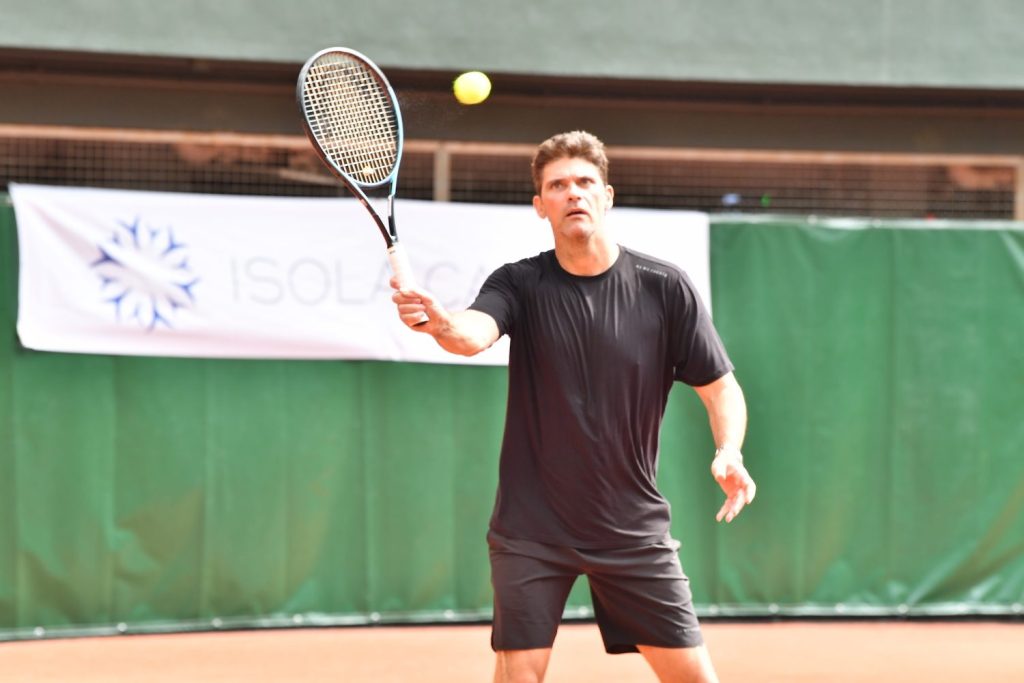
“Listen, give me the racket and strings these guys use today and I can serve at 160 miles an hour.” Mark Philippoussis is joking. It is August 29 at the Ladies’ Recreation Club in Hong Kong, where the former world No. 8, two-time Grand Slam finalist and winner of 11 ATP titles is the guest of honour at an exclusive morning event. It begins with a few rallies in a private clinic on court with club members and the signing of Isola Capital-branded memorabilia, before moving to an informal brunch and a fireside conversation with Isola Capital CEO, Anthony Chan. On the club’s clay courts, framed by the imposing LRC clubhouse and the skyscrapers rising into the Hong Kong sky, Philippoussis immediately commands attention. Among participants dressed mostly in classic white or traditional sportswear, the former Australian player is in severe, understated total black.
He can still unleash a formidable serve on the Legends circuit. At the height of his career, the shot was his signature. In 1997 he reached 229 km/h, a speed that made him one of the game’s great bombers. He played with heavier, more compact rackets built for control. Today’s professionals tend to favour lighter, more manageable frames and strings that help produce pace and spin. Hitting hard has become easier without sacrificing control, keeping the ball in court while giving it more shape.
For Philippoussis, though, the serve was never simply about speed. Consistency mattered more. If the first serve was landing often enough, he could hold his service games and take greater risks on the return. Pace on its own was never sufficient. Direction, spin and rhythm could make a serve difficult to read. It was the formula he took into his fourth-round match against Andre Agassi at Wimbledon in 2003, beating him in five sets with 46 aces. Against Agassi, “I knew I had to serve well,” he says now. When the pressure rose, it was that shot that kept him alive.
When the conversation turns to the one-handed backhand, Philippoussis is back on familiar ground. He played it throughout his career and still singles out Stan Wawrinka’s as one of the greatest single backhanders of the modern game. If he were teaching his own children, however, he would choose the two-hander. “The second hand gives you more support on the return and against high balls. My daughter already has a good two-handed backhand, actually; the problem is that after four minutes she might be more interested in chasing butterflies. My son plays basketball.”
The bigger change, he says, is in the surfaces and the balls. “They slowed the courts down and, by doing that, they slowed the balls down too.” The game has become more uniform. Even on grass, rallies can now stretch deep into double figures. It is not a complaint about the players, whom he regards as exceptional, but about conditions that have left less room for certain kinds of tennis. “I can’t see a kid growing up saying, I want to play serve-and-volley.” Training has changed with it. There was once more room for volleys, overheads and attacking the net. Now the game is built largely from the baseline. Power and spin.
That is why he would like faster courts, and more contrast between them. When grass genuinely rewarded the player who could serve and come forward, a specialist could cause problems for anyone. Wimbledon had players capable of troubling the biggest names because they had built their games around the surface: serve, variation, net play. He remembers a time when Wimbledon even adjusted the seedings according to grass-court results. Between 2002 and 2019, the system took account of a player’s results on grass over the previous two years. The tour was less uniform. Style could change the shape of a draw.
Philippoussis is not simply looking backwards. Sinner and Alcaraz have both won Grand Slams and reached No. 1, yet they keep adding to their games, particularly at the net. Their groundstrokes can force shorter replies and open the door forward. They may miss a volley, but they go again. That, for him, is how a champion grows: keep the weapons that made you, then find something else when the match asks for it.
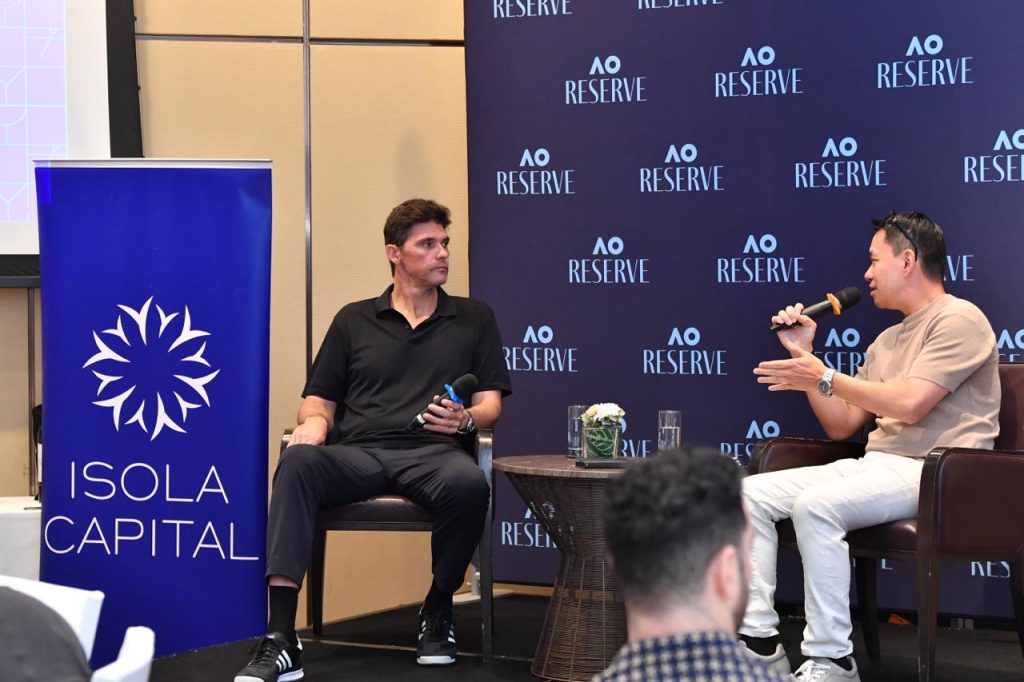
The conversation eventually comes back to Alex de Minaur, now world No. 5. “He’s world No. 5. Say that out loud: it’s not easy to get there. His weapons are speed, footwork, mentality and character. He’s a workhorse, capable of going through 20 or 30-shot rallies and running all day.” There is a price for that kind of tennis, though. A Grand Slam is seven matches in two weeks, best of five. De Minaur has to find ways to shorten the exchanges and make his service games less costly. For Philippoussis, the answer is the one-two punch: “A big serve and then the forehand.” Not a new identity, just a quicker way of turning speed and endurance into points. With the right draw, he can make a semi-final, Philippoussis says. Keep Sinner, Alcaraz, Djokovic or anyone with that kind of power on the other side of the draw, and the last four is well within reach.
The applause dies away. The group photographs are taken. The clay courts settle back into the slow rhythm of the members’ rallies. Philippoussis’s last thought hangs in the warm late-August air: tennis may have become a science of power and athleticism, but what separates one player from another, yesterday as today, is still the courage to step outside the script.