
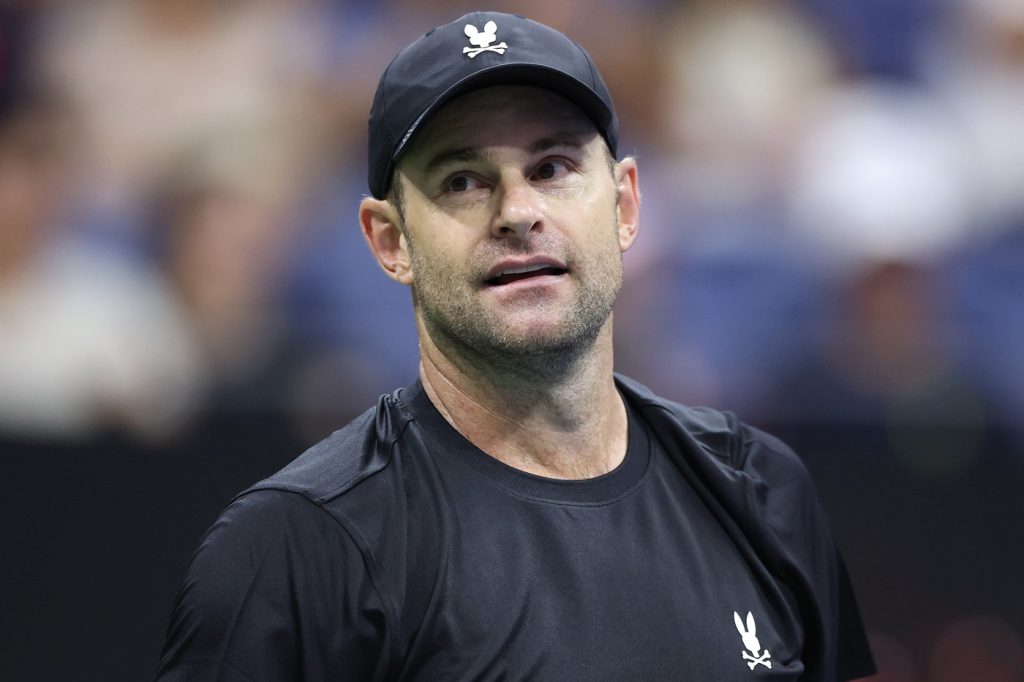
After more than a decade away from the spotlight, former world No. 1 Andy Roddick is back in it: he has launched a podcast, started working in television and even moved into film, naturally enough, in his own way. It began with a firm refusal. When Ben Stiller approached him about appearing in a film he was producing, a story about a former professional tennis player who takes up pickleball, Roddick said no. More than once. “Athlete cameos in movies are normally terrible,” Roddick told Forbes. “I probably told him no four or five times.” Stiller, though, explained that this would not be a simple appearance and that the film could not be made without Roddick playing the protagonist’s childhood tennis rival, who would eventually face him in the pickleball match that forms the film’s climax. In the end, the guilt worked and Roddick agreed to appear alongside Jake Johnson in The Dink, released on Apple TV this summer.
The film is only one part of the 43-year-old International Tennis Hall of Famer’s return to public life. In July, Roddick joined ESPN’s commentary booth and analysis desk at Wimbledon for the first time, and he will return for the US Open. He continues, meanwhile, to host Served twice a week, the podcast that has become one of the most popular tennis shows in the world. Forbes estimates that the podcast generated around $4 million in advertising revenue over the past year, much of it going directly to Roddick, with close to another $1 million in estimated earnings from his work in television and film. “I was always busy during the 10 years I was away from tennis, so I don’t know if it was a conscious decision,” Roddick said of his return to the spotlight. “I think it was more of a snowball effect, having fun with the things I did along the way.”
Given the fame Roddick had accumulated in the 2000s — celebrity relationships, appearances on Saturday Night Live, commercials for “Got Milk?” — a second career in sports media might have seemed the obvious next step when he abruptly announced his retirement in 2013, on his 30th birthday. At the time, though, podcasts were nowhere near as successful as they are today, and Roddick had no interest in following the ATP Tour around the world as a television personality. He was worn down by the constant travel and by a life organised around the professional tennis calendar. “Television was something I never thought I would do,” said Roddick, who won 32 ATP titles, spent nine consecutive years in the top 10 of the rankings and earned more than $20 million in prize money. “At the time, I struggled mentally with going and sitting in a commentary booth when I knew I could probably still be out there playing.”
Roddick chose instead to step away from public life. He invested in real estate, continued working with his foundation and focused on his young children. The family moved to Charlotte, North Carolina, to be closer to his wife’s relatives. His wife is the model and actress Brooklyn Decker.
Served, launched in January 2024, filled a gap in tennis coverage. Analysis of the tour had traditionally been confined to 30-second contributions during television broadcasts, while players themselves were generally available for only a few minutes in press conferences. Roddick’s stature as a former world No. 1, combined with the journalistic credibility of his co-host Jon Wertheim, formerly of Sports Illustrated, gave the show a way to move beyond that format. Tennis Channel provided an early boost by acquiring the cable broadcast rights. Before long, though, the podcast had become too large for Roddick to manage on his own. At the end of 2024, the show signed a deal with Vox Media Podcast Network for advertising sales and distribution. The shift came in March 2025, when Rafael Nadal appeared on Served for his first extended interview since retiring. “That’s when everything exploded,” Roddick said.
By its third year, revenue had doubled again. Today, Served averages 2.2 million downloads and views a month, with around half of its audience coming from the United States. Roddick has started to imagine a future in which Served Media houses several programmes, newsletters and other content. “The numbers we’re talking about now are crazy for what started as this little fun project in a garage and turned into something meaningful,” he said. “It’s still growing in 2026. I don’t know if I ever thought that was possible.”
The success of the podcast also made it possible for Roddick to finally consider working as a television commentator. There was one condition: he wanted to decide for himself how to do it. He wanted his children to be old enough to travel with him and the family, he wanted to make sure he knew all the players properly and, above all, he wanted to ensure that television work would not interfere with the regular rhythm of Served. “We needed to make Served big enough that anyone who wanted me for commentary wouldn’t think they could have a say in it,” Roddick said. ESPN agreed to the terms and offered him a multi-year contract. Roddick was suddenly back at the centre of the tennis world. Now he has the chance to build a different kind of legacy in the sport, for a generation that never saw him play.