
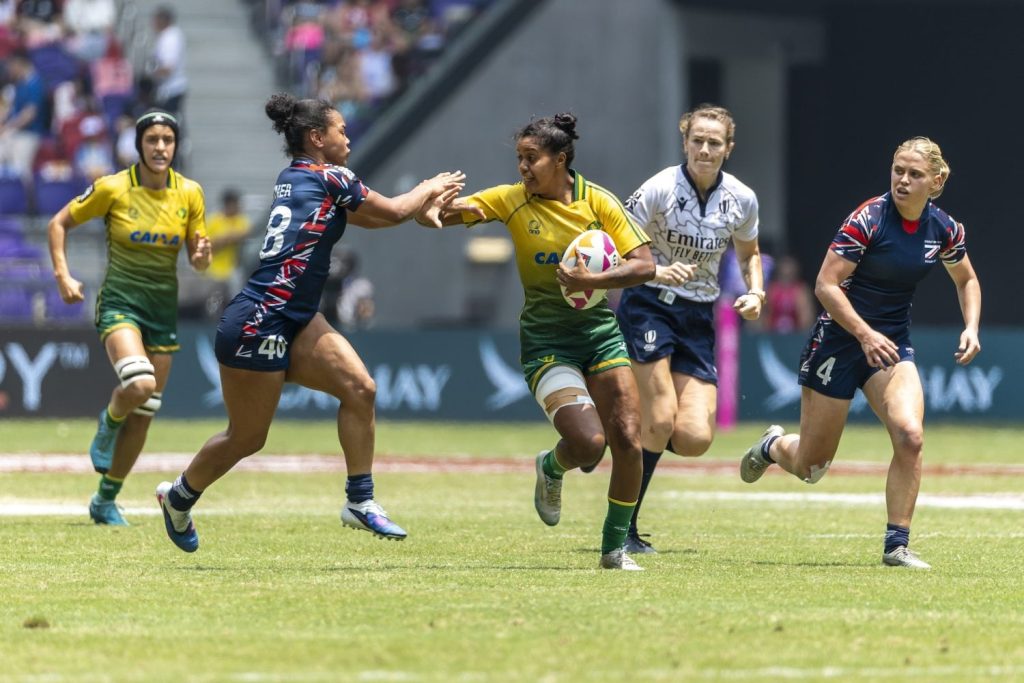
There is a particular solitude that settles over the pitch in the five seconds before kick-off. Thirty players spread across the halfway line, studs planted in the grass, the referee looking at the clock. For a moment, everything around the sport falls away. There are only bodies, lungs filling with air, and the prospect of eighty minutes of pure battle.
This September — on the 13th, 19th and 26th — the WXV Challenger brings that physical side of the game to the Kai Tak Youth Sports Ground in Hong Kong. Six national teams — Hong Kong China, Brazil, Fiji, the Netherlands, Samoa and Spain — will play nine Tests across three weekends. For the hosts, it means three high-voltage games in a row: Brazil, Fiji and Samoa. The tournament’s presence in Hong Kong answers a problem that has held women’s rugby back for decades: the lack of any real continuity between one World Cup and the next. There is no longer any question that an audience exists. More than 440,000 people attended the 2025 World Cup in England, with Twickenham sold out for the final. The commercial argument is settled. What elite women’s XV rugby still lacks is regularity. A steady run of fixtures, established rivalries, a setting in which players can think of themselves simply as athletes tout court, without having to fit training around office hours. That is the thinking behind the new WXV model. World Rugby provides an international framework for eighteen nations and covers the organisational costs of the Hong Kong leg, taking some of the financial pressure off the smaller unions.
Hong Kong is an unusual place to watch this take shape. The city’s rugby identity — already part of the history of the game in East Asia — has long been tied to the festive ritual of the Hong Kong Sevens, that slightly messy urban occasion woven into the local financial district and beloved by the expat community. Women’s XV rugby has followed a much quieter path. Since its World Cup debut in 2017, the game has grown through the city’s Premiership, built on the sacrifice of players living two lives at once. Three international Tests at home give the players in the stands something to see up close. A sporting pathway taking shape in their own city. There were encouraging signs recently on the Hong Kong China Dragons’ tour of Singapore, a side made entirely of players from the local league that won 57–0 on debut. But beyond the scoreline, the tour was a reminder of something obvious: international rugby is built years earlier in suburban clubs, on artificial pitches at nine on a wet Tuesday night, piling up kilometres on buses after a day at work.
The six national teams at Kai Tak represent different stages of that development. Brazil arrive with the first historic World Cup qualification by a South American women’s side, secured in 2025. Fiji bring an anarchic playing culture, sudden bursts of acceleration and improbable recycling when defensive structures come apart. Samoa return to the global stage after eleven years away. Spain bring the tactical discipline of a side that won WXV 3 in 2024. The Netherlands offer the most immediate benchmark for the hosts, two years after Hong Kong suffered a 33–3 defeat in their previous meeting. All six are looking towards the 2029 World Cup in Australia. With five places already assigned, the Hong Kong Challenger is a chance to test squad depth ahead of the 2027 qualification cycle.
Beyond the numbers — tackle percentages, metres gained, scrum performance — the value of the tournament is in the player who walks onto the pitch in front of her family after years of training out of sight. In September, nine matches will not redraw the map of world sport. Six teams will leave with a few more certainties.