
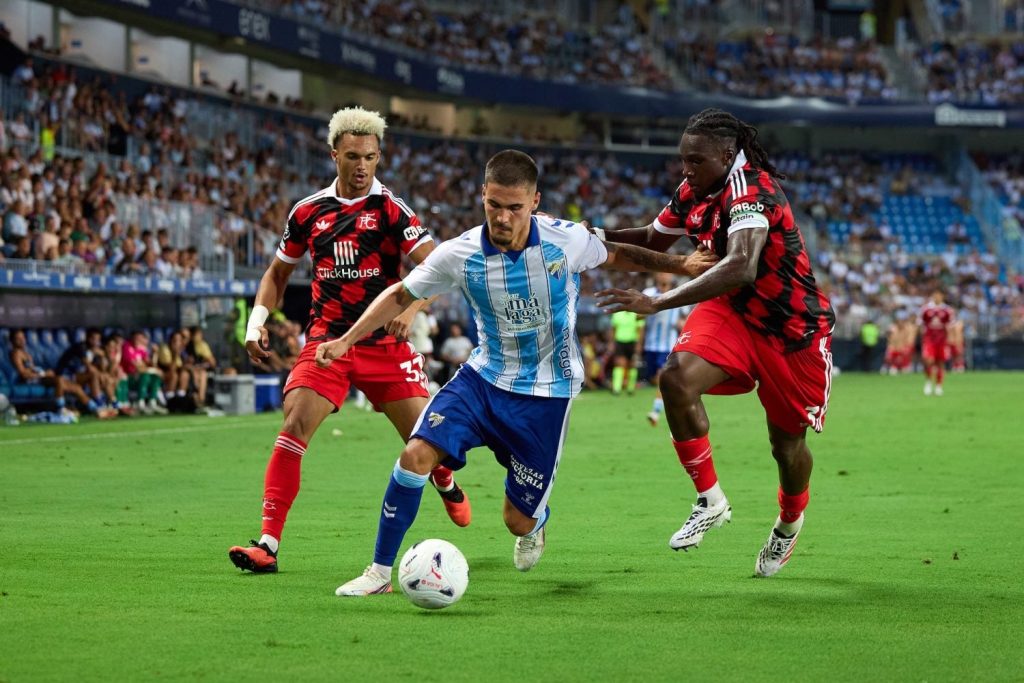
A new edition of La Liga has just begun, one that will appeal to the more nostalgic supporters: after several years away, three big clubs that had fallen into the lower divisions have managed to (re)claim their place in the top flight. They are Racing Santander, Deportivo La Coruña and Málaga, all promoted at the end of last season in the Segunda. All three clubs had, and still have, interesting projects, but the most surprising success story has been Málaga. Put simply, they are back in La Liga despite being – and still remaining – under administration and, in practice, having been absent from the transfer market since 2017: that summer was the last time the Andalusian club spent more than €10 million on incoming players. This year too, on the eve of their long-awaited return to La Liga, Málaga have spent just €300,000 on new players. It went towards the loan of Juan Cruz from Leganés. The other two arrivals are Calero, on a free transfer, and Salinas, on loan, both from Espanyol.
Two of the new arrivals, Cruz and Calero, have something in common: they came through Málaga’s academy before moving elsewhere. That is the foundation of the Andalusian club’s recent success: with its enormous financial problems having effectively shut down the transfer market, the only option left was – and remains – to rely on the academy, to build a squad from homegrown players at little or no cost. And it has worked, there is no denying that: after dropping into the third tier in 2023, Málaga fans have celebrated two promotions in three seasons, and now find themselves back in La Liga eight years after the last time. In the middle of the celebrations, sporting director Loren Juarros said that “stability and financial sustainability are fundamental prerequisites”. Which is why, to put it mildly, Málaga have approached the market with caution. The priority was to keep the best products of the academy, the leading figures in the promotion campaign, and add players who could fit the club’s new identity without upsetting the balance in the dressing room.
That is how the arrival of players already familiar with the Málaga environment fits in, alongside a squad with a fairly low average age of 25.4 and only three foreign players: Malian defender Diarra, Irish attacking midfielder Ochoa and Moroccan winger Abaida. And Diarra, Ochoa and Abaida all came through the academy too. So did Málaga’s brightest talents: Chupe, a 21-year-old striker, Larrubia, a 24-year-old winger, and Merino, a 20-year-old midfielder. It is difficult to imagine this squad, without further additions, going much beyond a battle for survival, but the supporters at La Rosaleda feel particularly close to this new era: only ten of last season’s 26,540 season-ticket holders failed to renew. That is even more than when the club were playing in the Champions League. And the overwhelming majority are very young, with an average age between 20 and 30. They are practically the same age as the players on the pitch, they are Malagueños like them, and the bond between the team and the crowd has never been stronger. It is an important asset, emotional but still an asset.