
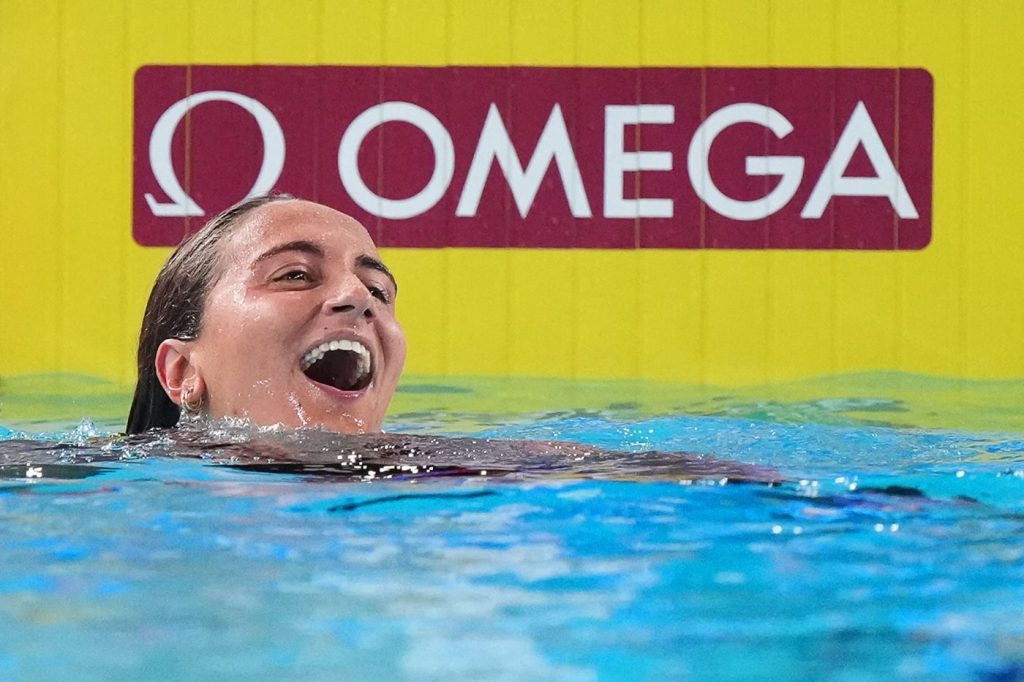
For a few moments, Simona Quadarella looked almost stunned. She touched the wall, looked at the scoreboard and an odd, disbelieving expression appeared on her face. It was not the face of someone who had just won another gold medal, her third in three events at the European Championships in Paris. It looked more like that of a young woman trying to work out whether it had really happened. Then came the realisation: yes, she had won again, and she had done it in the race in which, perhaps more than any other, she had not been the favourite. The 400m freestyle became the most surprising chapter of Quadarella’s week in Paris. After the golds in the 800m and 1500m, the Roman swimmer completed the treble with a 4:01.34, a championship record. More striking was the way she got there: through a comeback built slowly, without rushing, waiting for the race to come towards her. At 200 metres, Quadarella was only sixth. At 300, she had moved into third, but Germany’s Isabel Gose and Maya Werner were still ahead. It looked like a race that might slip away from her. Instead, the final lengths were where she turned it around.
“I waited as long as I could. I really didn’t think I would win. Towards the end I said: I’ll give it a go,” she told Sky Sport afterwards. Quadarella did not dominate from start to finish, nor did she impose the kind of pace she had in her favoured events. She watched, resisted, conserved energy and, above all, kept believing when the clock and her position in the race seemed to suggest otherwise. It was a victory of patience as much as strength. In the end she beat Isabel Gose again, the German who has become one of her most familiar rivals in distance events in recent years. Gose finished second in 4:02.41, with Maya Werner third in 4:03.73. The same three swimmers had occupied the podium in both the 800m and 1500m. This time, only the order at the wall had changed. Quadarella was still on top.
Three races, three golds. For Quadarella, it was the third treble of her career at the European Championships, after Glasgow in 2018 and Budapest in 2021. The 400m victory in Paris also took her tally of individual European gold medals to eleven. For years, though, there had almost always been one swimmer ahead of her, capable of making even an exceptional performance feel like second best: Katie Ledecky. The American was the reference point for Quadarella through much of her international career, particularly in the 800m and 1500m. At World Championships and Olympic Games, racing Ledecky often meant knowing there was another level to find. Quadarella kept trying anyway.
She kept training, improving and maintaining her level. She won the 1500m world title in 2019, then two world titles in Doha in 2024, in the 800m and 1500m, as well as Olympic bronze in the 800m in Tokyo. At Paris 2024, she finished fourth in both the 800m and 1500m. “The thing that impresses me most is the consistency, always managing to be there even in the 1500,” she said after the race. It is a simple sentence, but it describes her career rather well. Quadarella has been there for years, even with Ledecky ahead of her, even when a race seemed decided before it had properly begun, even when a World or Olympic podium looked as though it might get away from her. She kept swimming, kept working, kept training, waiting for the moment when the race would open up.
Perhaps she has found something in the 400m now, too. “It’s a surprise in this event. I couldn’t express myself well in the 400 before. Now maybe I’ve found the right key.” The surprise was not only for her rivals or the crowd. Quadarella herself seemed to be the first person who could hardly believe it. Her expression after touching the wall had said as much before she said anything. She had gone into the race trying to win without quite knowing, until the end, whether she could. Then the scoreboard gave her the answer: 4:01.34, championship record, gold. She stood there for a few moments, looking at it. Then it was clear. She had won the 400m, too.