
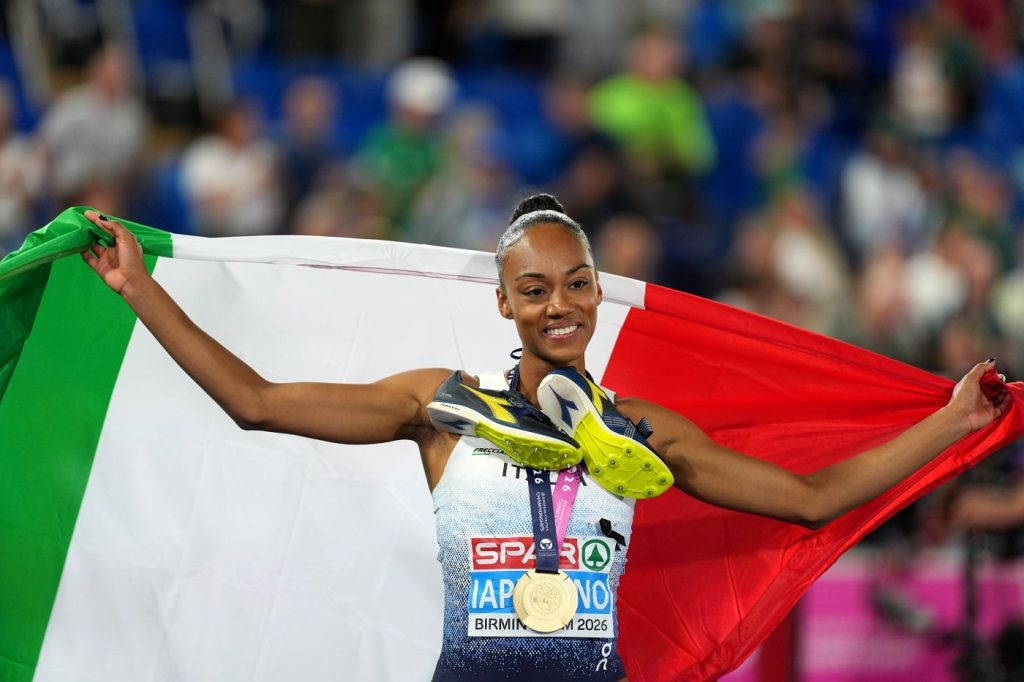
Exactly seven metres. One centimetre more than Jazmin Sawyers, two more than Hilary Kpatcha. That centimetre was enough for Larissa Iapichino to take European long-jump gold in Birmingham, and to turn a far from perfect competition into the biggest victory of her career. A victory of nerves, suffering, centimetres. The kind of competition where it is not only about how far you jump, but how well you hold on when the runway starts to feel like a battlefield and the challengers come closer with every attempt. Larissa began in front, with that 7.00m on her opening jump, but the +2.1 m/s wind, just beyond the 2.0 limit, meant the mark could not count as an official performance. It did not make the jump any less valuable in the competition. From then on, the final became a long test of resistance. A foul on the second attempt, then 6.93m in a strong +3.6 wind, followed by 6.71m (+1.2), 6.80m (+1.8) and one final attempt left to defend a lead that was becoming harder to defend.
Behind her, Birmingham had produced a final of remarkable quality. Sawyers, carried by the home crowd, reached 6.99m; Kpatcha stopped at 6.98m, then Agate de Sousa at 6.96m and Malaika Mihambo – Olympic champion and one of the favourites – fifth with 6.94m. Five athletes separated by six centimetres. Every round brought another possibility, another mark that could have changed the podium. Larissa, this time, stayed in front.
Iapichino did not find the spectacular jump that had set Italy dreaming in Eugene, when in July she broke her mother Fiona May’s 28-year-old national record with a 7.12m leap. She did not come close to that distance, nor did she reproduce the technical perfection of that flight. But she found a way through a competition that was never quite under control. Her best competition did not coincide with her best jump; the difference was in the way she handled the moments, and the anxiety that came with them. “It wasn’t completely the competition I wanted,” she said after the final. “I expect a lot from myself and after the first jump I was hoping to improve, but I was fighting a little with the runway. Still, it’s fine because it could have gone much worse.” At 24, Larissa is no longer simply an athlete with an extraordinary jump in her legs. There are days when the jump does not arrive, and now she knows how to stay in the competition anyway.
The Birmingham gold matters even more because it completes the journey that began two years ago in Rome. In 2024, in front of the crowd at the Olympic Stadium, Iapichino won silver with a 6.94m final jump, behind Germany’s Malaika Mihambo. This time Mihambo was left off the podium and Larissa took another step: she not only improved on her silver in Rome, but became the first Italian woman ever to win the outdoor European title in the long jump. She did it in England, the country her mother’s family comes from. “From a family point of view, we’ve added a title because my mum had never won the outdoor European Championships, so I’m the first. My whole maternal family, who are English, were here supporting me tonight, so this gold is worth twice as much.” Fiona May built a remarkable career without ever winning the outdoor European title. In Budapest in 1998, she set the Italian record of 7.11m, which stood for 28 years, but the title eluded her. Now that gap has been filled by her daughter. “Italy will always be my country, my heart belongs to Italy, but there’s a little part of me that is a bit English, so winning here is truly magical,” Larissa said. There was the family, then, but also the group that has worked with her in Florence for years: her father Gianni, Fiona May’s former husband and her coach since 2021, the Fiamme Oro and the whole team that has accompanied her development.
Her medal haul already belongs to a jumper who has collected senior international medals and titles almost everywhere. Silver at the 2023 European Indoor Championships in Istanbul, European outdoor silver in Rome in 2024, European indoor gold in Apeldoorn in 2025, silver at the 2026 World Indoor Championships in Nanjing, as well as victories in the Diamond League final and at major international meetings. Only two major boxes remain unticked: the outdoor World Championships and the Olympics. At the 2023 World Championships in Budapest she finished fifth, six centimetres from the podium; at Tokyo 2021, she could not compete because of the injury that stopped her a month before the Games. In Paris in 2024 she finally reached her first Olympic final, finishing fourth with 6.87m, nine centimetres short of bronze. Birmingham has added something less obvious. Not another big jump, but another kind of experience. The Italian record of 7.12m is already there, as are the distances that can put her in the fight for a World Championship medal. Now there is also the experience of staying in a competition when it closes around you, when one centimetre can separate gold from silver.
And while Larissa is building a future away from the runway too – she is studying law and dreams of becoming a lawyer – her sporting future is beginning to take on larger dimensions. “I saw the men’s 4×400 finish, we’re European champions!” she said after her final. Her gold and the relay victory helped Italy move decisively past Great Britain at the top of the medal table: 22 medals in all, 10 golds, six silvers and six bronzes, compared with Britain’s 19. The medal table, in the end, is almost a detail. At 24, after breaking her mother Fiona’s record and finally adding an outdoor European title to an already rich collection, Iapichino has the two biggest stages still ahead of her: the World Championships and the Olympics. The medal is still missing. So is the jump that might bring it. For now, seven metres and one centimetre will do.