
Since the beginning of time, man has measured himself by the strength he is able to display. It has always been a widespread belief, one that found fertile ground at Olympia, where it was soon transformed into a cult celebrated through athletic contests held in the name of Zeus. These were the same years in which, on the opposite side of that hand-shaped peninsula known as the Peloponnese, a temple dedicated to Asclepius, the god of medicine, was being built at Epidaurus. Beside the temple, a theatre. On those shores washed by the Aegean Sea, the ancient Greeks were the first to understand that, in reality, a strong and healthy body cannot exist without care for the soul. The head and the body become one, even if understanding it—and then accepting it—is not always easy. Especially in those disciplines where the power of the arms appears, at least on the surface, to be the only thing that separates an unbreakable hero from an individual who is inevitably fallible.
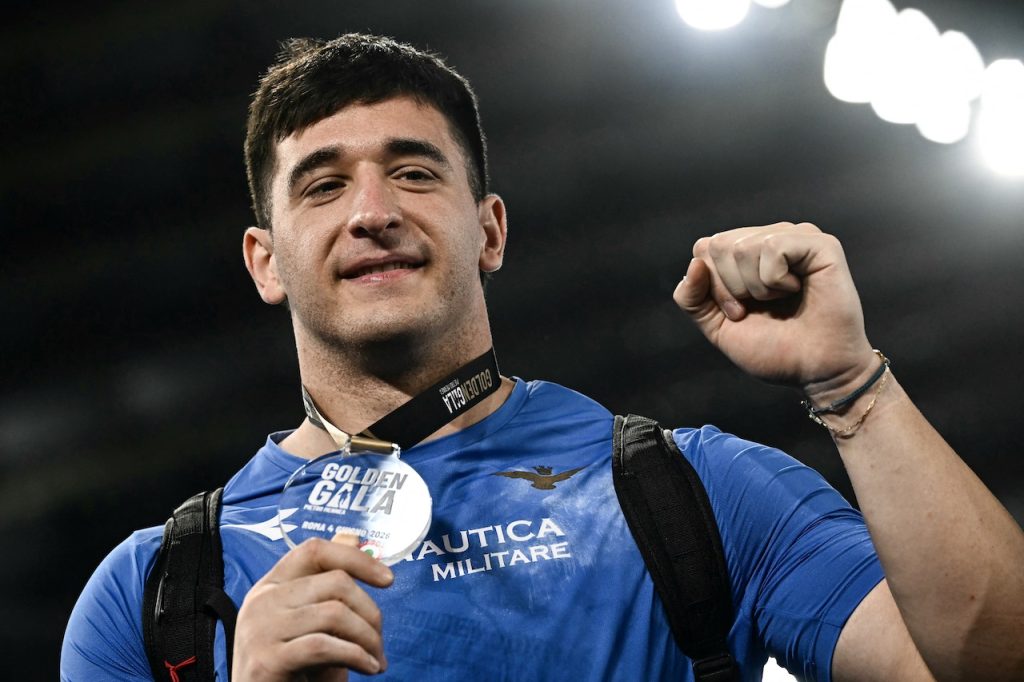
Leonardo Fabbri had to discover that for himself, and it tells us a great deal about the athlete he is today: a number one who, nevertheless, still does not feel entirely like one. A European shot put title is not enough, nor is leading the global rankings. “Without ever having won a world championship and an Olympic Games, it means little. But it gives me confirmation of my value and the belief that I am at least at the level of the best,” he tells Undici. The Aeronautica Militare athlete will arrive in Birmingham in a few days looking to defend his continental title.
Today he speaks like a young man who knows exactly who he is. It was not always this way. Even when, inside his head, there was only one objective: “Reaching the Olympics, becoming what I am now, I dreamed about it when I was a child and I never considered any alternative path. My father ran the 100 metres, I would always go and watch his races and I always wanted to compete too.”
The child Leonardo would be proud, because he did reach the Olympics and, in Paris two years ago, he also came close to a medal, finishing fifth. But the Leonardo of today, twenty-nine years old and carrying the body of a giant, is not satisfied yet. Not because of arrogance, but because, ultimately, no athlete competes simply to participate. The same impasse always returns: even the greatest champions, throughout their careers, will lose more often than they can ever win. Coming to terms with that is not simple.
“Sport teaches you how to react to setbacks, because sooner or later they happen to everyone. It happened to me too. I lived through difficult years: between 2021 and 2022 I was not doing well. I did not like myself, I had gained a lot of weight, and in competition I was terrible. I also missed a season because of osteitis pubis. Then, almost by chance, I sent a message to Lorenzo Venuti, a footballer who was playing for Fiorentina at the time, asking if he knew a mental coach who could help me. He put me in contact with Stefano Tavoletti, who I still work with today. Through him I became closer to Buddhism: meditation taught me to listen to myself, to understand myself, to manage my thoughts. I understood that, in order to perform in the circle, I first had to be well away from it.”
It is difficult to explain in words how, in sport, everything is connected. Sometimes numbers express the idea better: in the space of just one year, Fabbri went from finishing second-last at the World Championships in Eugene to winning silver at the World Championships in Budapest in 2023. The following season brought European gold in Rome, before he produced a throw of 22.98 metres in Brussels, the fifth-longest mark ever recorded in shot put history. It is the result of a team that, as Fabbri says, “wants to help me improve every day, and improve themselves too.” But above all, it comes from a kind of work that begins from within.
“It is true that in disciplines like mine genetics certainly help. You need muscles. But the truth is that today I train my mind more than my body. It is a sport that is mainly mental, because the time of action is incredibly short: the movement lasts one or two seconds, so mentally you have to be free, ready. If you are not well with yourself, you cannot find certain impulses. When I step into the circle now, I no longer have thoughts. I only think about what I have to do, maybe one specific movement: the left foot turning very quickly, or the right foot staying on the ground as long as possible. But I concentrate only on that and nothing else,” he continues. “Every day I work to find a balance that allows me first of all to be happy, to enjoy myself. Over time I have learned to have a healthy lifestyle, which for me above all means doing things for myself, things that make me feel good. That is the key to living peacefully. The best results in competition are only a consequence.”
Fabbri weighs his words with the same naturalness with which he now governs his thoughts. He has learned to experience sport at the highest level without becoming trapped in the kind of obsession that wears you down and, often, holds you back. “These are things you acquire through experience, especially in my speciality. It is the reason why, generally speaking, we reach our highest level a little later than athletes in other disciplines.”
Today, at twenty-nine years old, he is in the middle of his athletic maturity. He has found serenity, and with it he has found the best results of his career. At least for now. “I think about it often lately. I believe I have reached a good place, especially in the way I approach training, competitions, the management of difficult moments and also positive ones. If my career were to end today, I would consider myself happy: I have done a great deal, I have experienced incredible emotions. But I am still missing at least a world gold and an Olympic medal. I will only truly be satisfied if I achieve that.”When he talks about objectives, there is no shortage of energy. He is always clear-headed, with ideas that leave little room for doubt.
“First of all, I want to try to confirm the European title. Then I will put everything into the next Olympics: the result in Paris still hurts, but it will give me the right fuel for Los Angeles 2028. This year, too, I want to break the European record of 23.06 metres and then, who knows… maybe even the world record of 23.56.” Those who, like Fabbri, have learned to live with the fallibility of the modern athlete have no need to hide behind false modesty: dreams can be spoken aloud without the fear of falling short.“Sharing them like I am doing now gives me one more reason to commit myself. I want to dream big. I only want ambitious goals. Because ambition feeds motivation. It helps me give meaning to all my sacrifices, to all the things I have given up over the years. Without ambition, none of it makes sense.”
In the hand that grips the shot when he steps into the circle, the two souls of the Peloponnese exist together and complete each other. There is Epidaurus, the work a person does on themselves, and there is Olympia, the tangible result of that work: the care of the soul becoming the strength of the body.