
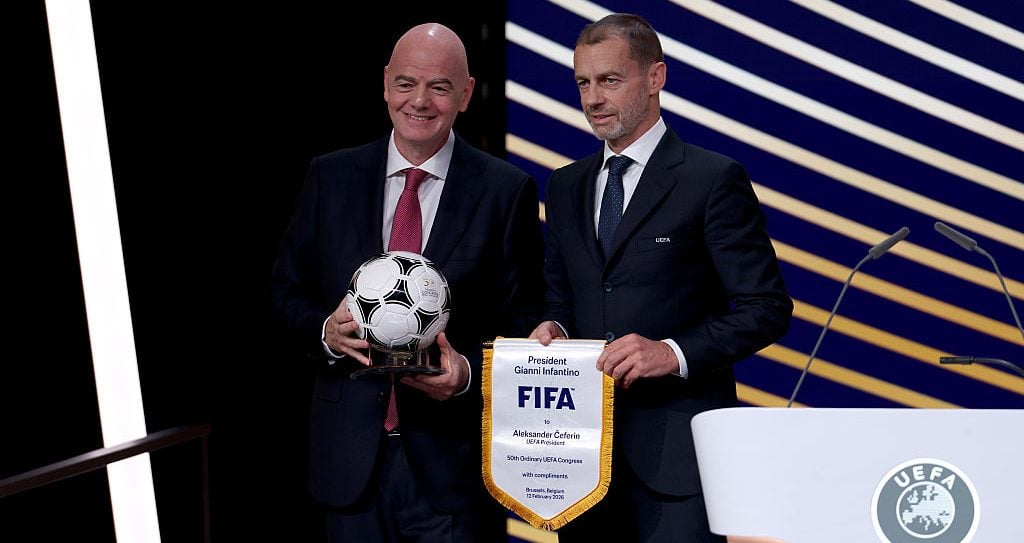
For some time, FIFA and UEFA had been struggling to contain a relationship that was becoming harder to sustain. Now the divide is complete, taking football back to the 1980s, to the atmosphere of the Cold War. The word is the same: boycott. UEFA, the European confederation representing 55 national associations, has decided to reject FIFA competitions, effectively the World Cups. All of them, including the women’s and youth tournaments. CONCACAF, the North American confederation, and the AFC, the Asian confederation, have already moved alongside UEFA, although without announcing a boycott. Under the current calendar, the first competition that could be played without European teams would be the Women’s Under-20 World Cup, beginning on 5 September. A possibility that would have seemed unthinkable only a short time ago.
The story begins with the investigation published by the Financial Times, which revealed that FIFA was preparing to hand part of the World Cup business to private investors through the creation of a new company, FIFA Football Enterprise. The proposed structure would bring together the commercial and organisational side of the global game: broadcasting rights, sponsorships, ticketing and licensing. The decision came after an emergency meeting lasting almost two hours, ending with UEFA united around a single position. In its statement, the confederation said its members “unanimously and without any ambiguity” rejected Infantino’s plan. It was not the only possible outcome. In the hours before the meeting, there had been fears that some smaller federations, attracted by the financial resources promised by the operation, might have chosen to stand with the FIFA president.
European associations are now preparing a formal communication to FIFA, notifying the organisation of their intention to withdraw from the next World Cups and all other competitions organised by the international federation unless the project is withdrawn completely. For Infantino, it is a heavy blow. The federations had until 19 September to join the initiative, but UEFA’s position has changed the balance of the discussion. FIFA may now be forced to rethink the project entirely or abandon it. The significance of the moment is also linked to what came before: most European federations had supported Infantino’s re-election bid for next March’s presidential election. In the statement released after the meeting, UEFA left no room for uncertainty: “Following today’s discussion, no national team affiliated to UEFA will participate in any FIFA competition for as long as these proposals remain on the table, unless they are fully withdrawn and legally binding guarantees are provided that FIFA will never again open its governance or competitions to private ownership.”
The meeting was opened by UEFA president Aleksander Čeferin, followed by interventions from members of the Executive Committee and UEFA representatives on the FIFA Council. According to the Guardian, those opening speeches shaped the discussion that followed, with around twenty federation presidents involved in an atmosphere repeatedly described as one of “great unity”. Among the strongest contributions was reportedly that of Debbie Hewitt, chair of the Football Association, who supported the boycott position firmly. The first test will come in October, when England’s women face Greece in a World Cup qualifying play-off. A fixture that could take on a different weight if FIFA decides not to step back. UEFA has also invited the other continental confederations to follow its position. According to sources close to the matter, several Asian federations already share some of Europe’s concerns.
A loss of support beyond Europe could have serious consequences for Infantino’s leadership, which has traditionally relied heavily on federations outside the continent. “National associations around the world now face an ultimatum: accept the irreversible transfer of the biggest football competitions or face the consequences,” UEFA said. “This is not a democratic decision, but a model of governance based on intimidation: an act of coercion unworthy of an institution entrusted with protecting world football.” In European football circles, the belief is growing that this confrontation could reshape the next FIFA election, opening the way for a UEFA-backed candidate to challenge Infantino seriously for the first time. Until now, the FIFA president had been expected to secure another term without significant difficulty. The first name already circulating is Nasser Al-Khelaïfi, president of PSG and, together with Čeferin, one of the leading figures behind the opposition to the Super League project in 2021.
Meanwhile, several European federations are said to have opened discussions with their governments, many of which have privately expressed support for the boycott position. The first political figure to take a public stance was Britain’s new prime minister Andy Burnham, who wrote on X that the World Cup is “a heritage that has never belonged to anyone to sell. It is a decision of principle that we strongly support. Football belongs to supporters, not billionaires and investment funds. Enough is enough: the time has come to defend our sport.”