
When Jackson Wang was announced as Global Ambassador for the International Fencing Federation, the most intriguing detail was not simply that a global pop star had entered the world of sport. It was that, in a sense, he was returning to one.
Before the international tours, the millions of followers and the global stages, there are photographs of a very young Jackson Wang in full fencing gear: the metallic lamé worn over his jacket, the breeches, the mask resting beside him. They show someone far removed from the performer who would later become one of the most recognisable figures in contemporary Asian entertainment, yet they already reveal something familiar: discipline, precision and control.
Years later, at the FIE announcement, the contrast was almost cinematic. Wang appeared not in fencing whites, but in the tailored elegance of the artist he has become: a global performer whose influence was built through movement between cultures, languages and audiences. The young fencer and the international pop star may seem like different versions of the same person, but they are connected by the same instinct: precision, adaptability and control. His appointment therefore means more than a celebrity partnership. It brings together two worlds that have historically followed different rules: a sport shaped by centuries of tradition and restraint, and a cultural phenomenon built on participation and digital immediacy. “While ultimately I chose to pursue a career in music, fencing has always been in my blood,” Wang said at the announcement in Hong Kong.
There is something fitting about the choice. Wang’s Magic Man era was defined by transformation: moving between identities, languages and audiences without ever fully belonging to only one world. Now sport is asking him to perform another kind of magic: not on a concert stage, but on a fencing piste, helping translate a centuries-old discipline into a language a new generation can understand. The question is not why Jackson Wang wants to represent fencing. The more interesting question is why fencing, and sport more broadly, feels the need to have someone like him by its side.
For much of modern history, athletes created moments, broadcasters transformed them into shared experiences, and supporters built identities around teams, nations and rivalries. Today, those moments compete with music, gaming, streaming platforms and creators. Sport still produces emotion, but it no longer controls the conversation around it. Formula 1 understood this shift early. The championship remains centred on racing, but around it has grown an entire universe of fashion, celebrity and storytelling. The NBA built a similar relationship between basketball, music and street culture, allowing players to become cultural figures beyond statistics. Football has followed the same path: the modern player exists simultaneously as athlete, creator and global personality. Erling Haaland’s popularity among Chinese fans shows that admiration is no longer built exclusively around performance. Goals matter, but so do personality, accessibility and the ability to exist inside the daily digital lives of supporters thousands of kilometres away.
This helps explain why Asia has become central to sport’s future. For years, international sport looked at Asia primarily as a market. But what if Asia is not simply the next market for sport, but the place where the next model of fandom is being invented? K-pop offers one answer. Groups such as BTS and BLACKPINK have shown that modern fandom is not simply about consumption; it is about participation. Fans translate, create, organise and amplify, turning individual moments into global cultural events. When BTS became part of football’s global spectacle, the significance went beyond the presence of a famous music group. It reflected a broader shift: major sporting events are no longer only competitions, but cultural occasions where identity, entertainment and belonging intersect.
BLACKPINK represents the same evolution from another angle. Their relationship with sports culture has moved beyond the traditional celebrity endorsement model. Their long-running partnership with adidas, through campaigns around iconic silhouettes such as Superstar, Gazelle and Forum, showed how sportswear has become part of a wider cultural language. More recently, their collaboration with Fanatics and Complex connected their aesthetic with American sports franchises such as the Chicago Bulls and Los Angeles Lakers, further blurring the line between music fandom and sporting allegiance.
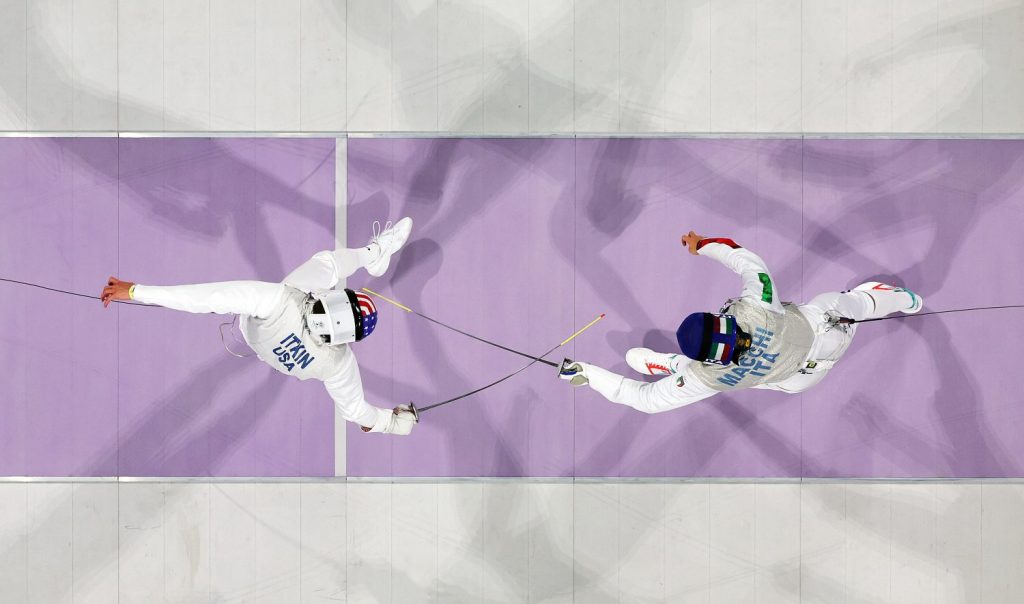
For fencing, this shift represents both a challenge and an opportunity. The sport does not lack history, excellence or Olympic prestige. What it lacks is a permanent place in the everyday conversations of younger audiences. Perhaps that is Jackson Wang’s real role: not to make fencing suddenly fashionable, but to make it visible to people who were never looking for it.
A sport built on inherited tradition has chosen someone whose influence was built through digital communities. That contradiction is precisely what makes the partnership fascinating. The future of sport will not belong only to those who create champions. It will belong to those who understand how champions become symbols and how symbols become culture.