
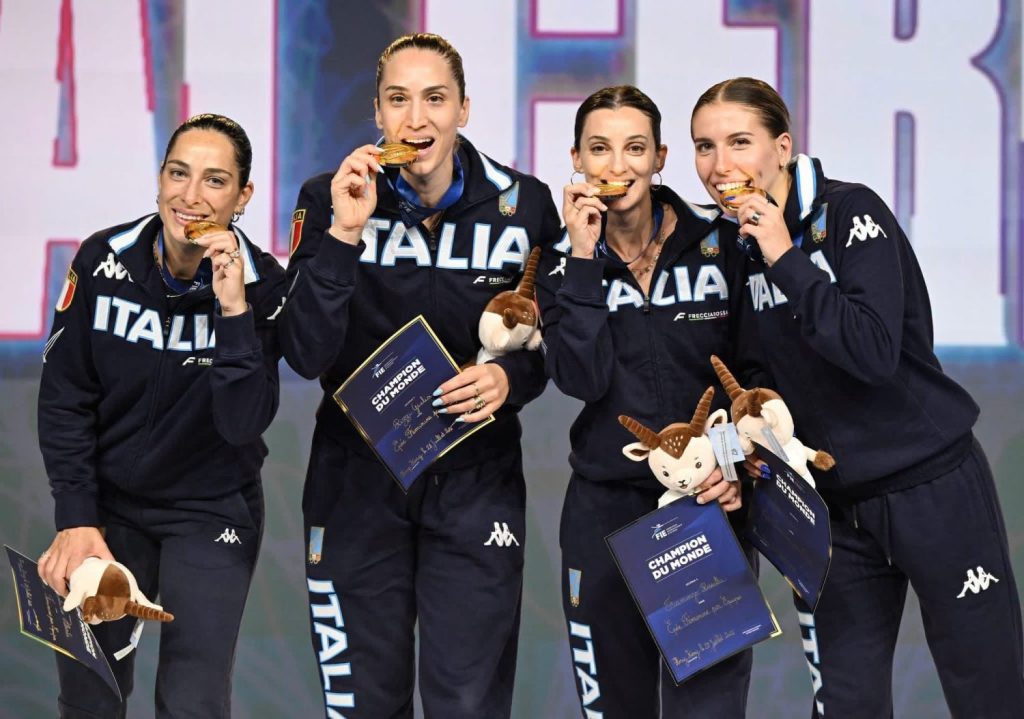
After the disappointments of the Paris Olympics and last year’s World Championships in Tbilisi, fencing in Hong Kong has offered Italy a familiar sight once again: the Azzurri are back among the world’s most competitive nations. The latest two medals came from the team events, the ones that more than any other reveal the collective nature of this sport. Two golds, two finals won with heart as much as with technique, taking Italy’s total to seven medals: already a stronger return, in both numbers and quality, than the six medals won at the 2025 edition. In the world standings, Italy have placed themselves among the leading nations of the championships, above all thanks to the weight of their gold medals. Three titles in total: Martina Favaretto’s individual victory in women’s foil, and the two team successes in men’s foil and women’s épée. A result that confirms Italy’s place among the leading forces of international fencing, alongside traditional powers of the discipline such as France, South Korea, Hungary and the United States. But beyond the medal table, what remains from the pistes of Hong Kong is the image of a movement able to renew itself while preserving the qualities that have always defined it.
The first masterpiece came in men’s foil. Guillaume Bianchi, Filippo Macchi, Tommaso Marini and Tommaso Martini defended the world title won in Georgia, in a final that had appeared to be slipping away against the hosts from Hong Kong. A bout in which technique alone was not enough; something else was required, the ability to stay composed when the pressure began to rise. The decisive passage belongs to Bianchi. When the scoreboard showed Hong Kong ahead 40-35, the gold appeared to be moving away. Then came the comeback: precise, relentless, built one touch at a time until the final 44-45. A reversal that says a great deal about this team: full of talent, but above all able to withstand the moments when the weight of the occasion is greatest.
Before the final, the Azzurri had already overcome one of the toughest challenges of the tournament, Japan. A meeting that has become a recurring test for Italian foil, because the Japanese team has established itself as a permanent presence among the world’s best. This time too, the contest appeared to be turning away from Italy: after a difficult opening phase and another round finished behind, the score stood at 29-30. Then came the response of a team accustomed to finding something extra in decisive moments. Macchi produced a crucial run, Marini restored balance, Bianchi completed the work with composure. A 16-5 final stretch transformed a delicate encounter into a victory shaped by the entire group: 45-37.
Less than an hour later came the second gold. This time from women’s épée, with Giulia Rizzi, Alberta Santuccio, Gaia Caforio and Rossella Fiamingo. A team that, in three of its four members, is the same one that won Olympic gold in Paris and that continues to stand among the strongest sides in world fencing. The final against Estonia was a contest of nerves. The Italians had to recover from difficult moments, following a fiercely fought semi-final against South Korea, won 45-44 after a match in which their opponents had managed to maintain control for long stretches. But once Italy reached 29-29, the rhythm of the bout changed. The lead arrived, the advantage grew to 33-29 and in the closing stages Alberta Santuccio used all her experience to protect a narrow but decisive margin. The final challenge was also one of expectation. Hong Kong in men’s foil, Estonia in women’s épée: opponents strengthened by the presence of Italian figures on the other side of the piste as well. Maurizio Zomparelli, who has long worked with the Hong Kong national team, or Giacomo Fanizza, mentor to the young talent Ho. But once again Italian fencing found a way through the moments that seemed most likely to complicate the path. Because behind these seven medals there is more than a place in the standings. There is a tradition that continues to produce champions, a school that evolves with the times while remaining unmistakably its own.