
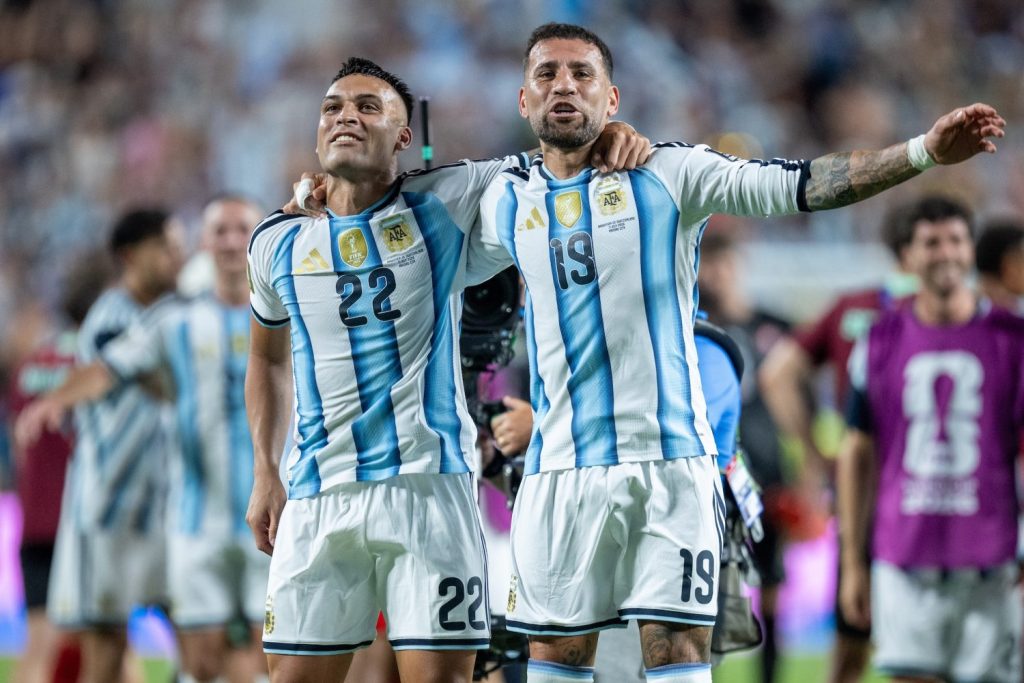
Argentina’s relationship with superstition has always been close. Almost half of the country’s population has Italian roots, and perhaps that heritage helps explain a certain instinct: the belief that football is never only football. The idea of mystique appears throughout Argentine life, in politics, in social rituals and, above all, in the game itself. Some habits are immediately recognisable. A supporter who keeps a note with the name of an opposing player in the freezer, who refuses to change shirt, bar or company during a match involving the national team, is almost certainly following the Selección. These are not isolated gestures, but part of a wider culture built around cábala: the collection of rituals, repeated actions and private beliefs that accompany Argentina through every World Cup. When Messi and his teammates approach the biggest stage, support becomes something more than passion. The signs begin to appear everywhere. Before the final against Spain, many supporters were convinced the outcome had already been written. The evidence was not only on the pitch, but in the details surrounding it. Argentina had scored 19 goals and conceded seven — the same numbers as the date of the final, 19 July. Against England, Lionel Scaloni changed the match by introducing Nicolás Otamendi, number 19, and Rodrigo De Paul, number 7. Once again, 19 and 7. Gonzalo Montiel entered with the number 4 on his back, the number of World Cups Argentina would have with another victory.
Inside the dressing room, the same logic applies. Once a habit becomes part of the routine, nobody wants to be the one who interrupts it. Lisandro Martínez, Cuti Romero and Nahuel Molina are among the strongest believers in cábala. Before matches, they light palo santo, the sacred South American wood whose smoke resembles incense and is traditionally associated with purification and concentration. It began during the World Cup in Qatar and has remained part of the group ever since. The three players even gave themselves a name: “the palo santo gang”. De Paul has his own ritual. Before warm-ups, he fills his pockets with soft sweets and hands them to his teammates. It started almost by accident during the camp in Kansas City and quickly became another match-day constant. The same happened with asados. Scaloni encouraged the Argentine barbecues as a way for the squad to spend time together away from the pressure of competition. The tradition began at the Ezeiza training centre before the journey to Qatar and followed the team to the United States. After each match, once the players return from seeing their families, the barbecue takes place with Dibu Martínez as asador.
The goalkeeper has kept another habit from Qatar too. He shaved his hair and had an Argentine flag dyed onto his left temple. It had worked once. There was no reason to change it. Many of these rituals belong to the mythology created by the 2022 victory. Sometimes they extend beyond the players themselves. Enzo Fernández’s brother, for example, did not travel to the United States before the quarter-finals. Not because of logistics, but because Enzo had asked him not to. In 2022, he had arrived at that stage of the tournament. Changing the order of events meant risking a sequence that had already become familiar. The team’s routines are followed almost without exception. Argentina always begin their warm-up in the same wedge formation, with Lionel Messi at the front and Paredes and De Paul alongside him. The captain is always the first to step onto the pitch, always with his left foot. The gesture goes back to the 1986 World Cup, when Diego Armando Maradona led Argentina to the title in Mexico. The national team has always had stories like these.
In 1978, there were rumours that Daniel Passarella watched horror films before matches. Eight years later, Carlos Bilardo turned superstition into something close to a method. Every player had his fixed place on the team bus. Chicken disappeared from the menu after a defeat that happened to follow a chicken-based meal. The same police escort accompanied the team bus throughout the tournament. Bilardo had his own ritual as well. Every match day, he called his wife at exactly the same time: five in the afternoon. For Argentina, cábala has always existed somewhere between belief and routine. It does not change what happens on the pitch, but it changes the way a team approaches the uncertainty before it. Scaloni has his own version. Before every match, he walks onto the pitch with his right foot and makes the sign of the cross. Then the game begins.