
Iomar do Nascimento became Mazinho as a child. He was extremely thin from his first kicks of a football in the small town of Santa Rita, in the state of Paraíba, in northeastern Brazil. At 16, he moved to Rio de Janeiro and began his career at Vasco da Gama, the club that would take him to the Brazilian national team. A Copa América winner at the Maracanã in 1989, a stadium he had always dreamed of visiting (as a boy, before his first match there, he lay down and literally rolled around on the concrete of the old ground), Mazinho would go on to live an even greater dream: winning the World Cup with Brazil at the Rose Bowl on 17 July 1994.
In 1994, the Seleção were coming off a difficult qualifying campaign and a defeat to Argentina at the 1990 World Cup. Did those scars help shape that group?
The 1990 World Cup was a completely negative experience for us, but at the same time it was important. It was negative because of everything that surrounded that moment: the turmoil, the whole story of covering the sponsor’s logo on our shirts with our hands, the elimination in the last 16. But all of that made us stronger. A large part of that 1990 group was still there in 1994. I had been around the Seleção since 1987, and there was always something happening within the group. In 1994, everything came together. The first thing we said when we got the call to go to the United States was: “We don’t care about money; we want to be champions. We don’t want to talk about bonuses; we don’t want to talk about anything else. What is the amount? That’s it? Fine. Let’s work and win.” Our heads were already on winning the title. We were ready to fight for it. The strength of that team came from the unity between the players. You could see it when we walked onto the pitch holding hands. We were genuinely together. That unity is what took us all the way to becoming world champions.
Known for the quality of its attacking players, Brazil conceded just three goals in seven matches at the 1994 World Cup. How important was the defensive structure built by Carlos Alberto Parreira?
We were a very well-organised defensive side. But when we had the ball, we played. Dunga often says something that is absolutely true: we went through the entire World Cup without playing one single pass back to Taffarel. When we didn’t have the ball, our job was to close every possible space and give the opposition nothing. That is what made Brazil so difficult to break down. Our starting centre-back pairing was supposed to be Ricardo Gomes and Ricardo Rocha, but both were injured. Before that, Mozer had already been left out. But Aldair and Márcio Santos were ready. I think everyone was in tune defensively. Any combination among those four would have worked perfectly.
Romário and Bebeto were the stars, and both were playing in Spain. How was the team built to allow them to shine?
Our idea was to give them the freedom to do what they did best: score goals. Defensively, we had to work a little harder. We won the ball back and tried to get it to Romário and Bebeto in the best possible conditions. We were the ones who had to do the dirty work behind them. We didn’t give the ball away easily. If you look closely, Brazil never really played with a traditional 4-4-2; it was always a 4-3-3. Parreira and Zagallo had to create a system that could match the tactical approach of European teams, knowing that technically we had the ability to beat them. Our job was to create the conditions for Bebeto and Romário to have their chances. And that is exactly what happened in that World Cup.
You replaced Raí during the tournament. What do you think you brought to the team that was different from him?
I wouldn’t say I won the place. I just worked and stayed ready for the opportunity, if it came. And it did. It started with the minutes I played against Cameroon. The team found its balance tactically. I kept the structure that Parreira wanted, especially because my characteristics were more defensive. I could give the team more support in that area. We became more solid on the pitch, especially on the right side with me and Jorginho. I had been a full-back. I could play on either side. We had movements where we would overlap on the right and put crosses into the box. That helped the team’s tactical balance a lot.
How much respect did you have for Italy before that final? An Italy side with Arrigo Sacchi, Baresi, Baggio, Maldini and so many others…
There was enormous respect. I think Italy were an incredibly strong defensive team, but also very similar to us in their approach. They had players who were outstanding defensively, but who also had great quality on the ball and understood the game perfectly. It was a very studied game, especially defensively. Both teams tried to make the most of the chances they created. Italy and Brazil both had opportunities to score, but unfortunately it ended 0-0. Italy are always a difficult opponent. They have always produced teams that make a huge impact at World Cups. For those of us who love Italian football and know it well, it is a real shame not to see them there. Three tournaments have now passed without Italy. Having played for Fiorentina and Lecce, I feel that even more. But football goes in cycles. Italy remain one of the great names in world football.
What are your strongest memories of that victory?
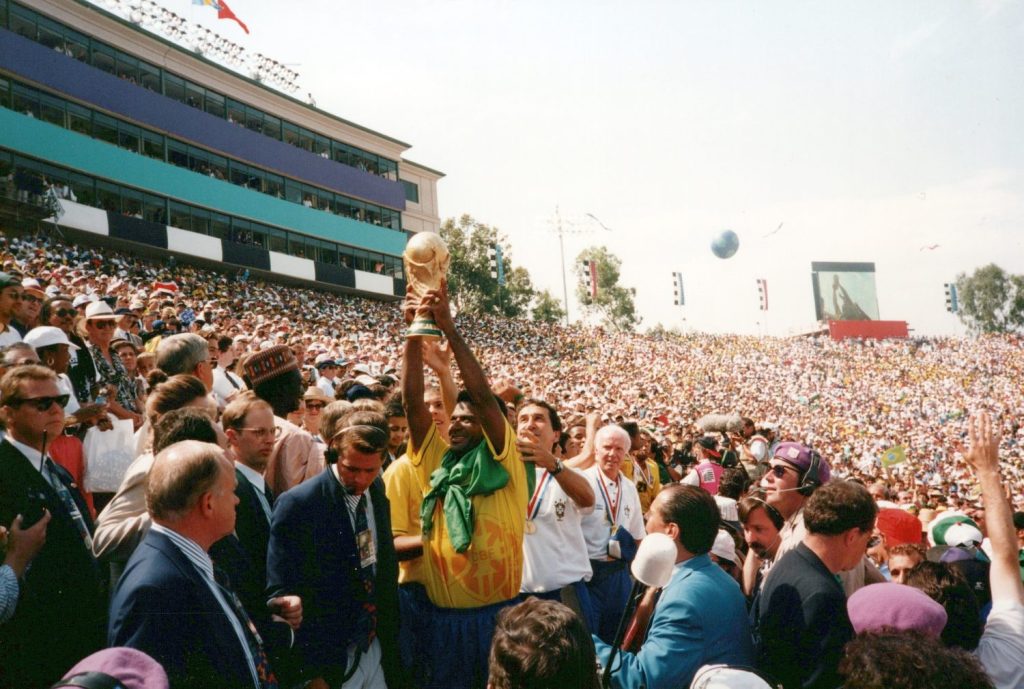
I have so many memories. Without doubt, one of the most iconic moments was the celebration for the birth of Matheus, Bebeto’s son. Nothing was planned. It all happened in that instant. Bebeto scores and makes the gesture of rocking a baby. I join him, then Romário joins us. That image travelled around the world. Even today, I still sign those photographs. There is always a fan who arrives with that famous picture of me, Bebeto and Romário. For me, that was one of the greatest memories of my life. But lifting the trophy, raising the cup, that was the greatest moment of all. Holding that trophy, something millions of players dream of, was an incredible feeling. We had achieved the goal we had chased for so long. I could name countless other unforgettable emotions, but those two moments are the ones that have stayed with me most.