
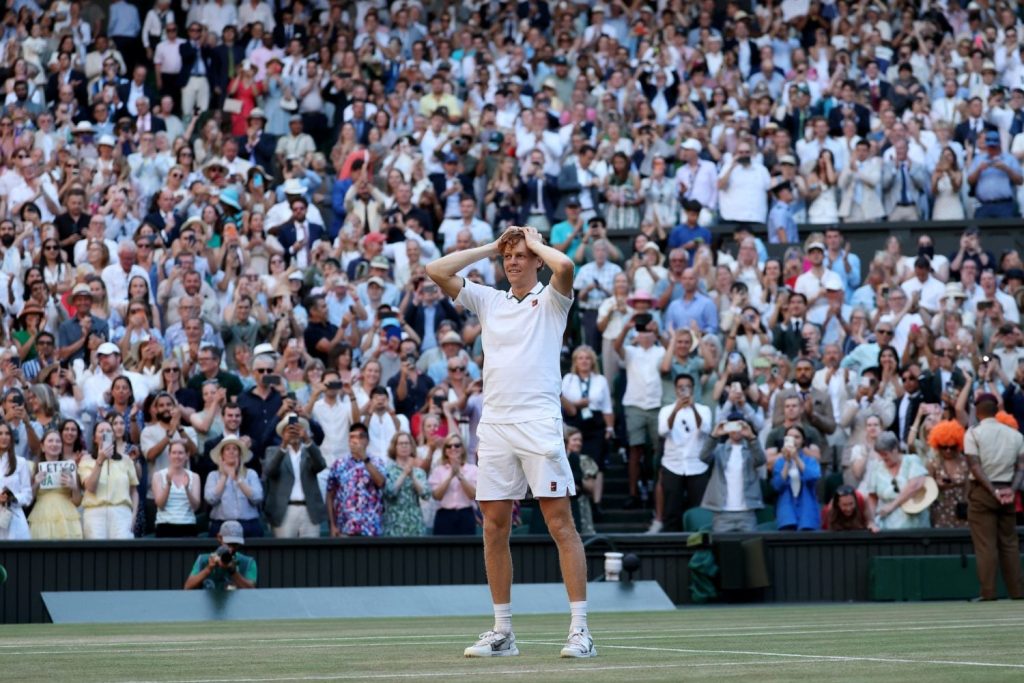
When Jannik Sinner crumpled against Cerúndolo at Roland Garros, all but dissolving in the third set before letting slip a match that had seemed his already, two thoughts immediately took hold. The first was obvious enough: with Alcaraz out of the picture, this was a remarkable chance to complete the Career Grand Slam, and it had vanished. The second lingered rather longer. What would Sinner look like when he came back? Could he still overwhelm opponents, dominate the biggest stages, win another major—another Slam? Six weeks later, more or less, he was standing on Centre Court with the Wimbledon trophy in his hands. Kate Middleton was in the Royal Box. Alexander Zverev was across the net. The whole sporting world was watching, not just tennis. That, on its own, tells you something about the scale of what Sinner achieved. Anyone who followed the tournament, though, knows the story didn’t unfold quite so neatly. This wasn’t the finest tennis of his career. Far from it. There were stretches when, technical lapses aside and with his emotions occasionally getting the better of him, he struggled to impose himself even against lesser opponents. The easy authority was missing. Finishing points became harder. Long rallies often seemed to sap him. Before the quarter-finals, The Athletic summed it up rather well: Sinner had reached that point in the draw largely on the back of an extraordinary combination of pace and precision on serve.
Then came Novak Djokovic. The semi-final changed the picture entirely. Suddenly those subdued early rounds looked less like vulnerability than restraint. Sinner had been managing himself. The world’s No. 1 still had another level to reach, and he had chosen the right moment to reveal it. Then there was Zverev. His tournament had been outstanding, and for long spells of the final he looked close to untouchable. Especially through the opening two sets, every part of his game seemed to click at once: overwhelming power delivered with uncanny accuracy, relentless pressure without the slightest hint of impatience. Sinner did brilliantly simply to stay alongside him. Dragging both sets into tie-breaks already felt like an achievement. Zverev grew more assured with every game, conceding just a single break point across the first two and a half sets. So Sinner held on the only way he could. His serve kept him alive and so did his patience. That was where the final was decided. Everyone knew Zverev couldn’t sustain that level indefinitely. Even he knew it. The question was never whether his level would dip, only when—and what Sinner would have left when it happened.
The answer turned out to be everything. Zverev never really fell away. There was no collapse, only the faintest easing of intensity, barely perceptible from one game to the next. Sinner, meanwhile, refused to move. He kept landing first serves, absorbed everything coming back at him, mixed in bold drop shots and improbable strikes down the line, and covered the court with the lightness that has become one of his defining qualities. From there, the match developed with the strange inevitability of a film whose ending reveals itself before the final scene. The margins remained thin. The rallies stayed brutal. Zverev continued to play exceptional tennis. Yet the direction of the match no longer felt in doubt. Sinner wasn’t overpowering him so much as quietly taking the match away from him. It was a victory built on consistency, tactical intelligence and flashes of imagination that arrived exactly when they were needed. Zverev deserved enormous credit—few players have produced a Wimbledon final of that standard without lifting the trophy—and for the good of the sport one hopes he continues to play like this. He never looked overawed by the occasion. Never disappeared. He matched Sinner for long stretches and earned his place on Centre Court.
Which only makes Sinner’s achievement feel larger. Winning Wimbledon again would have been enough. Doing it against an opponent playing at that level, after arriving in London carrying questions about his own game and his own body, gives the title a different weight. He wasn’t at his sharpest when the tournament began. That much was obvious. Yet he found reserves—physical, mental, emotional—that refused to empty. Even after dropping the opening set, there was no sense of panic. He simply rebuilt the match, point by point, game by game, until the balance shifted. Not with one decisive burst, but gradually, patiently, almost imperceptibly, until the match belonged to him. That’s the achievement. It deserves a place among the defining moments in the history of Italian sport. Think back to Paris. To Cerúndolo. To the images of Sinner struggling through that afternoon little more than a month earlier. Then picture him on the grass at Wimbledon, gold trophy in his hands, with Kate Middleton in the stands, Alexander Zverev beside him, and the tennis world looking on. There was only one possible response: Applause.