
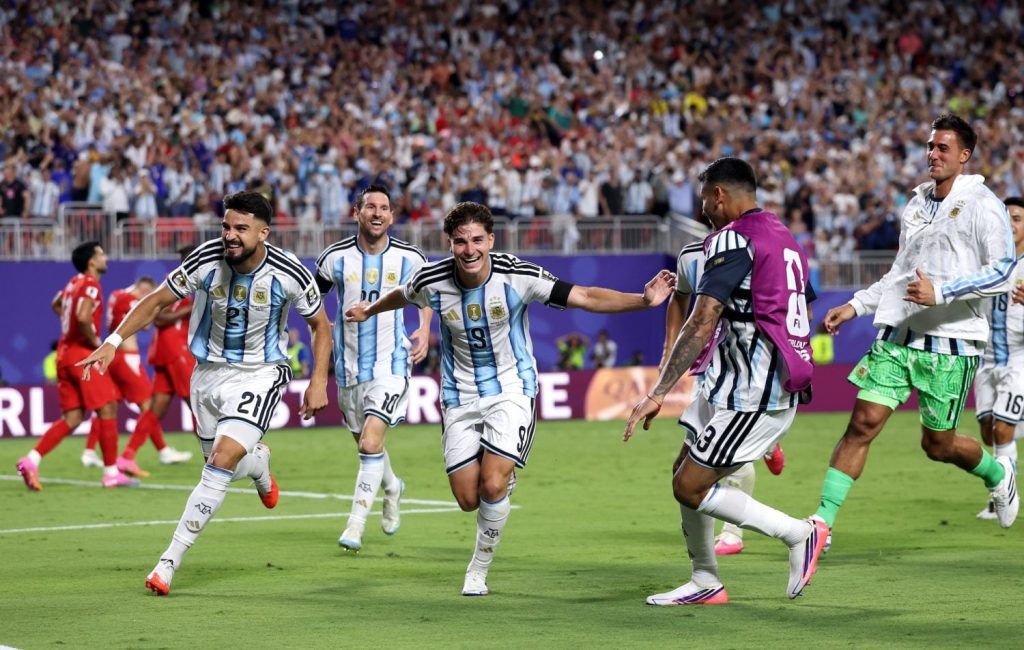
Argentina are the fourth semi-finalists of the 2026 World Cup, but once again the result tells only part of the story. The 3-1 victory over Switzerland after extra time sends the Selección through, while leaving behind the same feeling that has accompanied Scaloni’s side throughout the tournament. A match that seemed to be firmly under control of the world champions became another difficult night, settled only by the individual quality of a squad with very few limits. The opening suggested something far simpler. After just ten minutes, Alexis Mac Allister put Argentina ahead, finishing Lionel Messi’s tenth World Cup assist — another indication that the number 10 continues to shape games even when he is not the one putting the ball in the net. A goal that early, against a Switzerland side forced to open up, appeared to send the match in one direction. Instead, Argentina began to retreat into the game. Rather than continuing to attack, maintaining the pressure and making the most of the early advantage, the Selección slowed everything down. They chose control over momentum, possession over acceleration.
For this team, it remains a delicate balance. The Albiceleste is not built to take matches out of circulation. Its best football arrives when the game stretches, when spaces open, when opponents are forced to chase. But when the rhythm drops and the ball starts moving sideways, Argentina lose something of their edge and allow opponents back into the match. Switzerland understood it immediately. They pushed higher, gained territory and began to press the first phase of Argentina’s build-up. They did not need sustained dominance. The possession itself was enough to create the sense that an opportunity was coming. Argentina looked almost as if they were waiting for the game to return to them. The first real warning arrived in the 65th minute, when Dan Ndoye rose above the defence and forced an excellent save from Emiliano “Dibu” Martínez, once again present when the margins became narrow. It looked like the kind of intervention that could preserve the lead, but it only postponed the equaliser. Two minutes later, Ndoye found it, converting Ricardo Rodríguez’s assist and completing Switzerland’s return.
The pattern was familiar. Against Cape Verde. Against Egypt. Now against Switzerland. Argentina had started as the stronger side, created the conditions to control the match, then allowed the opponent to find a way back in. The turning point came with Embolo’s dismissal. The Swiss striker, already booked, went down after contact with Leandro Paredes and received a second yellow card. A moment of frustration that left Switzerland with ten men just as they seemed to have found their place in the match. With the extra player, Argentina pushed forward again. Messi went close in stoppage time, Lisandro Martínez did the same, and at the beginning of extra time Thiago Almada came within inches of restoring the lead. The chances arrived, but not always through a settled attacking structure. More often, they came through the players themselves: through instinct, talent, the feeling that someone would eventually produce something. It has become one of the defining images of this Argentina side. When everything follows the expected script, the Scaloneta can appear almost too comfortable. But when the game turns against them, the response is immediate: more intensity, more aggression, more speed. So far, that reaction has been enough.
This time, Messi was not the one to provide the decisive moment. It was Julián Álvarez who stepped forward, producing a magnificent curling strike in the 112th minute that left the Swiss goalkeeper with no chance. A goal of pure quality, and another reminder of how much Argentina still have beyond their captain. Even when Messi does not decide the match, there is always another player capable of doing so. Álvarez’s goal finally broke Switzerland’s resistance, and shortly afterwards Lautaro Martínez added the third. The final score was perhaps severe on Switzerland, but it reflected one of Argentina’s greatest strengths: the ability to punish opponents the moment the game opens. The question now follows Scaloni into the semi-final. How long can this balance last? For the third consecutive match, Argentina have been forced into a far more difficult contest than expected against opponents considered weaker on paper. The struggles against Cape Verde, Egypt and Switzerland reveal a team with extraordinary individual talent, but one still searching for a more complete control of matches.
Now comes England. History in World Cup knockout meetings belongs to Argentina, who have eliminated the Three Lions every time the two sides have met at this stage. But that record will only increase England’s hunger, and the chance to change the story will carry its own weight. If the Albiceleste continues to alternate long spells of management with sudden bursts of brilliance, the margin will become smaller. Argentina remain, alongside France, one of the most dangerous attacking teams in the tournament. But talent, however abundant, cannot always be the answer. Against Switzerland, it was enough. Against England, it will be tested.