
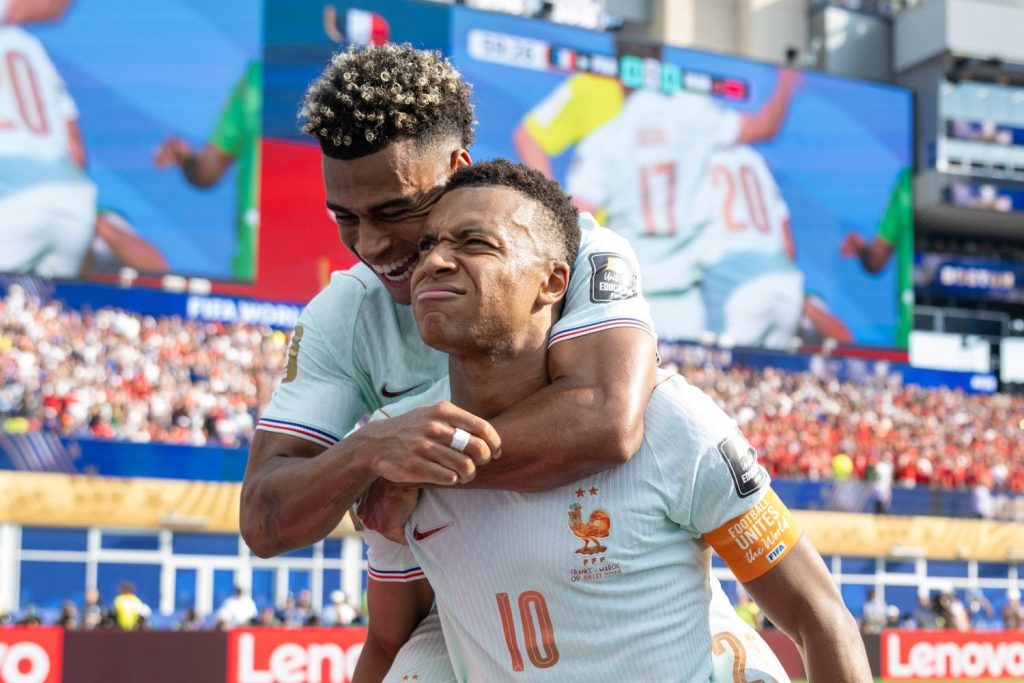
To understand how France beat Morocco and secured their place in the World Cup semi-finals, you have to return to the 28th minute, just seconds after Mbappé had almost placed his penalty into Bonou’s hands instead of breaking the deadlock. The miss changed nothing. Nobody around him appeared worried. The French players carried the kind of calm that can seem almost unsettling, as if the penalty had been nothing more than a brief interruption to a script already being written: victory, and a place in the final four of the tournament.
Whether Deschamps’ players truly experienced the moment that way is impossible to know. But that was the impression they left. France play with a certainty that feels unique among national teams. They know that, at some point, their talent will find a way to turn the match. It does not matter when. It does not matter how. Eventually, it happens. It happened against Morocco as well. For more than half an hour, the Bleus controlled everything that could be controlled: the ball, the territory, the rhythm of the game. The chances arrived one after another, yet the goal refused to come, and France went into the interval still at 0-0.
There was no panic, because there was no need for it. Deschamps’ side never lost its emotional balance. The tempo remained unchanged, as did the clarity behind every action. France continued playing with the same conviction, as though the outcome was not in doubt, only delayed. Their dominance did not come from an aggressive, all-out press or from a desperate need to recover possession immediately. It was something more calculated. Deschamps had built a selective pressing structure, one that allowed Morocco’s first pass to exist before taking away everything that came afterwards.
Diop and Mazraoui were given room to begin the move, receiving the ball without immediate pressure. But the space was deceptive. The moment Bouaddi or El Aynaoui received facing their own goal, Rabiot and Koné stepped forward with intensity, cutting off the next option and forcing Morocco either backwards or into difficult vertical passes that France’s defence could handle. It was not pressing designed to impress. It was pressing designed to control. France decided where the game would be played and when it would accelerate, turning Moroccan possession into something increasingly harmless. Mohamed Ouahbi’s team had previously stood out for its confidence in building from deep and its courage under pressure, but against France it struggled to consistently reach the attacking third.
The chances continued to belong to the Bleus. By half-time, France had produced 1.87 xG, the highest figure recorded at this World Cup by a team that had not yet scored. It looked like a contradiction only on paper. Watching the game, the feeling was different: the goal seemed unavoidable. And if there was one player who seemed most likely to produce it, it was Mbappé. After missing from the penalty spot, the French forward finally opened the game with the kind of moment that has become familiar. The remarkable thing was how little he seemed to need. For long periods he appeared almost detached from the action, then suddenly found another level. One movement, one touch, one perfect curling finish into the top corner, and the entire match changed.
It also opened the door for Dembélé. Six minutes later, he closed it. The goal was pure Dembélé: a few steps towards the outside to create the angle, then that familiar right-footed finish, travelling low and away from the goalkeeper with the precision that has made him one of the most dangerous forwards in European football over the last two seasons.
Eight goals for Mbappé. Five for Dembélé. No attacking partnership has carried a World Cup with this kind of impact since Ronaldo and Rivaldo did so for Brazil in Korea and Japan in 2002. Yet it would be a mistake to reduce France’s success to their two forwards. The real difference between France and the other semi-finalists is the depth available to Deschamps. While Morocco searched for fresh energy without being able to truly change the level of the team, France could turn to Barcola, Mateta and Malo Gusto from the bench, all of whom entered the match, while still having Theo Hernández, Tchouaméni, Cherki and Marcus Thuram waiting in reserve. Most national teams would build their side around players of that level. In France, they remain alternatives.
That is where the advantage becomes more than a question of individual quality. It means moving through a World Cup without overusing your best players, replacing a midfielder without losing intensity, changing wide players without losing speed, rotating forwards without weakening the attack. It means arriving at the decisive moments with more left in the tank than everyone else. Perhaps this is France’s greatest quality: not simply the strength of the squad, but the way that strength is managed. Against Morocco, they never needed to force the game. They did not have to increase the tempo endlessly or throw themselves forward in search of a desperate breakthrough. They controlled the spaces, waited for the opening and punished the moment when it arrived.
There are very few teams in knockout football that create this sensation, the feeling that they are never truly in danger because another solution is always available. France seem to have an answer before the question is even asked. Deschamps’ squad explains much of that. The calm faces after Mbappé’s missed penalty told the story. They were not expressions of arrogance, but of confidence built over time: confidence in the group, in the depth of the squad and in two attackers who appear capable of deciding the biggest matches. France have reached the semi-finals without having to empty themselves. For whoever meets them next, that may be the most troubling part.
A team with this much talent is not unusual. A team that can use it with such control is much rarer. Now Spain or Belgium will have to find a way to stop them. It will be a difficult task.