
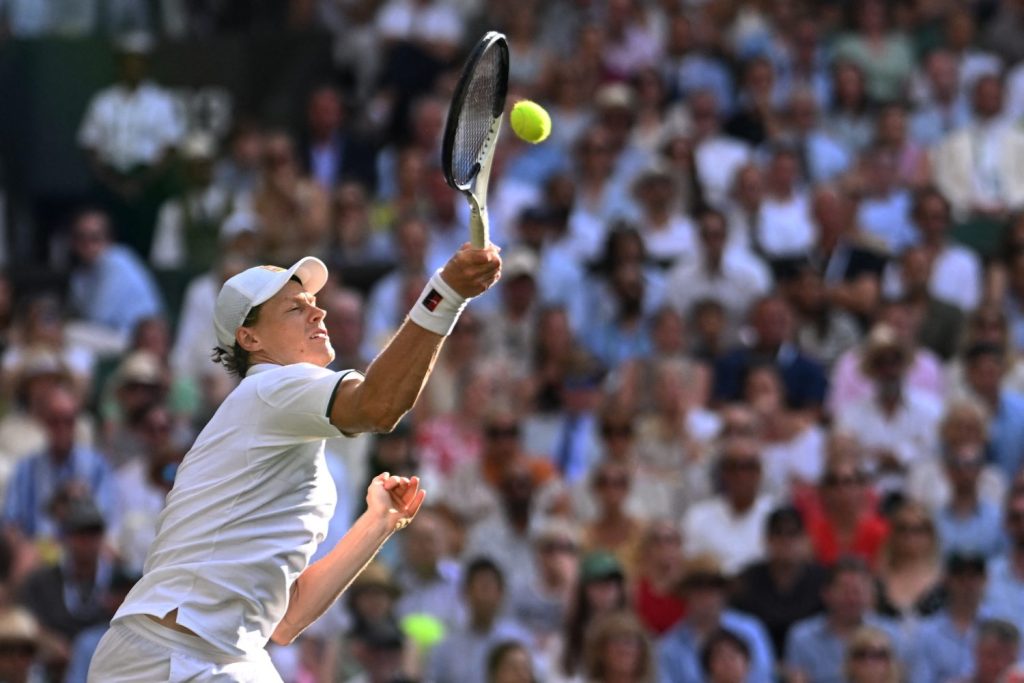
Jannik Sinner beating Novak Djokovic has become almost ordinary by now. Which is why there was nothing especially dramatic about what happened at Wimbledon: the 6-4 6-4 6-4 that sent the Italian into the final felt like the natural continuation of something that has been building for a while. And yet, before the match, there were questions. Not about Sinner’s ability, but about where exactly his level was. His previous matches had been won without ever fully catching fire, without the sense that he was overwhelming opponents or tearing them apart with the speed and relentless pressure of his tennis. Perhaps that was by design. Perhaps it was simply about managing energy, protecting his body and mind, especially after what happened at Roland Garros. Against Djokovic, the answer arrived immediately. Sinner was back to being ruthless, back to imposing his rhythm, back to making life extremely difficult for anyone forced to share the court with him.
Of course, this was Djokovic: a true great, perhaps the greatest player the sport has ever seen. So Sinner’s superiority was never going to be complete. But the match followed a clear pattern. The sudden accelerations, the relentless weight of his groundstrokes, the heavy exchanges, the serve struck with increasing conviction, and the occasional variations that prevented Djokovic from settling into a rhythm all pointed in the same direction. It was a match played almost entirely on Sinner’s terms. Djokovic remains Djokovic. He is less explosive and less physically overwhelming than he was during his prime, and he knows that better than anyone. Still, there were moments when Sinner had to withstand pressure, moments that could have changed the course of the match. Those were the moments when he found the shot that has become one of the defining features of this Wimbledon: a serve that is more powerful, more secure, more precise with every match. It allowed him to shorten exchanges and slowly take the match away from his opponent.
Djokovic, to stay alive, had to raise the intensity and accept greater risks. He pushed second serves, searched for impossible angles, tried to create points that were barely there. At times he managed it. But no player can live permanently at the edge, and there are some who are simply no longer built to sustain this kind of tennis for long stretches. Especially against Sinner, who never gave the match away. He absorbed Djokovic’s best moments, returned almost everything, and removed every realistic chance of a comeback before it could develop. The break-point numbers say enough: Djokovic created only one opportunity throughout the match, while Sinner faced three and saved all three. Those were the moments that decided everything, the ones that allowed him not only to win but to make his superiority visible on the scoreboard. A superiority that has almost become routine, even though it should not.
Before the semi-final, also because of the recent memory of Melbourne, Sinner – or at least the version of Sinner we had seen at Wimbledon until then – would probably have started behind the best Zverev of his career. Now the final looks far more balanced. Until Djokovic, Jannik had not yet found his best tennis or his best physical condition. His return to competition, and to grass in particular, after Roland Garros had been encouraging but inconclusive. After the semi-final, that has changed. We saw a Sinner who looked certain of himself, composed, difficult to disturb. Physically and mentally. At this level, that is never something to take for granted.