
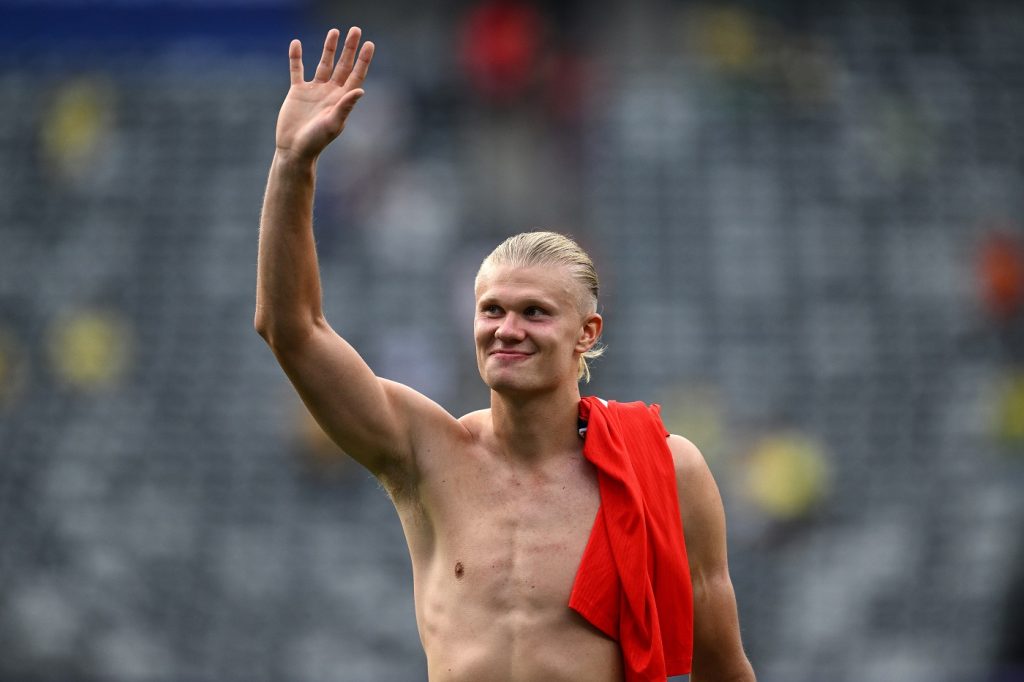
Erling Haaland is becoming increasingly popular in China. On the face of it, that shouldn’t come as much of a surprise. He is one of the world’s best strikers, the kind of player who can almost decide a World Cup round-of-16 tie against Brazil on his own. But there’s something unusual about what’s happening. China has spent years trying to turn football into a genuine mass obsession, with mixed results. So when Chinese audiences become this captivated by a Norwegian footballer, it’s worth paying attention. Jing Daily reports that, helped by the buzz around the 2026 World Cup, the Manchester City striker has become one of the defining figures on Chinese social media. His appeal now reaches well beyond football. On RedNote, views for the Haaland hashtag have climbed in just a few days from a little over 530 million to almost one billion. That puts him ahead of Manchester City itself, whose hashtag sits at around 847 million views.
By now the shift is unmistakable. Haaland isn’t simply one of the finest forwards in the game. He’s become a figure of digital culture. It really began at Borussia Dortmund. Chinese fans had already christened him “the Northern Cyborg” and “the Robot Striker”, fascinated by the relentlessness of his goalscoring. His move to England in the summer of 2022 changed the scale of everything. As the Premier League tightened its grip on Chinese audiences—around 300 million people now follow it regularly—Haaland produced a record-breaking season that ended with the Treble. Before long, he was recognisable even to people who rarely watched football.
The goals only explain part of it. On Chinese social media, people are drawn just as much to everything that happens away from the pitch: the exaggerated expressions, the unintentional comedy, the wonderfully odd interviews, the sense that he never quite realises how funny he can be. He’s become perfect meme material, endlessly recycled into viral videos. Eventually users settled on an affectionate nickname: “Habao”, literally “Baby Ha”. It says a lot about the version of Haaland they’ve embraced. At once an unstoppable goalscorer and someone who can seem oddly childlike, awkward in the most endearing way. Brands have noticed. Alongside global partnerships with Nike and Beats by Dre, Haaland has spent the past few years building closer ties with Chinese companies. In 2023 he became Midea’s global ambassador. This year he took on the same role for Walovi, the international brand owned by herbal tea giant Wang Lao Ji.
The campaigns show how comfortably his public image travels beyond football. In one advert for Midea he lifts a refrigerator as though it were a barbell before sprinting on a treadmill hooked up to a washing machine. In another, for Walovi, he speaks Mandarin. Both lean into deliberate absurdity, exactly the kind of self-aware humour that has become increasingly common in Chinese advertising. The story doesn’t end with Haaland. His partner, Isabel Haugseng Johansen, has also built a substantial following on Xiaohongshu, where she is approaching 200,000 followers. Her posts revolve around travel, cooking, training and ordinary moments at home. It’s a very different register from the polished distance of traditional celebrity culture, reinforcing the impression of a couple who feel unusually accessible.
One of the platform’s most widely shared discussions asked why Haaland had become so popular in China. The highest-rated reply was also the shortest: “Because he’s incredible, but at the same time adorable.” That tension seems to explain almost everything. On the pitch Haaland is overpowering, almost intimidating. Away from it he often comes across as gangly, funny, even slightly awkward. To China’s Gen Z, that feels far more convincing than the carefully managed perfection of so many other sporting superstars.
His popularity points to something larger, too. Audiences increasingly gravitate towards public figures who seem imperfect, genuine and willing to exist in constant conversation with the communities that form around them online. Haaland has ended up as something more than a global footballer. He’s become a cultural brand in his own right, somewhere between sport, entertainment and the internet’s own visual language. Someone who resonates with European football supporters and one of the world’s biggest digital audiences at the same time. In an age when the boundaries between athletes, influencers and celebrities continue to dissolve, that may be his greatest asset.